Knowing which one to use helps your writing land exactly the way you intend.
The Verb “Eat” — Why It Has Two Past Forms
Eat is an irregular verb. It doesn’t follow the normal “-ed” rule like walk → walked. Instead, it changes form completely depending on tense.
| Verb Form | Word | Example |
|---|---|---|
| Base Form | eat | I eat lunch every day. |
| Simple Past | ate | She ate lunch an hour ago. |
| Past Participle | eaten | They have eaten already. |
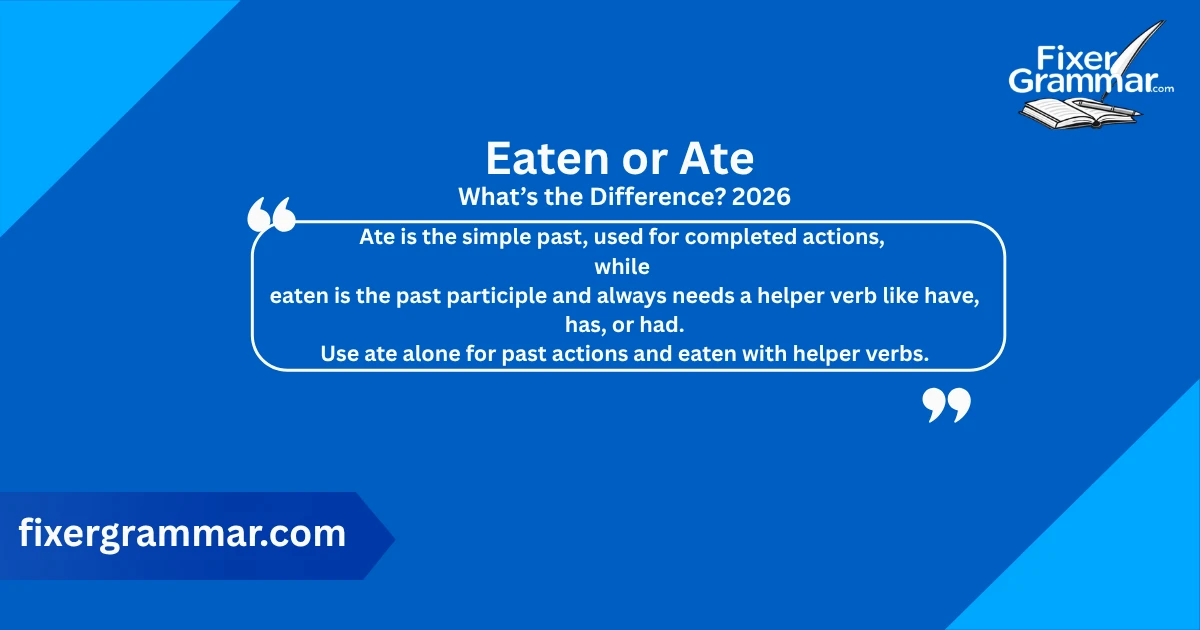
The simple rule: ate stands alone. Eaten always needs a helper verb like have, has, had, or will have.
More Posts:Marquee vs. Marquis — What’s the Difference? 2026
When to Use “Ate”
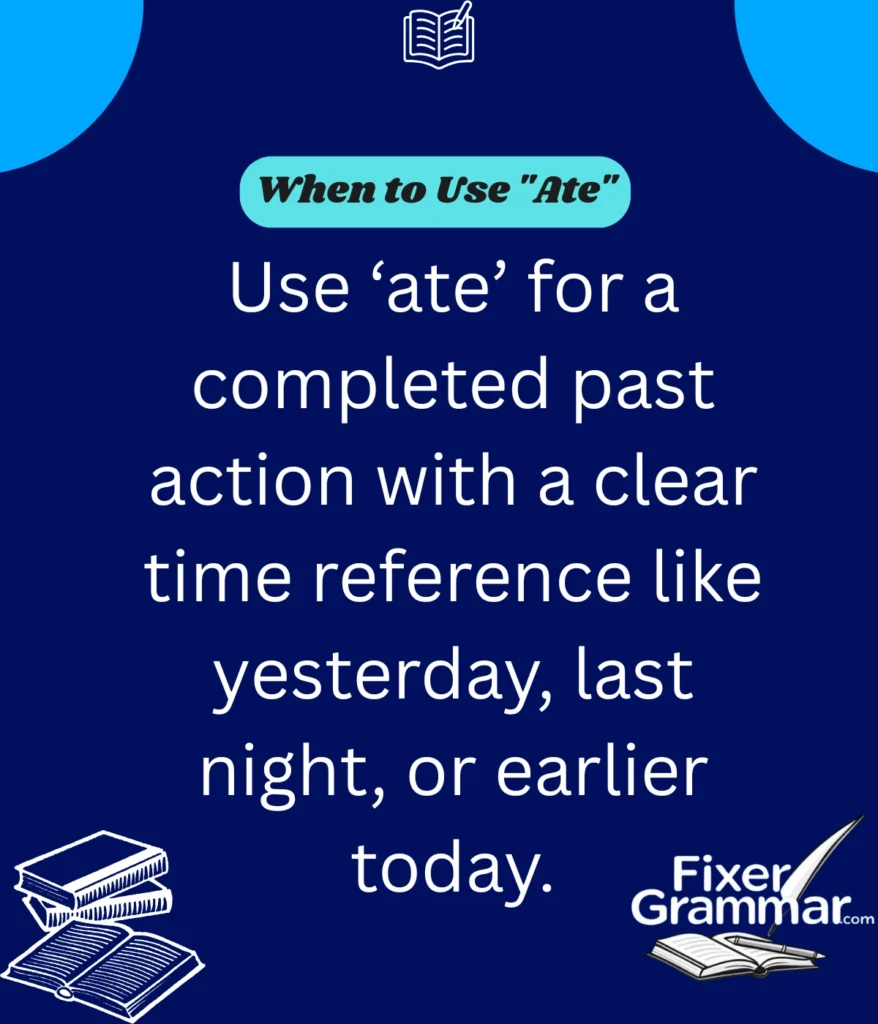
Ate describes a completed action in the past. The action is done. It has no connection to right now.
You’ll almost always see ate paired with time markers like yesterday, last night, this morning, or two hours ago.
✅ Correct:
- I ate breakfast at 7 AM.
- We ate at that new place last Friday.
- She ate too much cake last night.
❌ Incorrect:
- I have ate dinner. (never pair ate with have/has/had)
- She had ate before we arrived.
Quick tip: If you can answer “When did it happen?“ with a specific time — use ate.
When to Use “Eaten”
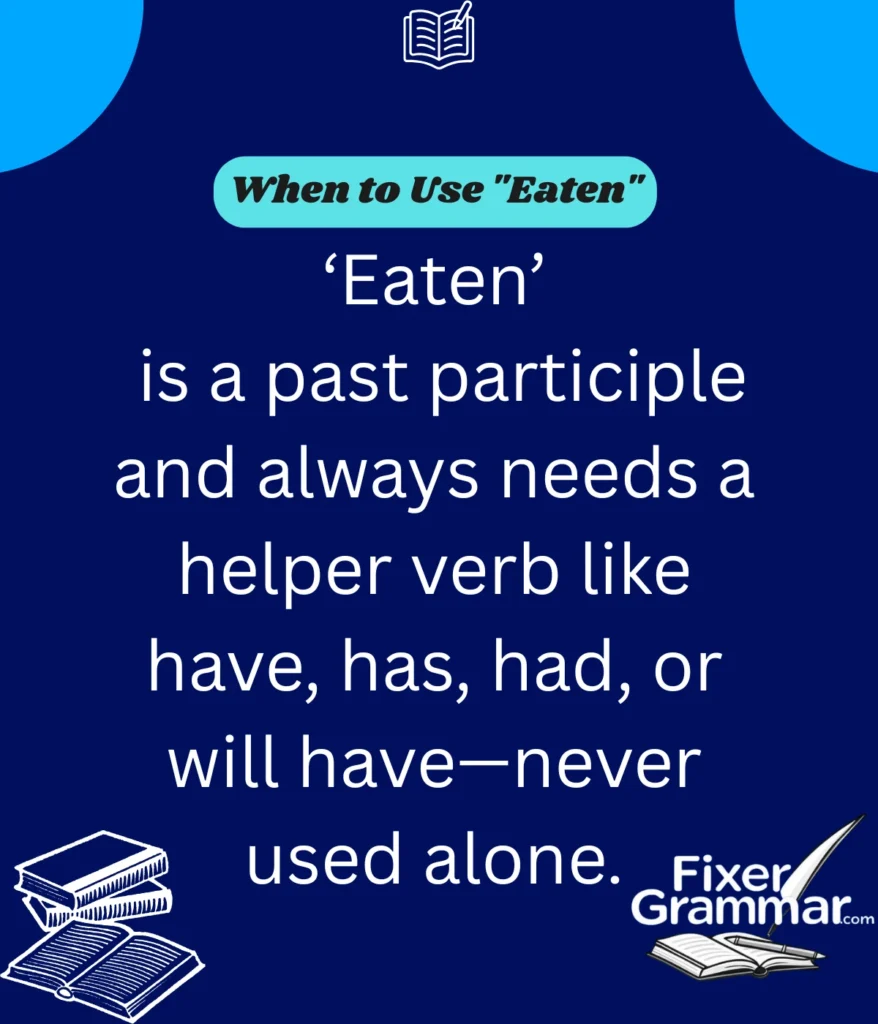
Eaten is the past participle of eat. It never stands alone. It always needs an auxiliary verb — have, has, had, or will have.
Eaten is used in all perfect tenses and in passive voice constructions.
✅ Correct:
- I have eaten sushi before. (present perfect)
- She had eaten before he arrived. (past perfect)
- By 8 PM, they will have eaten. (future perfect)
- The cake was eaten by the kids. (passive voice)
❌ Incorrect:
- I eaten lunch already. (missing helper verb)
- She eaten all the cookies. (same error)
Memory trick: If you see have, has, had, or will have — always use eaten, never ate.
Ate vs. Eaten — Side-by-Side Comparison
| Form | Tense | Structure | Example |
|---|---|---|---|
| Ate | Simple Past | Subject + ate | I ate pizza last night. |
| Eaten | Present Perfect | have/has + eaten | She has eaten here before. |
| Eaten | Past Perfect | had + eaten | We had eaten before the show. |
| Eaten | Future Perfect | will have + eaten | By noon, I will have eaten. |
| Eaten | Passive Voice | was/were + eaten | The food was eaten quickly. |
The clearest rule: No helper verb? Use ate. Helper verb present? Use eaten. That single check eliminates most mistakes.
More Posts:Tear vs. Tare – What’s the Difference? 2026
Common Mistakes and How to Fix Them
These are the most frequent errors — even fluent speakers make them.
“I have ate” → Should be “I have eaten” The verb have demands the past participle. Ate is simple past — it can’t follow have, has, or had.
“Have you ate?” → Should be “Have you eaten?” This is one of the most common spoken errors. The correct question is always “Have you eaten?”
“She had ate dinner” → Should be “She had eaten dinner” Had is a perfect tense helper. It pairs with eaten, never with ate.
Real-life dialogues:
Casual: Friend 1: “Did you eat yet?” Friend 2: “Yeah, I ate before I came over.” Friend 1: “Nice — I haven’t eaten anything all day.”
Workplace: Manager: “Have you eaten lunch?” Employee: “I ate at my desk earlier.”
Classroom: Teacher: “By the time class ends, how many of you will have eaten today?”
FAQs — Eaten or Ate
What is the main difference between “eaten” and “ate”?
Ate is simple past — used for finished actions with a specific time. Eaten is the past participle — always used with a helper verb like have, has, or had.
Can “eaten” be used without a helper verb?
No. Eaten always needs an auxiliary verb. Saying “I eaten lunch” is grammatically incorrect. The correct form is “I have eaten lunch.”
Is it “have you eaten” or “have you ate”?
Always “Have you eaten?” — The verb have requires the past participle form, which is eaten, not ate.
Why do so many people confuse “ate” and “eaten”?
Because both refer to the past, the boundary feels blurry. The key is recognizing helper verbs — they always signal that eaten is needed.
Is there any difference between British and American usage?
Both follow the same rule. One note: British English sometimes uses “I’ve eaten” more frequently in casual speech, while standard usage is identical in both dialects.
Does “eaten” ever appear without “have” or “had”?
Yes — in passive voice. For example: “The pizza was eaten quickly.” Here, was acts as the auxiliary verb.
Conclusion
The rule is simple. Ate stands alone for past actions. Eaten always pairs with a helper verb.
Spot a have, has, had, or will have? Use eaten. No helper verb? Use ate.
Practice this in everyday sentences and the right choice will become automatic.

At FixerGrammar.com, Johnson Isaacs shares easy grammar tips, clear examples, and helpful guidance to make writing simple, smooth, and mistake-free.
Related Posts