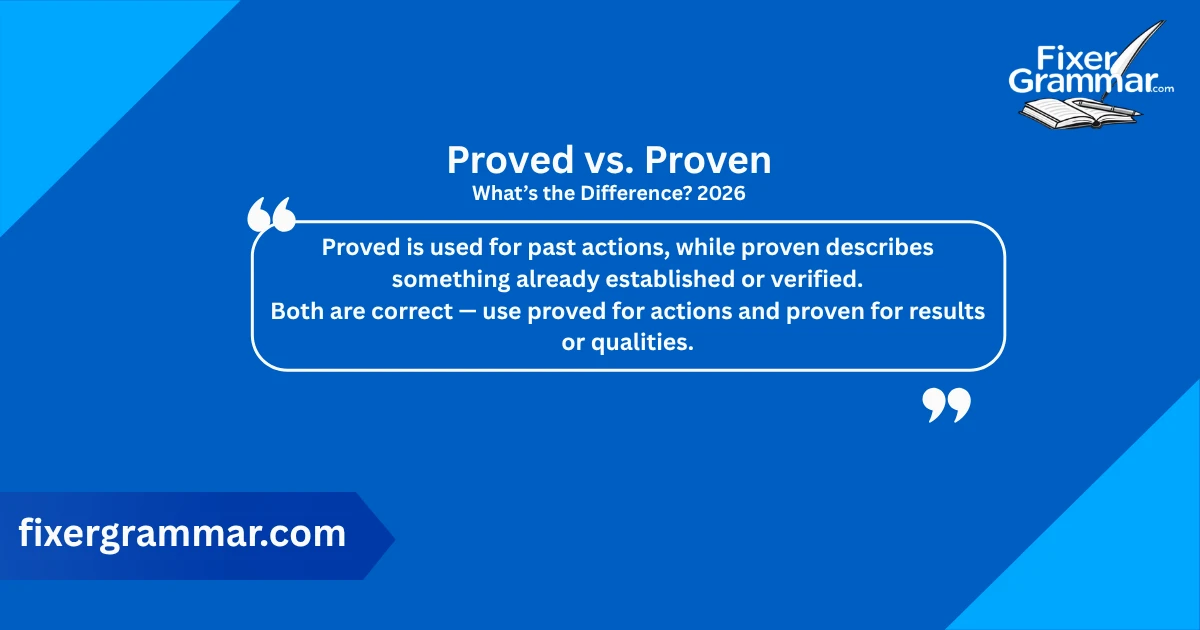
Knowing the difference makes your writing cleaner and more precise.
What Do Proved and Proven Mean?
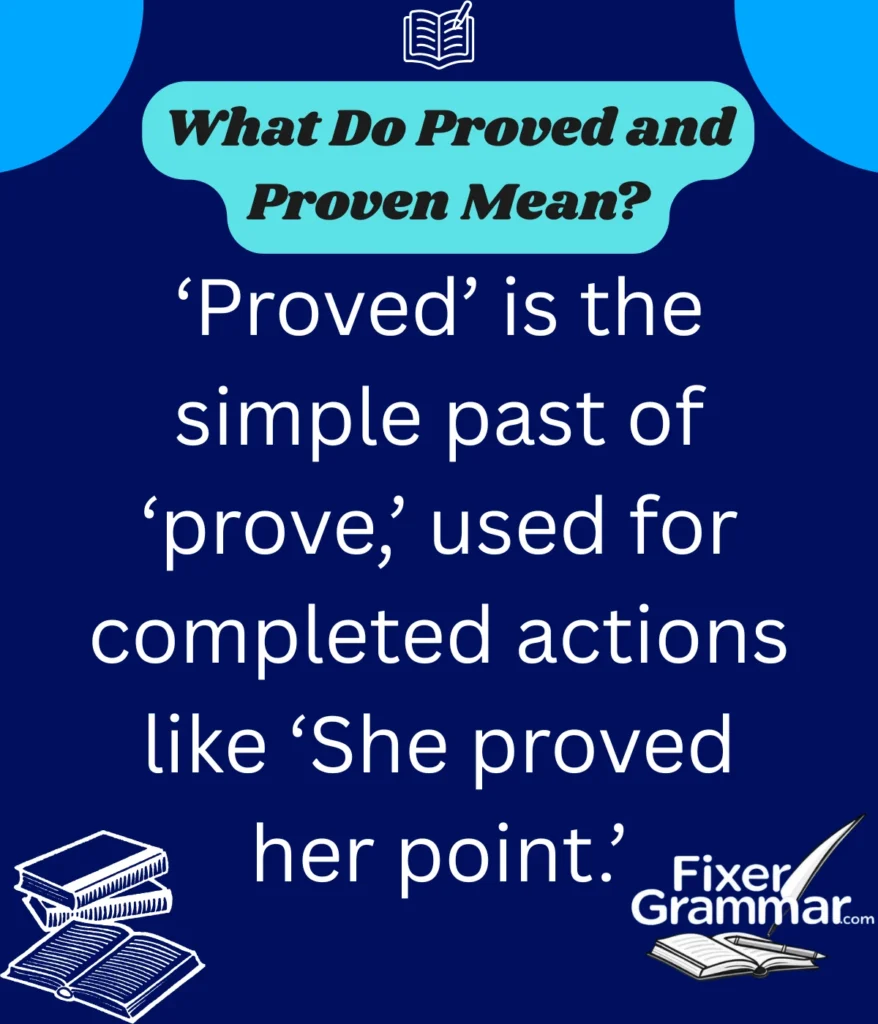
These two words share the same root but play different roles in a sentence.
What Does Proved Mean?
Proved is the simple past tense of prove. Use it when describing a completed action.
- She proved her point in the meeting.
It can also serve as a past participle in formal writing — especially in legal and scientific contexts.
- The theory was proved correct by the data.
What Does Proven Mean?
Proven is most naturally used as an adjective — meaning something already established or verified.
- He followed a proven strategy.
It also works as a past participle after auxiliary verbs like has, have, and had.
- The treatment has proven effective in clinical trials.
Proved vs. Proven — Grammar Rules Explained
Proved vs Proven — Forms & Usage
| Form | Function | Example |
|---|---|---|
| Proved | Simple past tense | She proved the theory. |
| Proved | Past participle (formal) | It was proved beyond doubt. |
| Proven | Past participle | He has proven himself capable. |
| Proven | Adjective | A proven method of success. |
Key rule: If the word comes before a noun, use proven. If it describes a past action, use proved.
- A proven technique ✅ A proved technique ❌ — sounds unnatural
More Posts:Tortuous vs. Torturous — What’s the Difference ? 2026
When to Use Proved vs. Proven in a Sentence
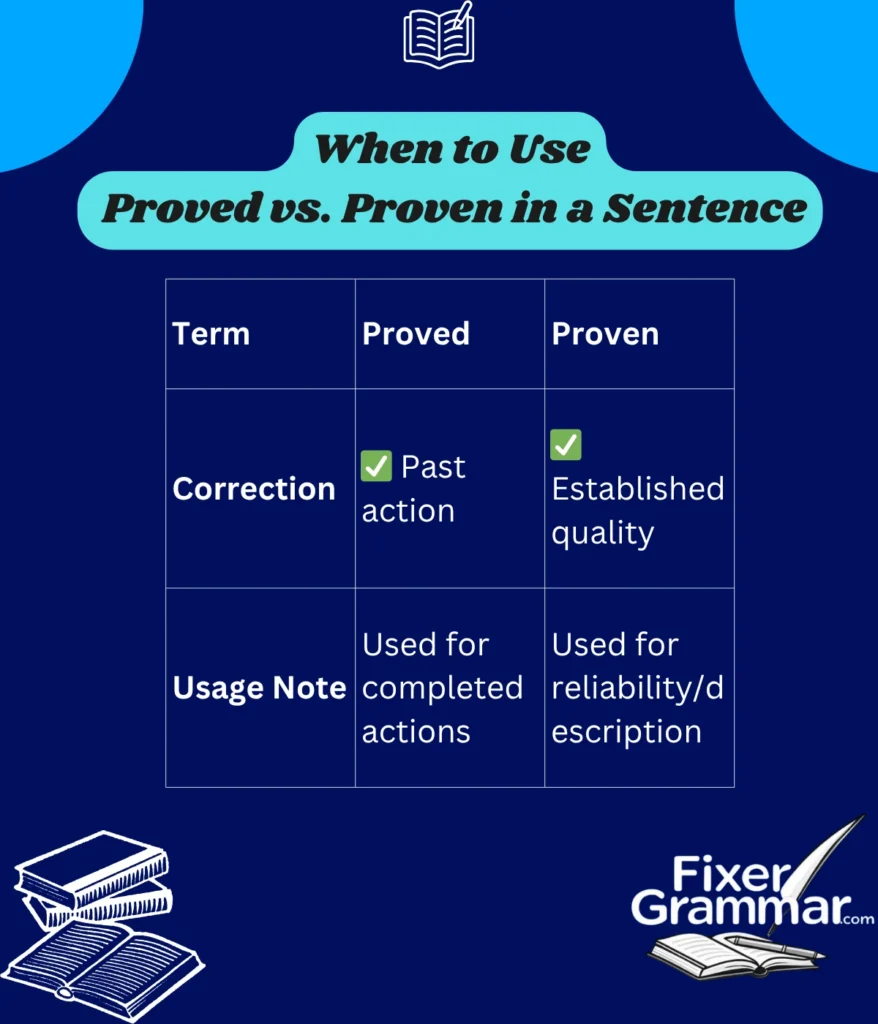
Ask yourself one simple question: Am I describing an action or describing a quality?
If you’re describing something that happened, use proved.
The scientist proved the hypothesis in 2021.
If you’re describing something that is established or reliable, use proven.
This is a proven approach to weight loss.
Passive voice works with both forms — but stay consistent within the same piece.
The claim was proved by witnesses. ✅ The claim was proven by witnesses. ✅
Proved or Proven — American vs. British English
This is the one place where regional preference genuinely matters.
Standard usage today strongly favors proven as the past participle and adjective. Proved remains the preferred past participle in formal British writing, while proven dominates in everyday and professional usage everywhere else.
Quick rule for most writing: Use proved for past actions. Use proven as an adjective or after has/have/had.
More Posts:Loot vs. Lute — What’s the Difference ? 2026
FAQs — Proved vs. Proven
Is “proved” or “proven” correct?
Both are correct. Proved is the standard simple past tense, while proven is preferred as an adjective and past participle in common usage.
Can I say “has proved” and “has proven”?
Yes — both are grammatically acceptable. Choose one and stay consistent throughout your piece.
Is “proven” only used in American English?
No. Proven appears widely across varieties of English. British formal writing may still lean toward proved as a past participle, but proven is globally understood and accepted.
Which sounds more natural — “a proven method” or “a proved method”?
A proven method is the natural, modern choice. A proved method sounds stiff and unnatural to most readers today.
Should I say “proved guilty” or “proven guilty”?
Both are used. Legal writing has historically favored proved guilty, but proven guilty is widely understood and equally correct.
How do I remember which one to use?
Simple test — if you can replace the word with established, use proven. If the sentence describes a past event or action, use proved.
Conclusion
The difference is straightforward. Use proved when describing a past action. Use proven when describing something established, reliable, or verified — especially before a noun.
When in doubt, run the substitution test: swap the word with established and see which version sounds right. Master this small distinction and your writing becomes noticeably sharper.

At FixerGrammar.com, Johnson Isaacs shares easy grammar tips, clear examples, and helpful guidance to make writing simple, smooth, and mistake-free.
Related Posts