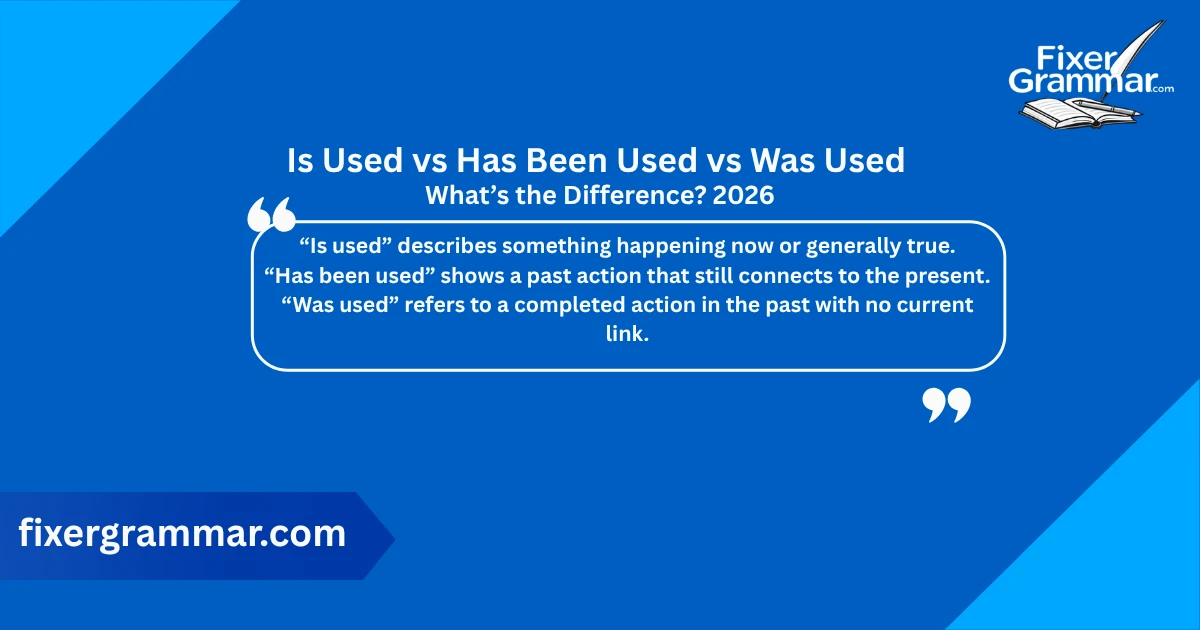
Picking the wrong one changes your meaning completely. This guide breaks down each form simply and clearly.
Why Verb Tense Changes Everything in English
Verb tense tells your reader when something happens. A single wrong word can confuse the timeline of your entire sentence.
Look at these three sentences. Same action, different meaning:
- “The software is used by our team daily.” → still happening
- “The software has been used in three projects.” → past, still relevant
- “The software was used in 2019.” → finished, no current link
What “Is Used,” “Has Been Used,” and “Was Used” Each Mean
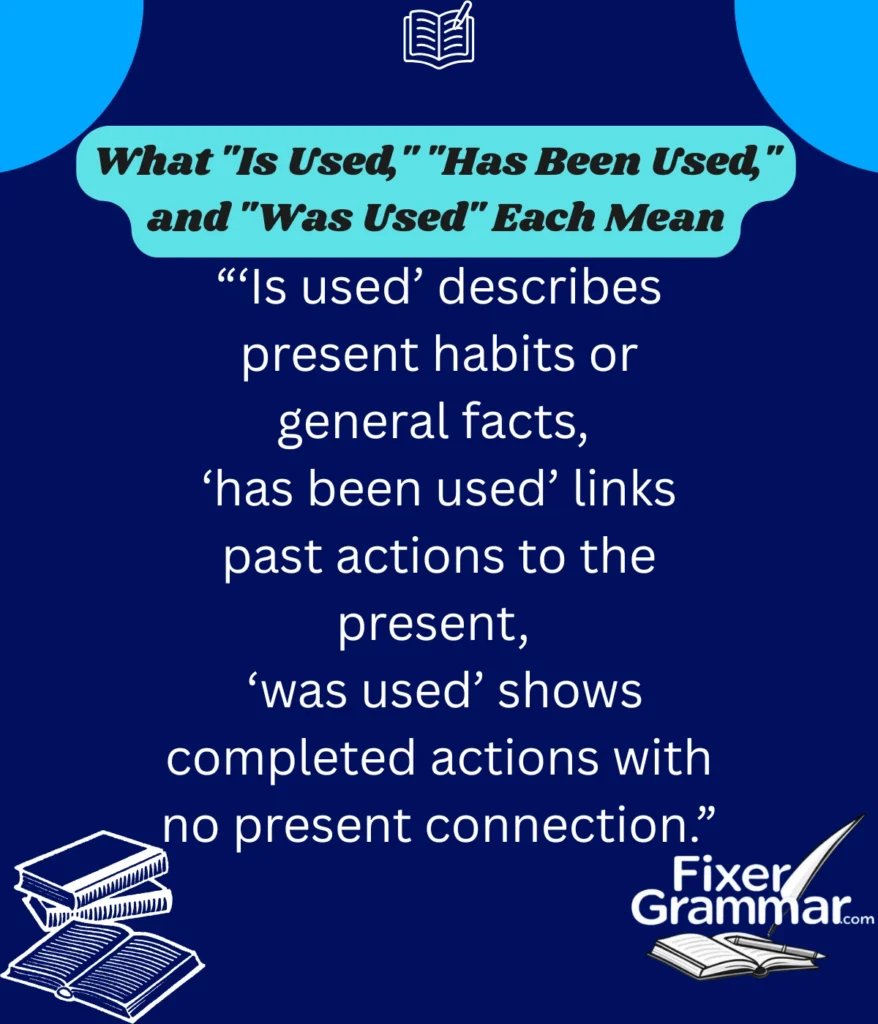
These three forms belong to three separate tense structures in passive voice construction.
| Form | Tense | Time Signal | Key Use |
|---|---|---|---|
| Is used | Present Simple Passive | Now / Always | Habits, general facts |
| Has been used | Present Perfect Passive | Past → Present | Past with current relevance |
| Was used | Simple Past Passive | Definite Past | Completed actions |
“Has been used” works when the past action still matters today.
“Was used” is for events that ended and have no present connection.
Is Used vs Has Been Used vs Was Used – Real Examples Side by Side
Seeing all three forms in real sentences makes the difference easy to spot.
“Is used” examples:
- “This formula is used to calculate compound interest.”
- “Solar energy is used in homes across the country.”
“Has been used” examples:
- “This method has been used in classrooms for over 20 years.”
- “The tool has been used by researchers since 2010.”
“Was used” examples:
- “The old system was used before the upgrade last March.”
- “Steam power was used widely in the 19th century.”
Time markers are your biggest clue:
| Form | Tense | Time Signal | Key Use |
|---|---|---|---|
| Is used | Present Simple Passive | Now / Always | Habits, general facts |
| Has been used | Present Perfect Passive | Past → Present | Past with current relevance |
| Was used | Simple Past Passive | Definite Past | Completed actions |
Quick Tips to Always Choose the Right Form
Ask yourself these three questions before choosing:
- “Is the action still happening or generally true?” → Use is used
- “Did it happen in the past and still matters now?” → Use has been used
- “Did it finish at a specific time with no present link?” → Use was used
A simple memory trick: Think of three time zones — now, then-but-still-relevant, and done. Each form lives in one zone.
Read your sentence out loud. If it sounds like you are describing something finished and gone, use “was used.” If it feels like it still connects to today, “has been used” is your answer.
When in doubt, switch to active voice. “Researchers used this method” is clearer than “This method has been used by researchers.”
More Posts:Proved vs. Proven — What’s the Difference? 2026
Is Used vs Has Been Used vs Was Used – Usage Across Contexts
Each form fits naturally into different writing situations.
Academic writing leans on “has been used” to connect past research to present findings.
Example: “This framework has been used extensively in psychological studies.”
Instructions and manuals use “is used” for current, general truths.
Example: “This button is used to restart the device.”
Historical writing relies on “was used.”
Example: “Morse code was used as the primary long-distance communication method.”
One regional note worth knowing: British English often prefers present perfect in situations where standard usage might accept simple past — for example, “I have just eaten” versus “I just ate.” This has no impact on the passive forms covered here, but it can affect surrounding sentence structure.
More Posts:Marquee vs. Marquis — What’s the Difference? 2026
FAQ’s – Is Used vs Has Been Used vs Was Used
When should I use “is used”?
Use “is used” when describing something currently true, habitual, or generally accepted — like facts, instructions, or regular processes.
What does “has been used” mean?
“Has been used” means the action happened in the past but still holds relevance or impact in the present moment.
How do I know when to use “was used”?
Use “was used” when the action is completely finished and tied to a specific past time — with no connection to now.
Can these three forms appear in the same document?
Yes — as long as each form matches the correct time frame it describes, mixing all three in one document is perfectly fine.
Any easy tip for remembering the difference?
Think: now = is used, past-but-relevant = has been used, done = was used. Time markers like yesterday or since 2010 will almost always point you to the right choice.
Does “used to” mean the same as “is used”?
No. “Used to” is an idiom meaning accustomed to or formerly did. It is completely different from the passive voice construction of is used.
Conclusion
“Is used,” “has been used,” and “was used” each live in a different time zone.
Present facts use is used. Past actions that still matter use has been used. Finished past events use was used. Check your time markers, ask the three quick questions, and your choice becomes simple every time.

At FixerGrammar.com, Johnson Isaacs shares easy grammar tips, clear examples, and helpful guidance to make writing simple, smooth, and mistake-free.
Related Posts