Mixing them up in writing — especially in legal, medical, or professional contexts — can completely flip your intended meaning.
What Do Prescribe and Proscribe Mean?
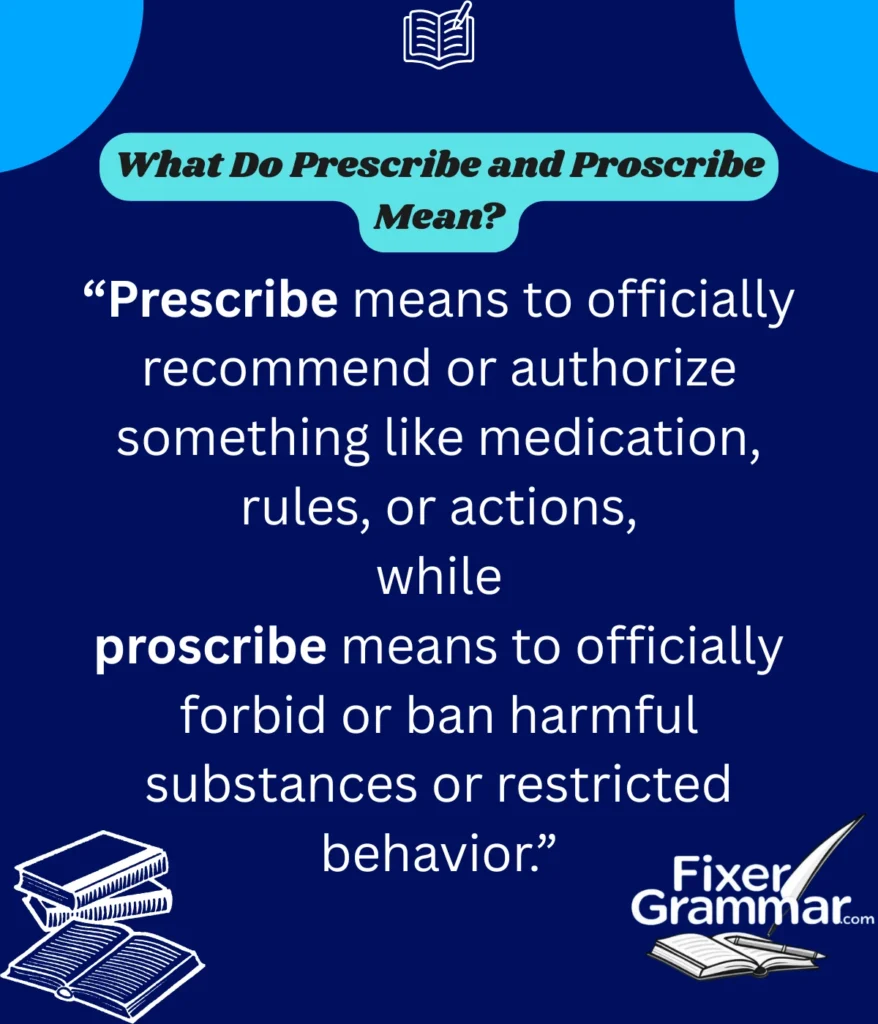
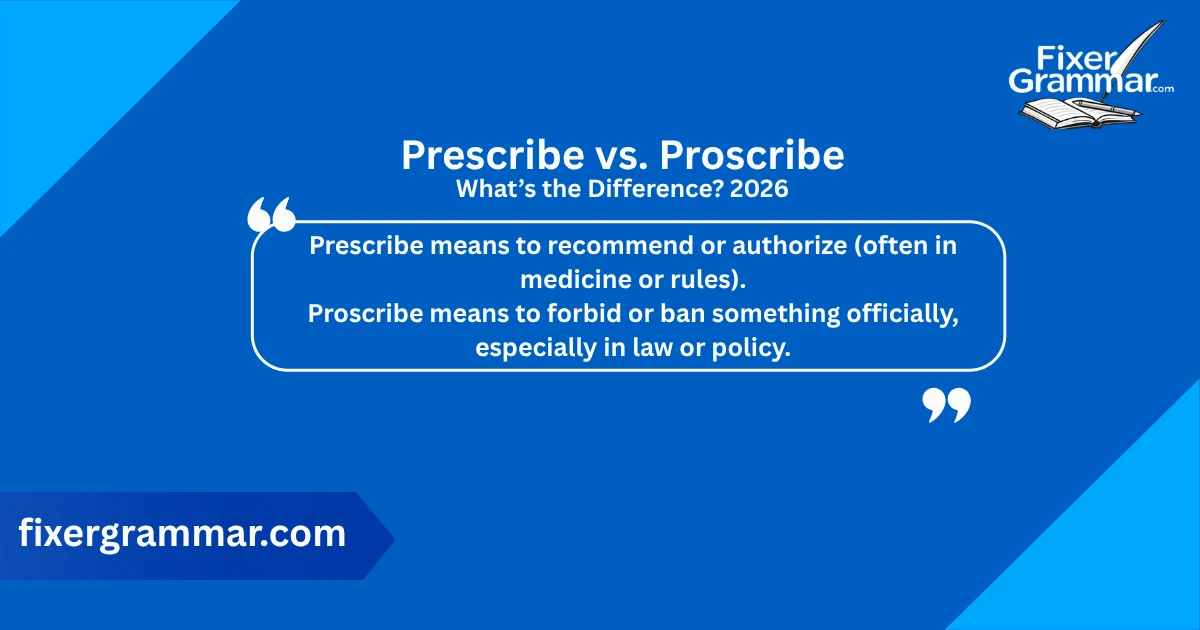
Prescribe means to officially direct, recommend, or authorize something.
- A doctor prescribes medication.
- A law prescribes a penalty.
- A syllabus prescribes required readings.
Proscribe means to officially forbid or prohibit something.
- A government proscribes dangerous substances.
- A company policy proscribes harassment.
- A court proscribes certain behaviors.
| Word | Core Meaning | Quick Example |
|---|---|---|
| Prescribe | To recommend or authorize | The doctor prescribed antibiotics. |
| Proscribe | To forbid or ban | The law proscribes insider trading. |
Key rule: If something is being ordered or recommended, use prescribe. If something is being banned or outlawed, use proscribe.
Latin Roots — Where Prescribe and Proscribe Come From
Both words share the same Latin base — scribere, meaning “to write.” But their prefixes pull them in opposite directions.
Prescribe comes from Latin praescribere — prae meaning “before” + scribere meaning “to write.” It originally meant to write instructions in advance, like a rule or directive.
Proscribe comes from Latin proscribere — pro meaning “publicly” + scribere. In ancient Rome, proscription was deadly serious.
More Posts:Accent vs. Ascent vs. Assent — What’s the Difference? 2026
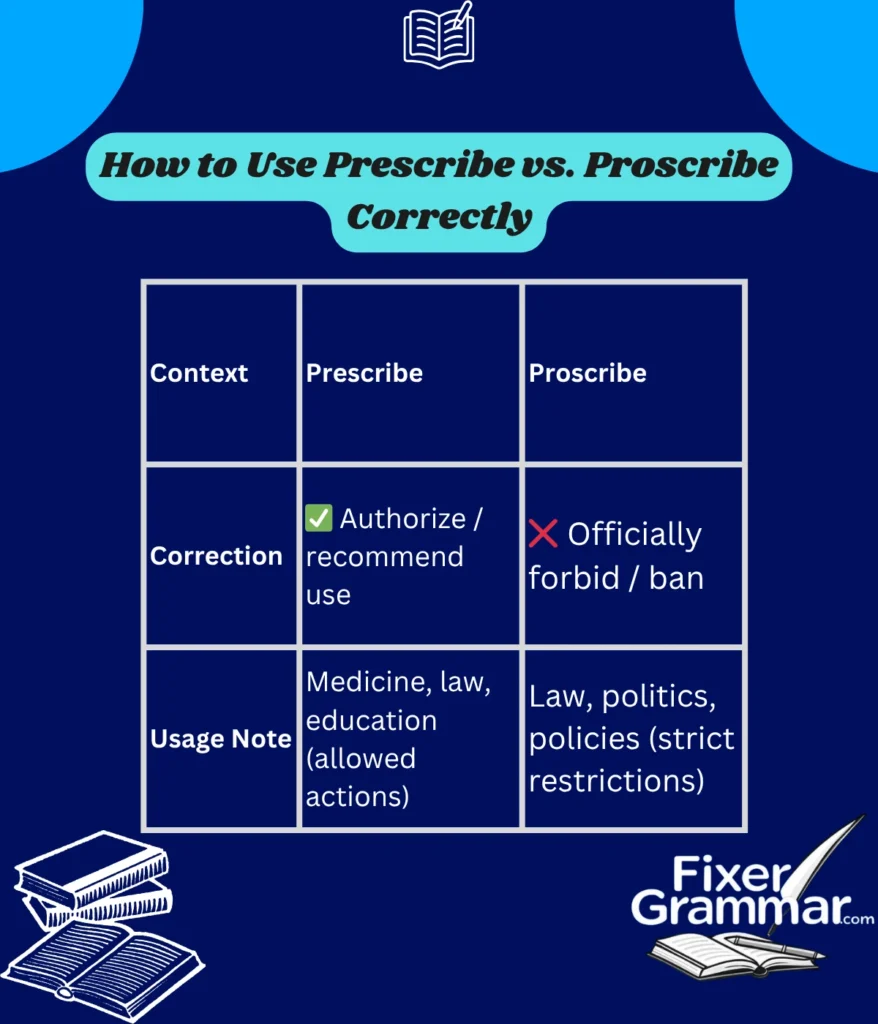
How to Use Prescribe vs. Proscribe Correctly
Prescribe in Medicine, Law, and Everyday Use
In medicine, prescribe is used when a licensed professional authorizes a treatment. According to the FDA, only licensed practitioners can legally prescribe controlled substances.
In law, statutes prescribe procedures, penalties, and requirements. In education, a curriculum prescribes which texts students must study.
- The physician prescribed a 10-day course of antibiotics.
- State law prescribes the exact steps for removing a health officer.
- The course syllabus prescribes five novels for the semester.
Proscribe in Law, Politics, and Workplace Policies
Proscribe appears most often in formal, legal, or institutional language. It signals a strict ban — not just a suggestion to avoid something.
- The UK Parliament proscribed Hezbollah as a terrorist organization.
- The university proscribes plagiarism in all submitted work.
- Company policy proscribes the use of personal devices during client meetings.
| Context | Prescribe Example | Proscribe Example |
|---|---|---|
| Medicine | Doctor prescribed rest and fluids. | FDA proscribes untested drug use. |
| Law | Law prescribes maximum penalties. | Law proscribes insider trading. |
| Education | Syllabus prescribes required readings. | School proscribes academic dishonesty. |
| Workplace | HR manual prescribes annual training. | Policy proscribes workplace harassment. |
Easy Memory Tricks to Never Confuse Them Again
These two mnemonics work every time:
“Prescribe = Provide. Proscribe = Prohibit.”
Both word pairs share the same starting letters. That pattern locks the meaning in fast.
“Doctors prescribe. Laws proscribe.”
This one works because it ties each word to a real-world setting you already know. When you think of a doctor, you think of help and treatment — that’s prescribe. When you think of a law, you think of what’s not allowed — that’s proscribe.
Pronunciation reminder:
- Prescribe → pri-skrahyb (starts like “predict”)
- Proscribe → proh-skrahyb (starts like “prohibit”)
More posts:Indolence vs Insolence – What’s the Difference? 2026
FAQs About Prescribe vs. Proscribe
Why do people confuse prescribe and proscribe?
They differ by just one letter in the prefix, sound nearly identical in fast speech, and both appear in formal writing — making them one of the most commonly mixed-up word pairs in English.
What does prescribe mean?
Prescribe means to officially recommend, authorize, or direct something — most commonly used when a doctor orders a treatment or a law sets a requirement.
What does proscribe mean?
Proscribe means to officially forbid or ban something because it is harmful, dangerous, or unlawful.
Does the prefix “pro” always signal something positive?
No. In proscribe, “pro” derives from the Latin for “publicly” — historically used to announce public bans and condemnations in ancient Rome. It carries no positive meaning here.
Is there any difference between British and American usage of these words?
No meaningful difference exists. Both prescribe and proscribe carry the same meanings and are used the same way across both varieties of English.
How can I remember the difference easily?
Link prescribe to “provide” and proscribe to “prohibit.” Both pairs start with the same letters — making the connection quick, clean, and unforgettable.
The Difference Comes Down to One Choice
Prescribe gives direction. Proscribe sets a ban. One recommends — the other restricts.
Once you connect prescribe to “provide” and proscribe to “prohibit,” the confusion disappears for good. Practice both words in real sentences, and you’ll never mix them up again.

At FixerGrammar.com, Johnson Isaacs shares easy grammar tips, clear examples, and helpful guidance to make writing simple, smooth, and mistake-free.
Related Posts