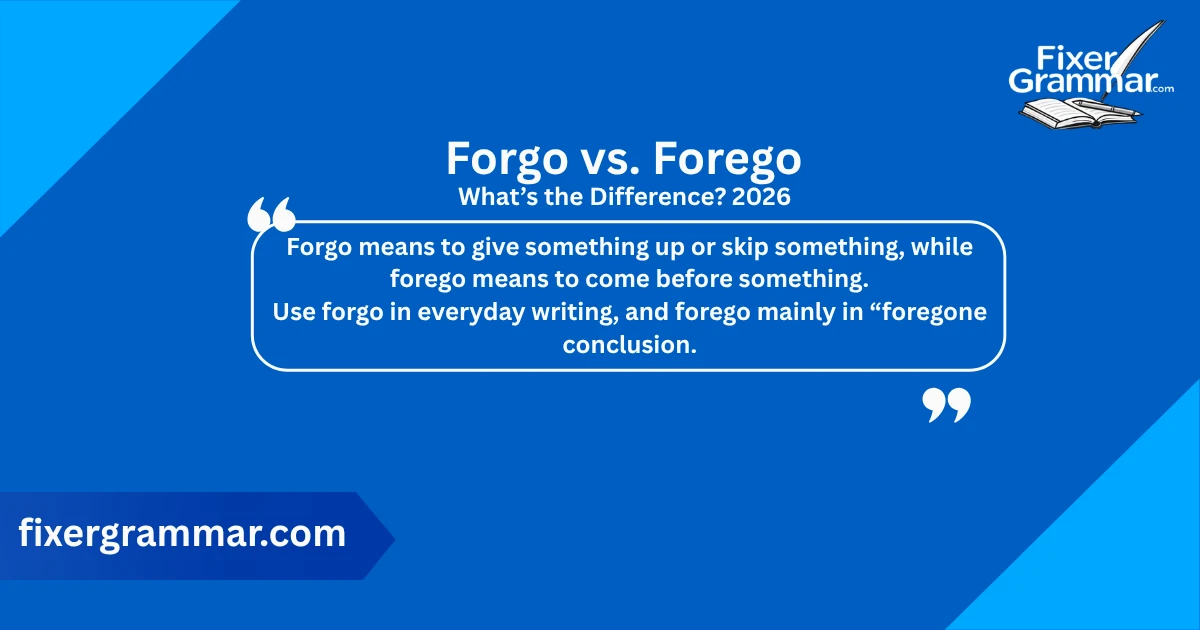
These two words look almost identical, but they carry different meanings. Knowing the right one keeps your writing sharp and credible.
What Do Forgo and Forego Actually Mean?
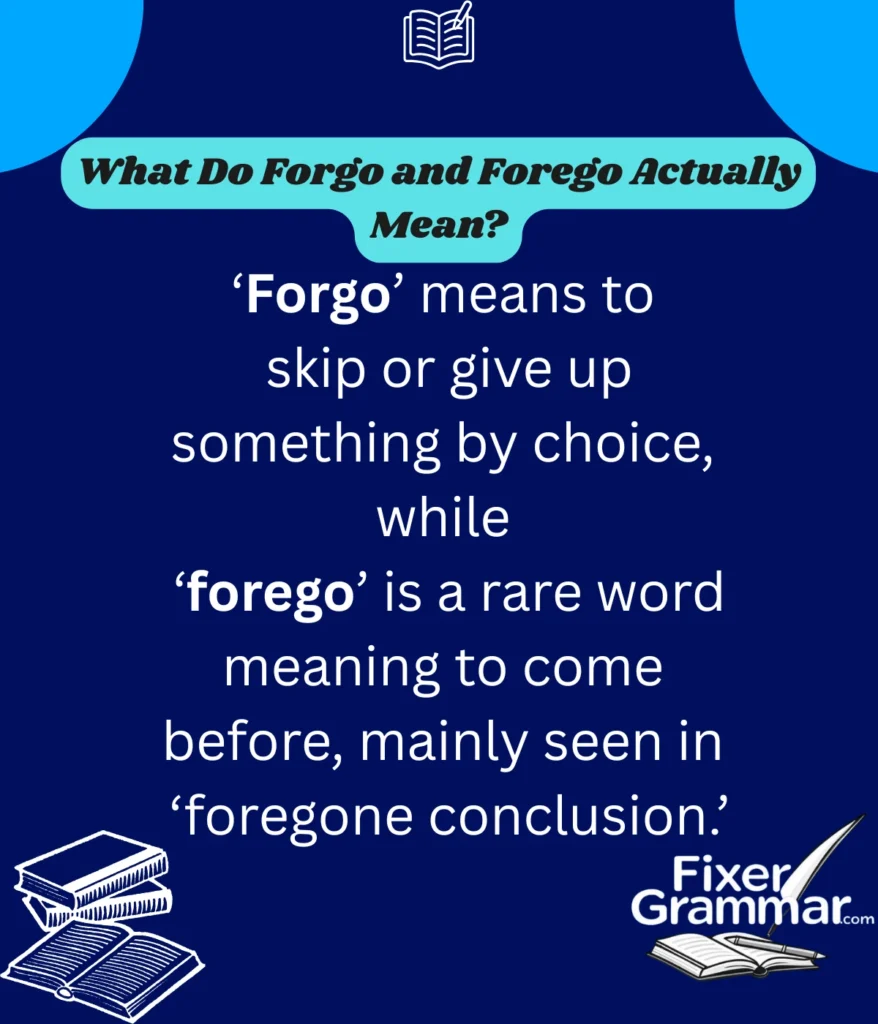
Forgo is the word you’ll use most. It means to go without, skip, or abstain from something — usually by choice.
Forego is older and rarer. It means to precede or go before something else. You’ll mainly see it locked inside one phrase: foregone conclusion.
| Word | Core Meaning | Example |
|---|---|---|
| Forgo | To give up or skip | She chose to forgo dessert. |
| Forego | To come before | A summary will forego the report. |
| Foregone | Already decided | It was a foregone conclusion. |
Quick answer: If you mean “give up,” use forgo. If you mean “go before,” use forego.
More Posts:Marquee vs. Marquis — What’s the Difference? 2026
Forgo vs. Forego: Key Differences Explained
The biggest difference is meaning — not spelling.
Forgo shows up in everyday decisions — skipping meals, passing on opportunities, giving up habits. Forego is almost extinct in modern writing outside of foregone conclusion.
- Forgo → voluntary sacrifice or restraint
- Forego → something that precedes another
- Foregone conclusion → an outcome already decided before it happens
Most style guides — including Merriam-Webster and the Chicago Manual of Style — treat these as distinct words with separate meanings.
How to Use Forgo and Forego Correctly in a Sentence
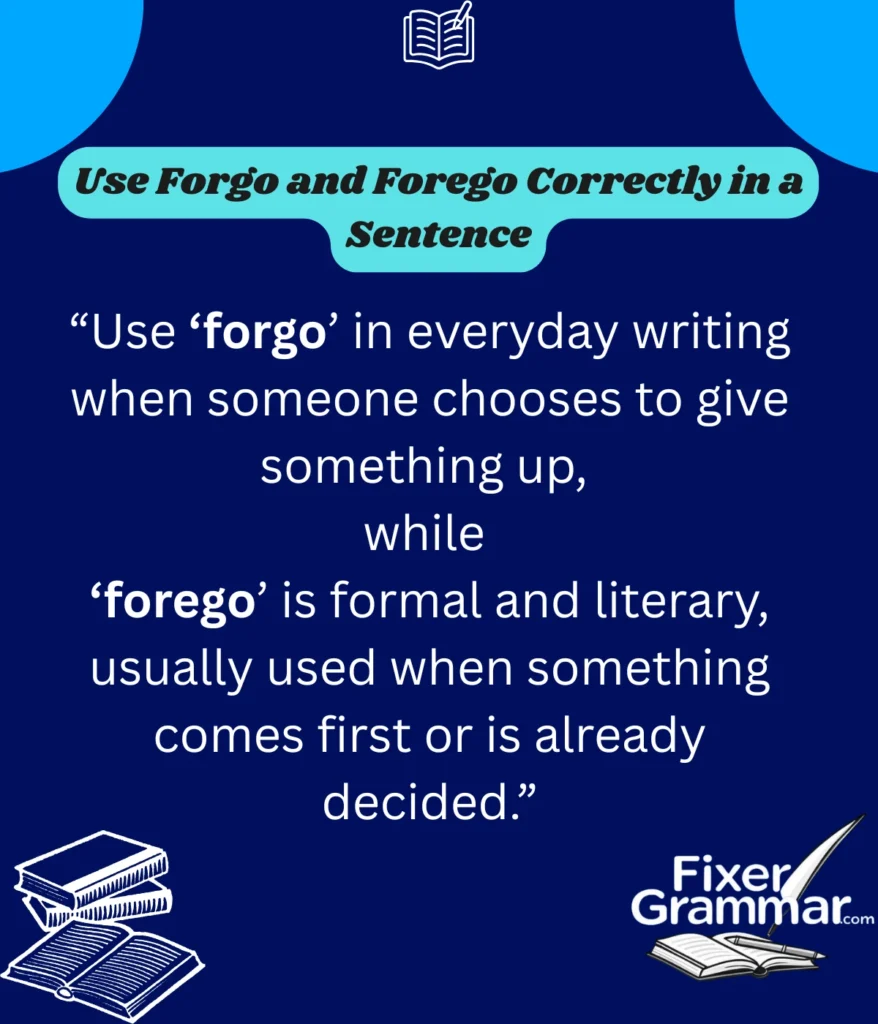
Forgo fits naturally in everyday writing:
- “They chose to forgo the trip and save money.”
- “She will forgo her salary bonus this quarter.”
- “Many people forgo breakfast when rushing to work.”
Forego belongs in formal or literary contexts — and almost always near conclusion:
- “His win was a foregone conclusion from the start.”
- “A brief introduction will forego the main lecture.”
Simple rule: Ask yourself — am I talking about giving something up? Use forgo. Am I talking about something that happened first? Use forego.
More Posts:Ageing vs. Aging — What’s the Difference ? 2026
Simple Tricks to Remember the Difference Every Time
Memory tricks make this effortless.
Forgo = “For-getting it” — you’re giving it up, letting it go. Forego = “Fore-runner” — like a foreword or forecast, it comes first.
Think of it this way:
- Fore = before (forearm, foresee, forefront)
- Forgo = skip it, pass on it
Synonyms that help:
| Word | Synonyms |
|---|---|
| Forgo | Skip, abstain, decline, pass up, relinquish |
| Forego | Precede, come before, lead up to |
FAQ — Which Is Correct, Forego or Forgo?
Which is correct, forego or forgo?
Both are real words, but they mean different things. Forgo is correct when you mean to give something up. Forego is correct only when meaning “to precede” — most commonly in the phrase foregone conclusion.
Can forgo and forego be used interchangeably?
Not in modern writing. They were loosely interchangeable in older English, but today’s style guides treat them as separate. Using them interchangeably can confuse readers and weaken your writing.
What does “foregone conclusion” mean?
It means an outcome that was already decided or inevitable before it officially happened. Example: “With their lead, winning was a foregone conclusion.”
Is forego even used anymore?
Rarely — and almost always only in foregone conclusion. Outside that phrase, forgo is the word modern writers reach for. British English historically used forego more broadly, but standard usage today keeps them separate.
How do I remember which one to use?
Think: “Fore” = before. If something comes before, use forego. If you’re giving something up, use forgo. That one mental check works every time.
Final Verdict
In nearly every situation — forgo is your word.
It’s the modern, standard choice when you mean to give up, skip, or abstain from something. Forego lives almost entirely inside foregone conclusion and a handful of formal texts.
Bottom line:
- Giving something up? → Forgo
- Something comes before? → Forego
- Already decided outcome? → Foregone conclusion
Master this small distinction and your writing instantly becomes cleaner, more precise, and more trustworthy.

At FixerGrammar.com, Johnson Isaacs shares easy grammar tips, clear examples, and helpful guidance to make writing simple, smooth, and mistake-free.
Related Posts