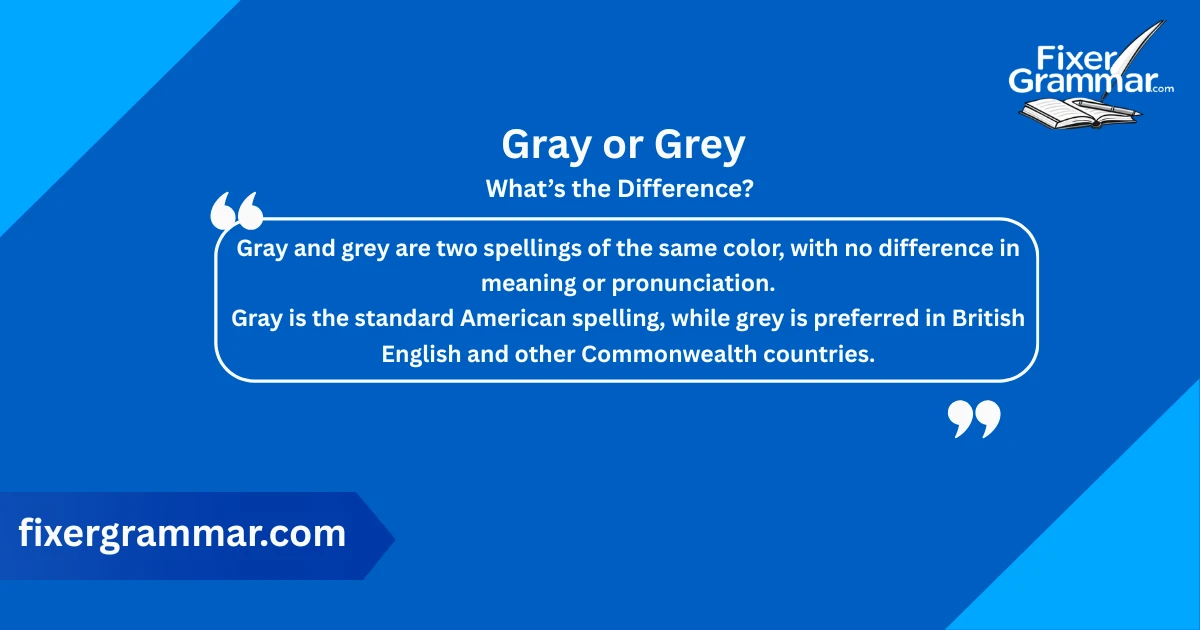
If you’re writing for a US audience, gray is the standard spelling. It’s what you’ll find on Crayola crayons, in textbooks, and in every major US dictionary. Use it, and you’re correct.
What Do Gray and Grey Actually Mean?
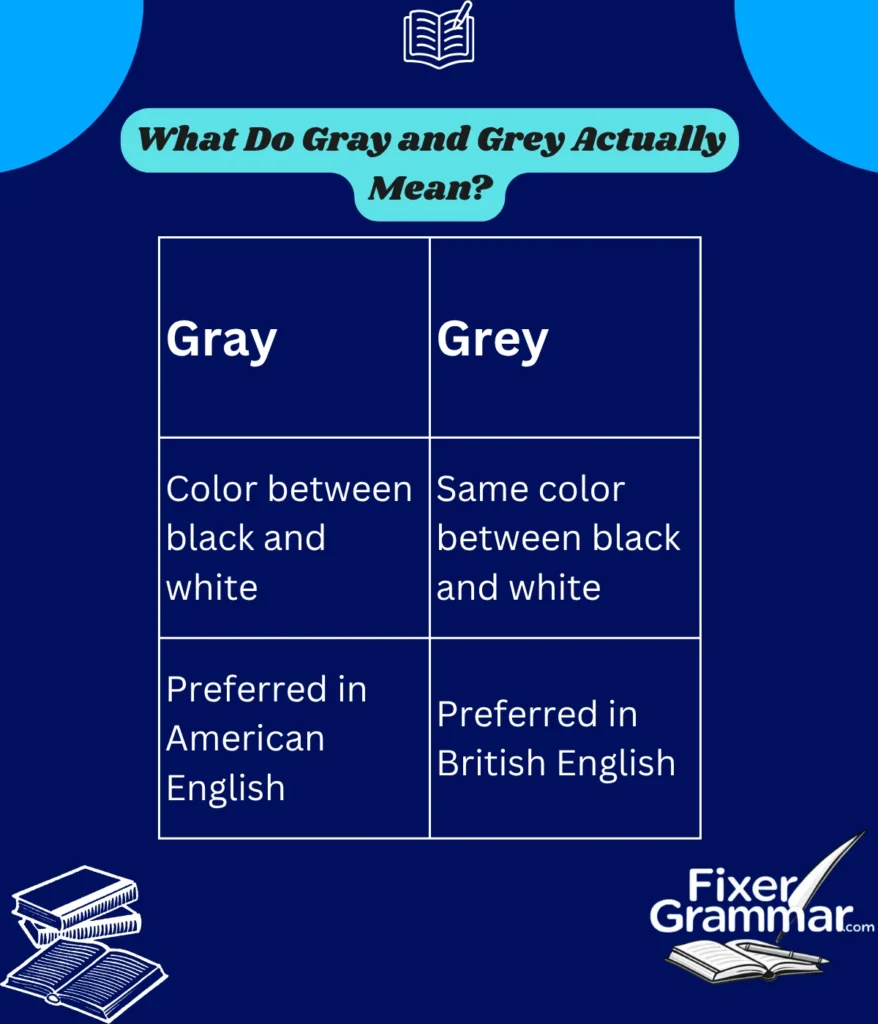
Both words describe the color between black and white. That’s it. There is no shade difference, no meaning difference, no pronunciation difference.
You can use gray as a noun (“wear a shade of gray”), as an adjective (“a gray cat”), or even as a verb (“his hair started to gray”). The same rules apply to grey.
Gray as a Noun, Adjective, and Verb
| Use | Example with Gray | Example with Grey |
|---|---|---|
| Noun | “She dressed in gray.” | “She dressed in grey.” |
| Adjective | “A gray sky.” | “A grey sky.” |
| Verb | “His beard started to gray.” | “His beard started to grey.” |
All three are grammatically correct in both spellings. The choice comes down to one thing: the spelling convention you’re following.
More Posts:Recurring vs. Reoccurring – What’s the Difference ? 2026
Gray vs. Grey: The Real Difference
Gray is standard in the US, and grey is standard in Britain, Canada, and Australia.
This is one of the most well-known differences between American and British English — like “color” vs. “colour” or “organize” vs. “organise.” Neither spelling is wrong. They just belong to different spelling traditions.
An Easy Trick to Remember the Difference
This mnemonic has helped thousands of people — students, writers, ESL learners — get it right every time:
- Gray has an A → America uses gray
- Grey has an E → England uses grey
That’s the whole trick. One letter. Two countries. Easy to remember forever.
When You Can’t Choose: Fixed Spellings to Know
Sometimes the spelling isn’t up to you. Proper nouns, brand names, and species names lock in one specific spelling — and you have to use it exactly as written, no matter your preference.
Getting these wrong looks careless, especially in professional or published writing.
Always Spelled “Grey”
- Greyhound (the dog breed)
- Earl Grey tea
- Fifty Shades of Grey (the novel)
- Grey’s Anatomy (the TV show)
- Grey Poupon mustard
- Gandalf the Grey (from The Lord of the Rings)
Always Spelled “Gray”
- Grayling (a freshwater fish species)
- Gray (the SI unit of absorbed radiation dose)
- Gray whale (the species Eschrichtius robustus)
Quick rule: If the word is part of an official name — a brand, a species, a character — look it up and use the exact spelling. If it’s just describing a color, you have a choice.
FAQ’s Gray or Grey — Quick Answers
Is it gray or grey in the US?
Gray is the standard spelling in the US. It’s used in American dictionaries, style guides, and everyday writing.
Are gray and grey the same color?
Yes, completely. They describe the exact same color — the neutral tone between black and white. There is no shade difference between the two spellings.
Which spelling should I use in formal writing?
Use gray for US audiences and grey for British or international audiences. Either is acceptable in formal writing — consistency matters most.
Can I use “grey” instead of “gray” in everyday writing?
Yes. Both are understood and accepted. However, if you’re writing for a US publication or following a US style guide, gray is the expected form.
Why do both spellings exist?
Both developed from the same Old English root. Over centuries, grey became standard in Britain while gray became standard in America — mainly due to Noah Webster’s push for distinct American spelling conventions.
Does the spelling change the pronunciation?
No. Gray and grey are pronounced exactly the same way: /ɡreɪ/. The vowel sound is identical regardless of which letter you use.
The Bottom Line
Gray or grey? If you’re writing for a US audience, go with gray. If you’re writing for a British or international audience, grey is the natural choice.
Both are correct. Both have centuries of history behind them. The only “mistake” is switching between them in the same piece of writing — pick one and stay consistent.
When in doubt, remember: A for America, E for England. That one trick will save you every time.

At FixerGrammar.com, Johnson Isaacs shares easy grammar tips, clear examples, and helpful guidance to make writing simple, smooth, and mistake-free.
Related Posts