This is one of the most commonly confused word pairs in English. Knowing the difference helps you write with clarity, accuracy, and confidence.
What Is Calvary and What Is Cavalry? Definitions Explained
Both words are nouns. Both come from Latin. But they belong to completely different worlds — one spiritual, one military.
What Does Calvary Mean?
Calvary is the hill outside ancient Jerusalem where Jesus was crucified. The name comes from the Latin word Calvaria, meaning “skull.” It is also called Golgotha in Hebrew.
The Bible references it directly in Luke 23:33 — “And when they were come to the place, which is called Calvary, there they crucified him.“
Calvary is also used figuratively to describe an experience of intense suffering or personal ordeal. For example:
- “His long recovery felt like a personal calvary.”
- “The church’s stained-glass window depicted the sorrow of Calvary.”
- “She carried her grief like a walk to Calvary.”
Key facts about Calvary:
- Located outside Jerusalem’s ancient city walls
- Also known as Golgotha — “Place of the Skull”
- Central symbol of Christian faith, redemption, and sacrifice
- Used in hymns, church names, and religious art across the world
What Does Cavalry Mean?
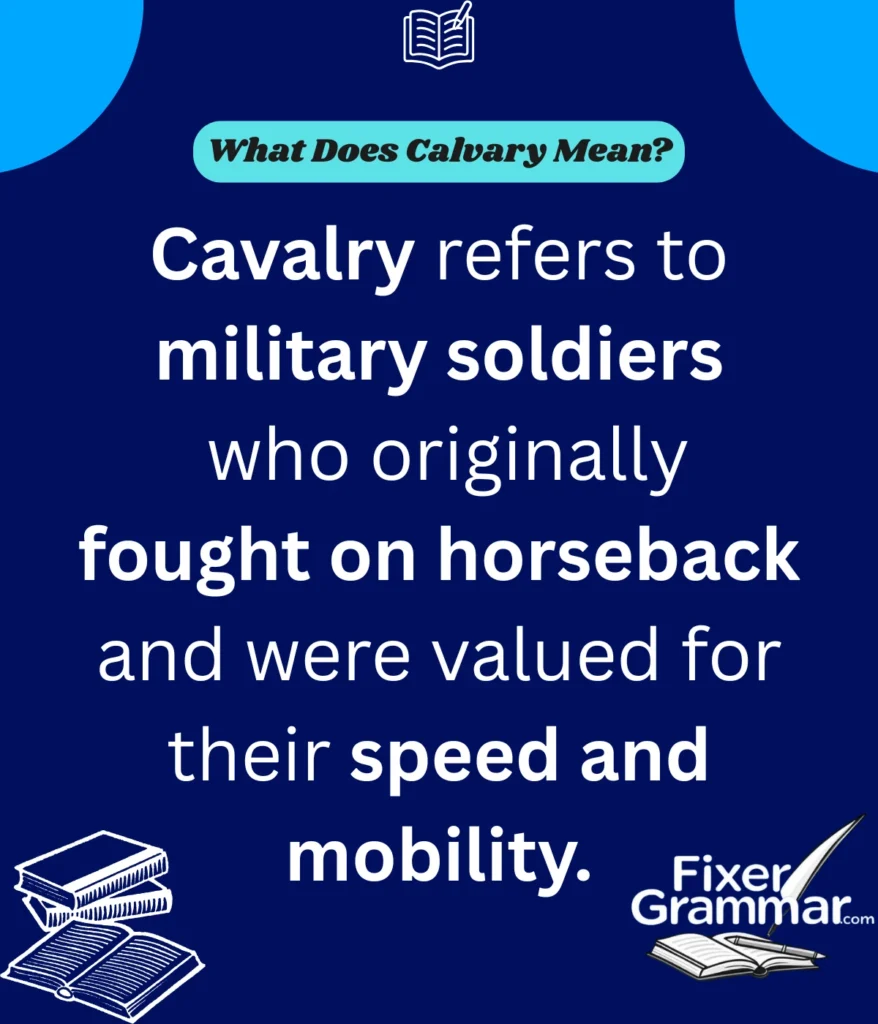
Cavalry refers to soldiers trained to fight on horseback. Over time, as warfare evolved, the term expanded to include armored vehicles and air units — fast-moving military forces built for speed and impact.
The word traces back to the Italian cavalleria and the Latin caballus, both meaning “horse.”
The U.S. Army’s 1st Cavalry Division is a modern example — it now operates tanks and helicopters but carries the historic name proudly.
Key cavalry facts:
- Cavalry units date back to the 9th century BCE in Assyria and Persia
- Medieval knights on horseback were the elite cavalry of their era
- By the 20th century, horses gave way to armored divisions and helicopters
- The idiom “Here comes the cavalry!” means help has arrived
How to Pronounce Calvary vs. Cavalry Correctly
This is where most of the confusion begins. The two words sound almost identical in fast, casual speech.
| Word | IPA | Plain Guide |
|---|---|---|
| Calvary | /ˈkæl.və.ri/ | CAL-vuh-ree |
| Cavalry | /ˈkæv.əl.ri/ | CAV-ul-ree |
The key difference: Calvary stresses the “L” sound — CAL. Cavalry stresses the “V” sound — CAV.
Linguists call this kind of letter-swap metathesis — when two sounds trade places in everyday speech. It’s the same reason people sometimes say “aks” instead of “ask.” Your brain processes sound faster than your mouth can keep up.
Quick tip: Slow down and stress the second sound clearly. Say “CAL” for the hill. Say “CAV” for the charge.
Calvary vs. Cavalry: The Core Difference at a Glance
| Feature | Calvary | Cavalry |
|---|---|---|
| Meaning | Hill of Jesus’ crucifixion | Soldiers on horseback / mobile military |
| Root | Latin Calvaria (“skull”) | Latin Caballus (“horse”) |
| Context | Religion, faith, suffering | Military, warfare, rescue |
| Pronunciation | /ˈkæl.və.ri/ — “CAL-vuh-ree” | /ˈkæv.əl.ri/ — “CAV-ul-ree” |
| Part of Speech | Noun | Noun |
- “Cavalry fights battles. Calvary changed the world.” — that one line is all you need to remember.
Easy Tricks to Remember the Difference Between Calvary and Cavalry
You only need one good memory trick to get this right forever.
Mnemonic 1 — For Cavalry: Think of the word cavalier — a bold, horse-riding figure. CAValry and CAValier both start with “CAV.” Both involve horses, speed, and boldness.
Mnemonic 2 — For Calvary: Think of Christ’s cross. CALvary and Christ both start with the same sound and feeling — sacred, still, and significant.
Visual memory method:
- Picture a horse charging into battle → that’s Cavalry
- Picture a wooden cross on a quiet hill → that’s Calvary
The one-sentence test: If your sentence has horses, movement, or rescue → Cavalry. If your sentence has a cross, suffering, or faith → Calvary.
This test works every single time.
Semantic clues to watch for:
- Words like battle, charge, rescue, troops, horseback, military, armored → Cavalry
- Words like crucifixion, redemption, Jesus, faith, sacrifice, suffering, church → Calvary
FAQ’s Calvary vs. Cavalry
Why do people confuse Calvary and Cavalry?
They are near-homophones — they sound almost identical in casual speech. The brain processes sound before spelling, which is why the mix-up happens so easily, especially in spoken English.
What does Calvary mean?
Calvary is the hill near Jerusalem where Jesus Christ was crucified. It comes from the Latin Calvaria, meaning “skull.” It is also used figuratively to describe an experience of deep personal suffering or ordeal.
What does Cavalry mean?
Cavalry refers to soldiers who fought on horseback or, in modern warfare, fast-moving military units using vehicles or helicopters. It also appears idiomatically as in “Here comes the cavalry!” — meaning help has arrived.
How can I remember the difference between them?
Use this: CAValry = CAValier = horse = military. CALvary = Christ = cross = faith. Picture a charging horse for cavalry and a cross on a hill for calvary. That image sticks.
Is it disrespectful to misuse these words?
It can be. Using cavalry in a religious context where calvary is intended may come across as careless or even offensive to those of Christian faith. Accuracy here shows both language skill and cultural respect.
Is there a difference between British and American English for these words?
No meaningful difference. Both Calvary and Cavalry carry the same spellings, meanings, and pronunciations across all English-speaking regions. This is one word pair where no regional variation exists.
The bottom line on calvary vs. cavalry: One letter is all that stands between a sacred hill and a charging army. Know the root — Calvaria for the cross, Caballus for the horse — and you’ll never mix them up again.

At FixerGrammar.com, Johnson Isaacs shares easy grammar tips, clear examples, and helpful guidance to make writing simple, smooth, and mistake-free.
Related Posts