In this blog, you’ll learn the exact meaning of both words, how to use them correctly in sentences, common mistakes people make, and easy memory tricks to never confuse them again.
What Are Homophones?
Homophones are words that sound the same but have different spellings and meanings. English is full of them — their/there/they’re, flour/flower, right/write.
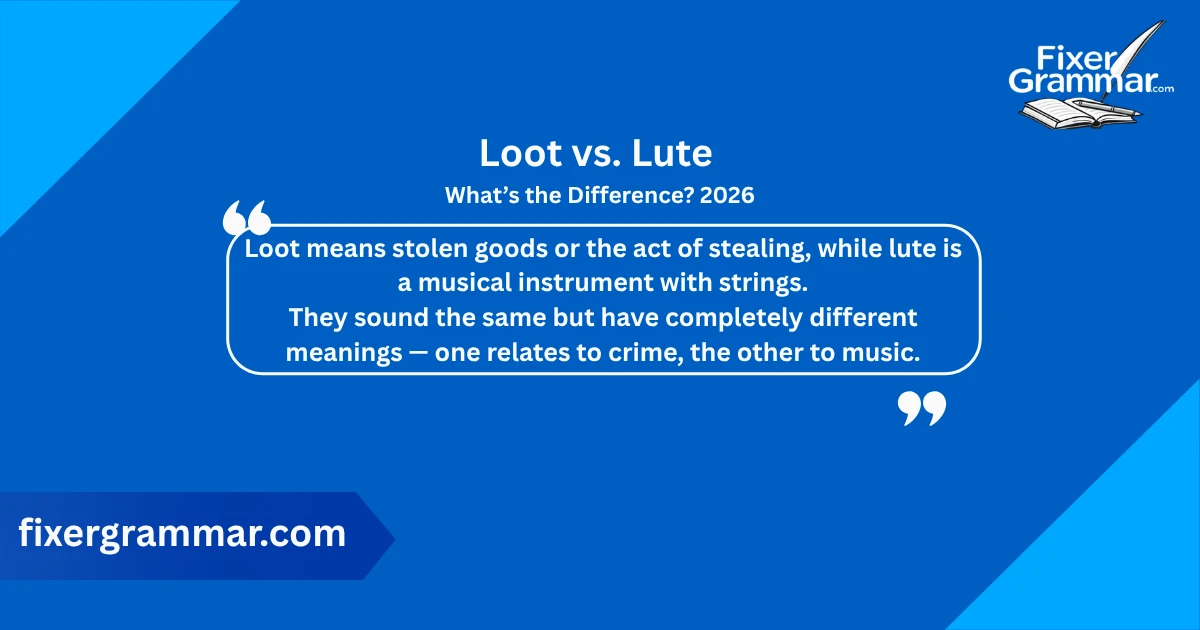
Loot and lute are classic homophones. Both are pronounced /luːt/. Your ears hear the same sound. Only your eyes — and context — reveal the difference.
Loot Meaning — Stolen Goods, Slang Money, and the Act of Plunder
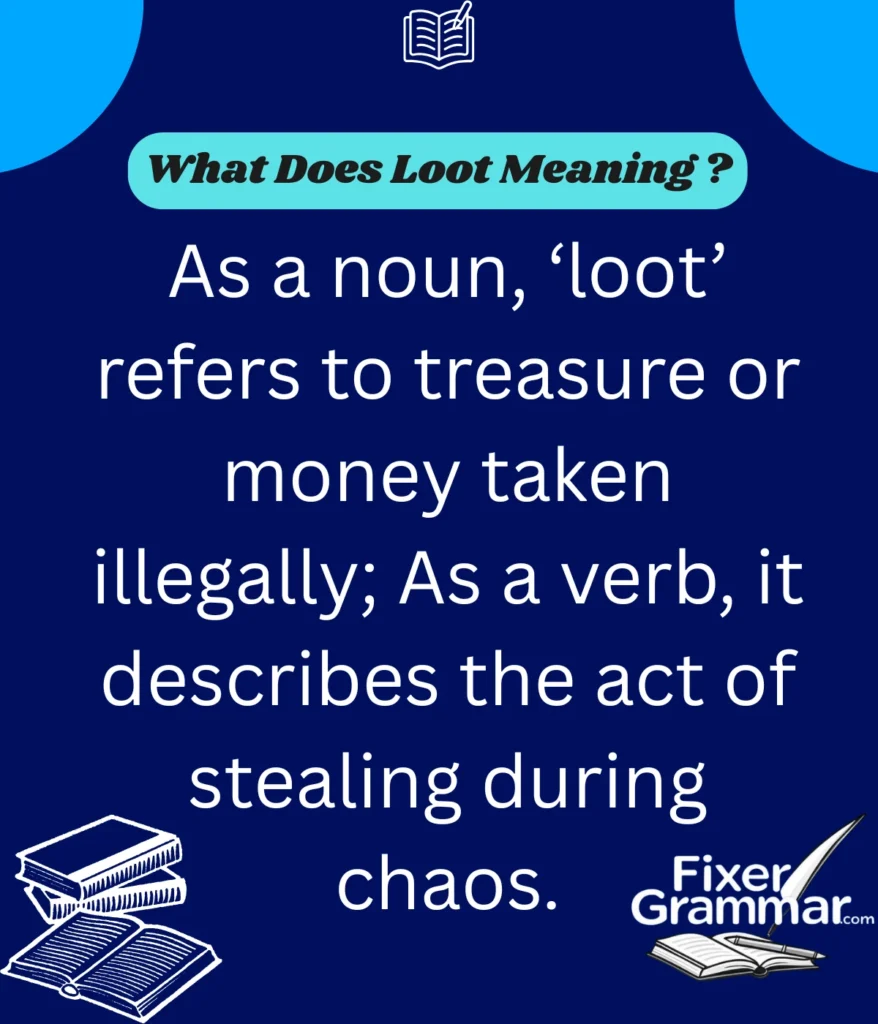
Loot works as both a noun and a verb.
As a noun, it means stolen goods, treasure, or valuables taken by force. As a verb, it means to steal or plunder — usually during war, riots, or chaos.
Usage Examples of “Loot”
| Usage | Example |
|---|---|
| Noun | The pirates divided their loot after the raid. |
| Verb | Rioters began to loot stores during the blackout. |
| Slang | He spent his loot on new sneakers. |
The word loot comes from the Hindi word lūṭ, meaning “to plunder.” It entered English during British colonial times in India in the early 19th century.
More Posts:When I Can or When Can I – Which Is Correct? 2026
Lute Meaning — The Ancient Stringed Instrument With a Rich History
A lute is a plucked stringed instrument with a pear-shaped wooden body, a fretted neck, and a warm, delicate sound.
It originated from the Arabic word al-ʿūd, meaning “wood.” It spread through the Middle East, North Africa, and entered Europe during the medieval period.
Quick lute facts:
- By the 1500s, the lute was the most popular household instrument in Europe
- Kings, poets, and composers all celebrated it
- A person who plays the lute is called a lutenist
- The lute is considered a direct ancestor of the modern acoustic guitar
The lute is always a noun. It never functions as a verb in standard usage. If your sentence involves music, melody, or classical history — lute is your word.
Loot vs. Lute — Side-by-Side Comparison, Common Mistakes & Memory Tricks
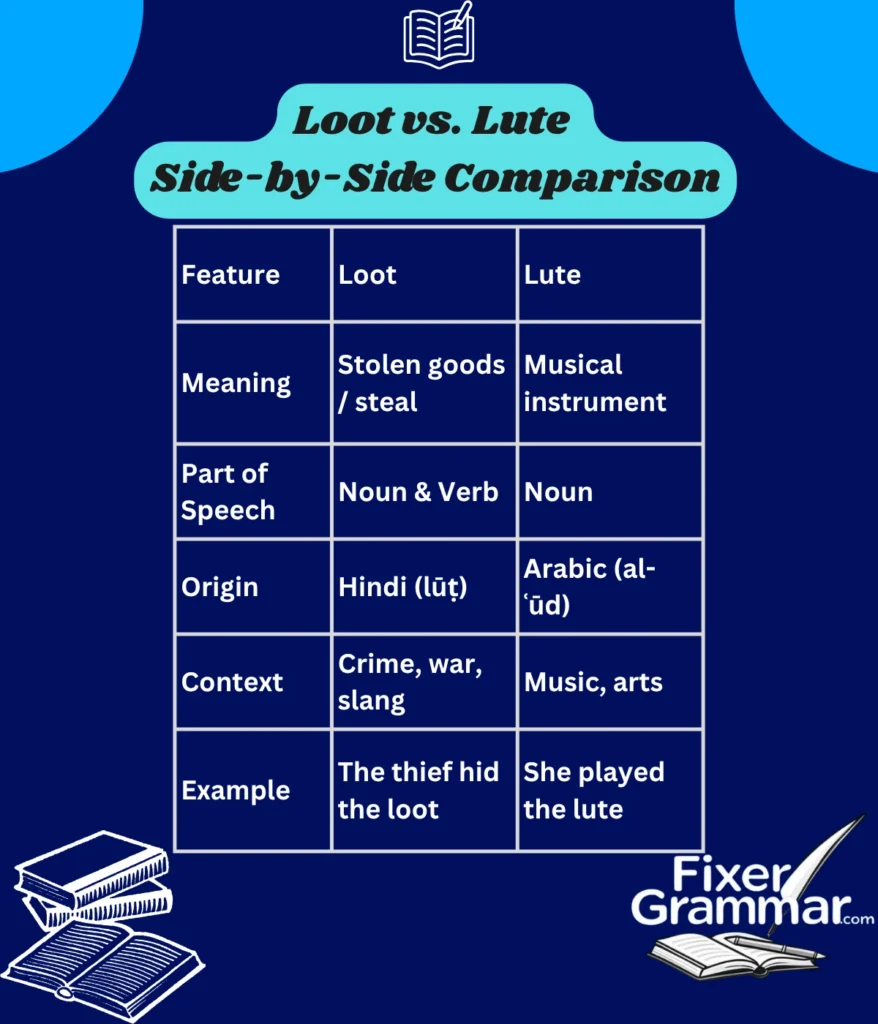
Here’s the clearest breakdown of both words:
Loot vs Lute — Quick Comparison
| Feature | Loot | Lute |
|---|---|---|
| Meaning | Stolen goods / to steal | Musical instrument |
| Part of Speech | Noun & Verb | Noun only |
| Origin | Hindi — lūṭ | Arabic — al-ʿūd |
| Context | Crime, war, gaming, slang | Music, history, arts |
| Example | The thief hid the loot. | She played the lute beautifully. |
The most common mistake people make is typing one while thinking of the other — especially in fast writing or dictation. Spell-check will not catch this error because both words are spelled correctly.
Memory tricks that actually work:
- Loot has double-O — picture two open sacks of stolen gold
- Lute rhymes with flute — both are musical instruments
- Ask yourself: “Is this about theft or music?” — that single question solves it every time
More Posts:Company-Wide or Companywide– Which Is Correct? 2026
Real-World Examples — How to Use Loot and Lute Correctly in a Sentence
Seeing words in context is the fastest way to lock in correct usage.
Loot in sentences:
- Police recovered looted artwork worth millions.
- The soldier carried his loot back to camp.
- “She spent all her loot at the mall” — casual slang, perfectly acceptable.
Lute in sentences:
- The lutenist performed at the royal banquet.
- He repaired the broken strings on his lute before the show.
- Poets of the Renaissance often wrote about the soft sound of a lute.
Wrong — and why it’s wrong:
- ❌ “He strummed the loot gently.” — loot is not an instrument
- ❌ “Thieves luted the warehouse.” — lute is never a verb meaning to steal
One wrong word flips an elegant sentence into nonsense instantly.
FAQs About Loot vs. Lute
What is the difference between loot and lute?
Loot refers to stolen goods or the act of stealing. Lute is a medieval stringed instrument similar to a guitar. They sound identical — /luːt/ — but have completely unrelated meanings. Context is the only way to know which word belongs in a sentence.
What does lute loot mean?
Lute loot is not a standard phrase. When people search it, they’re usually looking to understand the difference between the two words. Lute relates to music and classical history. Loot relates to theft, treasure, or slang money. Using them interchangeably is always incorrect.
Conclusion
Loot and lute are homophones — same sound, completely different meanings. Loot belongs to the world of crime, plunder, and slang. Lute belongs to music, history, and art.
Remember: lute rhymes with flute, and loot has those two O’s like two full bags of stolen gold. Master this simple difference and your writing becomes instantly clearer and more precise.

At FixerGrammar.com, Johnson Isaacs shares easy grammar tips, clear examples, and helpful guidance to make writing simple, smooth, and mistake-free.
Related Posts