Most people use these two words as if they mean the same thing. They don’t — and knowing the difference makes your writing clearer, sharper, and more professional.
What Do Recurring and Reoccurring Mean?
These two words look almost identical. But they carry different meanings, and the distinction comes down to one thing: frequency and pattern.
Understanding both starts with their roots.
Definition of Recurring
Recurring comes from the Latin word recurrere — meaning “to run back.” It describes something that happens repeatedly at regular or expected intervals.
Think of your monthly phone bill. It shows up every month, like clockwork. That’s a recurring charge. A recurring event has a built-in rhythm — daily, weekly, monthly, or yearly.
| Recurring Example | Frequency |
|---|---|
| Monthly subscription fee | Every month |
| Weekly team meeting | Every week |
| Annual health checkup | Every year |
| Seasonal allergies | Every spring/fall |
More Posts:Hail vs Hale — What’s the Real Difference? 2026
Definition of Reoccurring
Reoccurring comes from the prefix re- (meaning “again”) + occur (meaning “to happen”). It simply means something happens again — but not necessarily on a schedule.
A software glitch that crashes your app twice in six months is reoccurring. It happened more than once — but there’s no pattern to predict when it’ll strike next.
Reoccurring signals repetition without rhythm.
Recurring vs. Reoccurring: The Core Difference
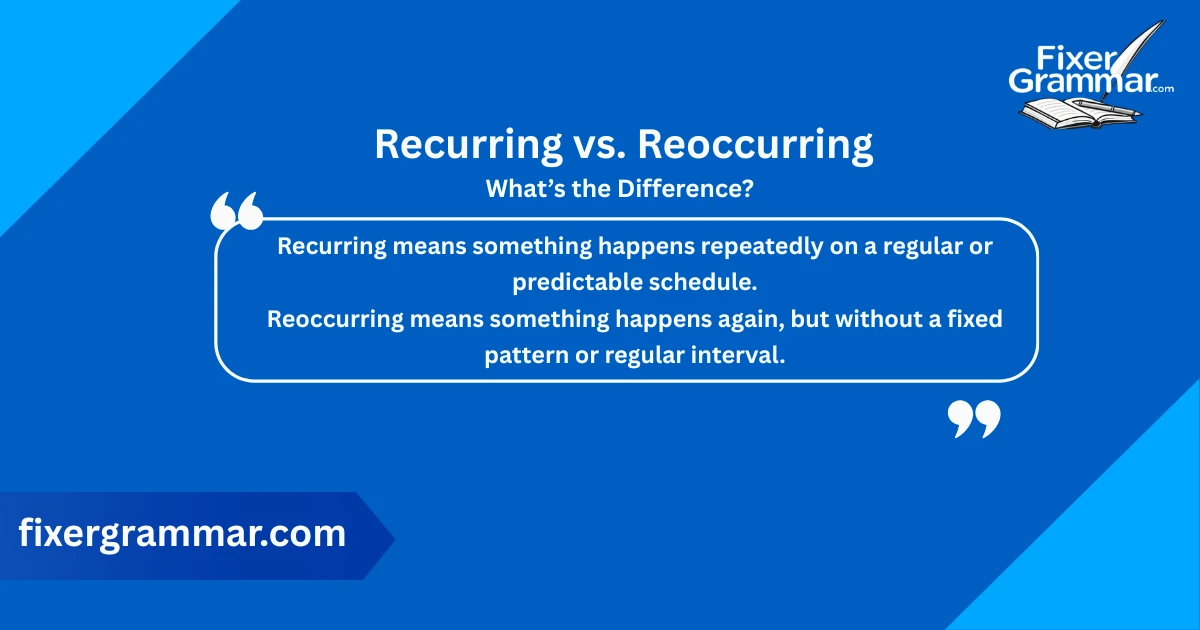
- Recurring = patterned, predictable, scheduled repetition
- Reoccurring = happens again, but irregular or random
| Feature | Recurring | Reoccurring |
|---|---|---|
| Pattern | Yes — predictable | No — random |
| Schedule | Follows a set interval | No set interval |
| Example | Weekly meeting | Unexpected server error |
| Formal Writing | Preferred | Less common |
The Frequency and Pattern Factor
Pattern is everything here. If you can mark something on a calendar and expect it to show up — that’s recurring. If something surprises you by happening again — that’s reoccurring.
According to Merriam-Webster, recur means “to occur again periodically or repeatedly.” The word reoccur is defined simply as “to happen again” — with no mention of regularity.
All recurring events are reoccurrences — but not all reoccurrences are recurring.
A Simple Rule to Remember the Difference
Ask yourself one question: “Can I put this on a calendar?”
- If yes → use recurring
- If no → use reoccurring
Your gym membership renews every month? Recurring. A random headache you got twice this year? Reoccurring. This single test cuts through the confusion every time.
More Posts:Trawling vs Trolling – What’s the Difference ? 2026
Real-World Examples of Recurring and Reoccurring
Recurring in Everyday Use
Recurring fits anywhere a repeated, expected pattern exists.
- “She set a recurring reminder every Monday morning.”
- “The company charges a recurring annual fee of $99.”
- “His recurring dream about flying returned every few weeks.”
- “Flooding is a recurring problem in that neighborhood every rainy season.”
These events have a predictable cycle. You can anticipate them.
Reoccurring in Everyday Use
Reoccurring fits situations where something happens again — but unpredictably.
- “The Wi-Fi issue reoccurred after the technician left.”
- “Her back pain reoccurred months after treatment.”
- “The same spelling error reoccurred in three different documents.”
- “The data breach risk reoccurred when the old software was reinstalled.”
No schedule. No pattern. Just — it happened again.
When to Use Recurring vs. Reoccurring in Writing
Using Recurring in Professional and Formal Writing
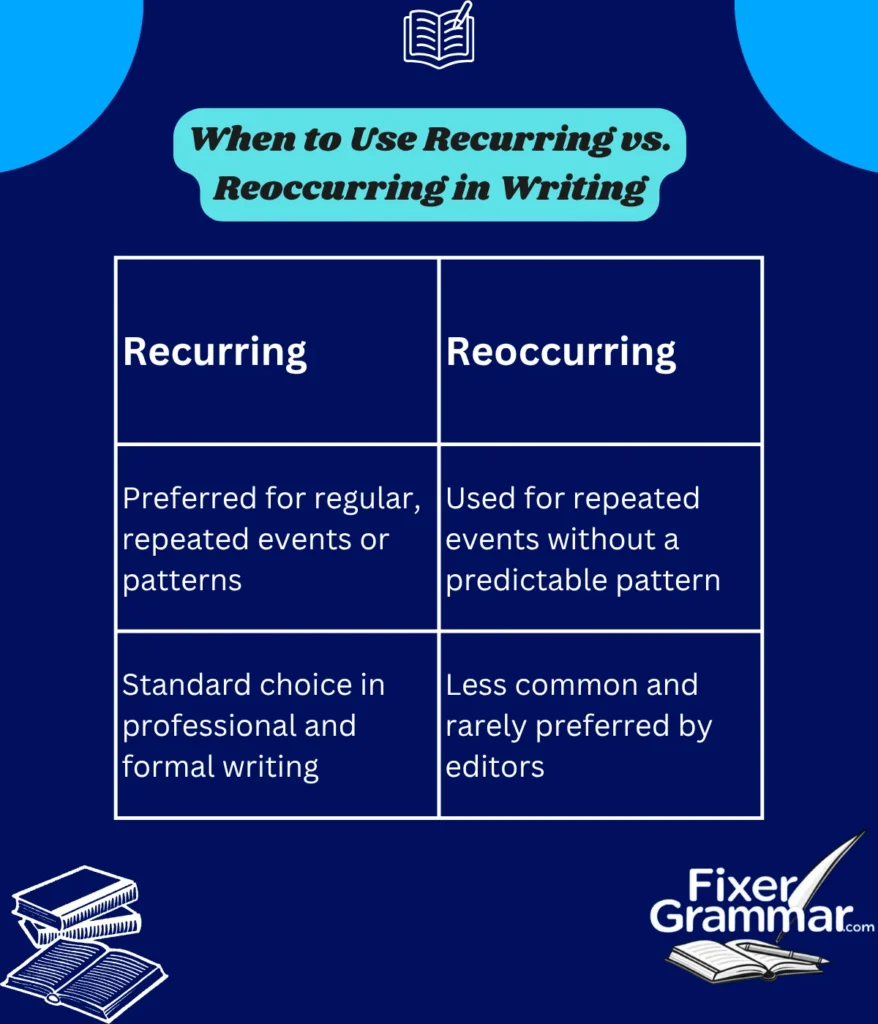
In business writing, reports, and professional emails, recurring is almost always the right choice. It’s more precise, more widely accepted, and preferred by most editors and style guides.
Use recurring when writing about:
- Recurring revenue in financial reports
- Recurring meetings in project management
- Recurring symptoms in medical documentation
- Recurring themes in academic writing
According to a Google Ngram analysis, recurring appears roughly four to five times more frequently than reoccurring in published English writing. It’s simply the dominant term.
Reoccurring isn’t wrong. But in formal settings, it can sound informal or imprecise. Save it for casual descriptions where something simply happened again.
Frequently Asked Questions
Is “reoccurring” a real word?
Yes, reoccurring is a real, valid English word. It simply means something that happens again. It’s less formal than recurring and used less often in professional writing, but it’s grammatically correct.
Can I use recurring and reoccurring interchangeably?
Technically, many dictionaries treat them as synonyms. But for precision — especially in formal writing — they’re not identical. Recurring implies regularity. Reoccurring does not.
Which is more correct — recurring or reoccurring?
Both are correct. However, recurring is the more widely accepted and preferred term in standard writing. If you’re unsure, recurring is almost always the safer choice.
What is a recurring event?
A recurring event is something that happens repeatedly at regular intervals — like a weekly meeting, a monthly bill, or an annual checkup. It follows a predictable cycle.
What does reoccurring mean in a medical context?
In medicine, reoccurring (or more commonly, recurrence) describes a condition or symptom that returns after a period of improvement. For example, a reoccurring infection is one that comes back after treatment — though doctors typically prefer the term recurrence in clinical documentation.
Does British English use these words differently?
The distinction between recurring and reoccurring applies the same way in both British and standard English. The difference isn’t regional — it’s about pattern versus randomness, regardless of where you are.
The Bottom Line
Recurring vs. reoccurring comes down to one thing: pattern.
Use recurring when something happens on a regular, predictable schedule. Use reoccurring when something happens again — but without a set rhythm.
When in doubt, ask: “Is this something I can schedule?” If the answer is yes, go with recurring. You’ll sound cleaner, clearer, and more professional every time.

At FixerGrammar.com, Johnson Isaacs shares easy grammar tips, clear examples, and helpful guidance to make writing simple, smooth, and mistake-free.
Related Posts