Knowing which word to use makes your writing sharper, more vivid, and more accurate.
What Do “So Do I” and “So Am I” Actually Mean?
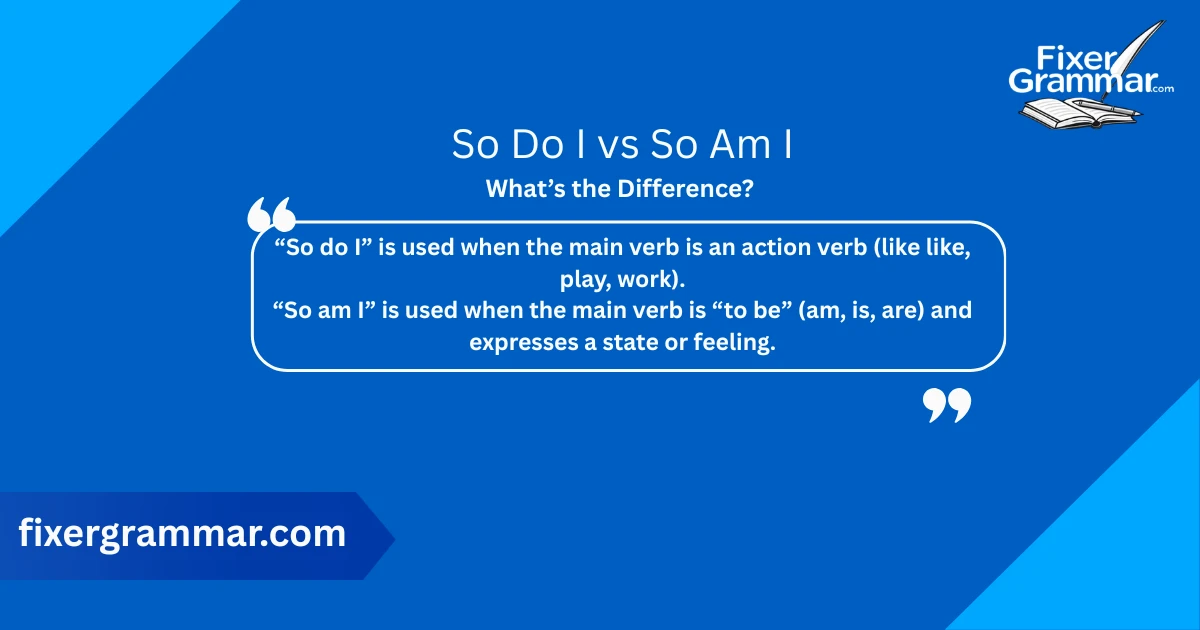
Both phrases express agreement with what someone just said. They’re short, natural responses that replace repeating a full sentence.
Think of them as elegant shortcuts. Instead of saying “I also love pizza,” you simply say “so do I.” Instead of “I am also tired,” you say “so am I.”
The verb in the original statement decides which one you use.
| Phrase | Used With | Example Response |
|---|---|---|
| So do I | Action verbs | “I love coffee.” → “So do I.” |
| So am I | Verb to be | “I’m tired.” → “So am I.” |
When to Use “So Do I” — Agreeing with Actions
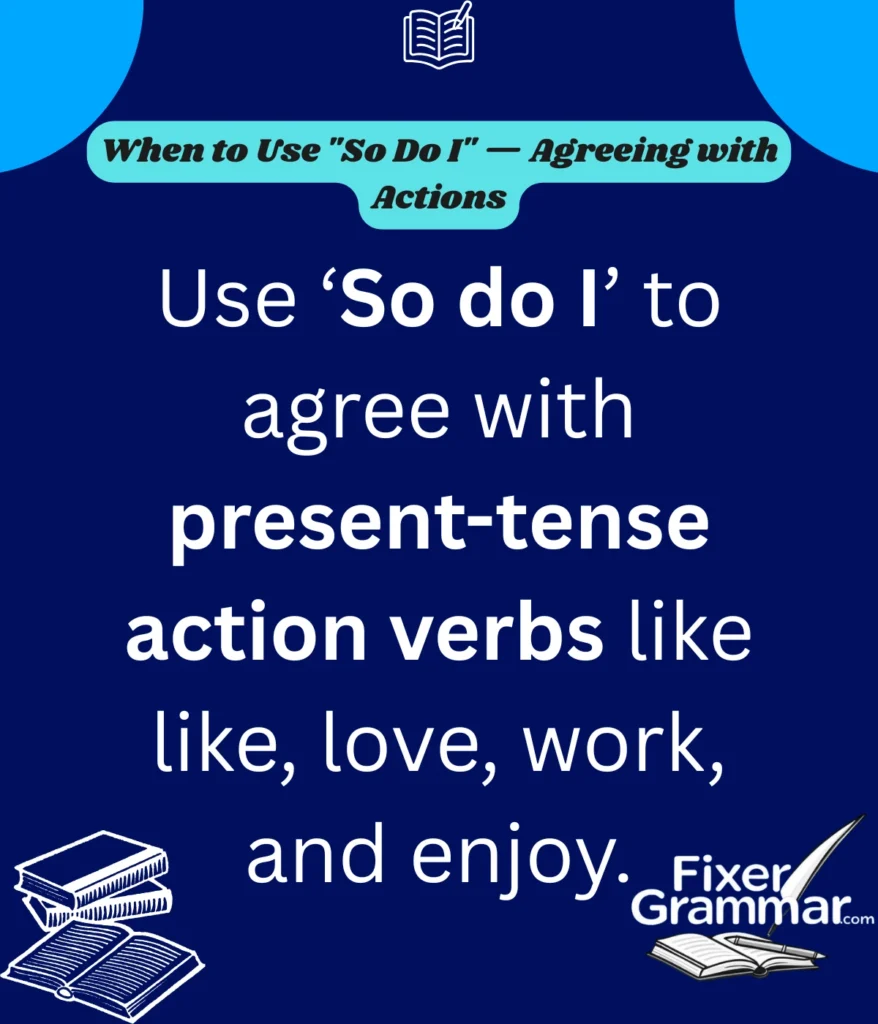
“So do I” follows any statement that uses an action verb in the present tense — verbs like like, love, play, work, enjoy, eat, study.
The hidden logic: “I like music” secretly means “I do like music.” The do is always there. So your agreement mirrors it.
Quick examples:
- “I work from home.” → So do I.
- “I enjoy long walks.” → So do I.
- “I study at night.” → So do I.
More Posts:Elegy vs. Eulogy – What’s the Real Difference? 2026
When to Use “So Am I” — Agreeing with States & Feelings
“So am I” follows statements built on am, is, or are. These sentences describe a state, feeling, condition, or trait — not something you do, but something you are.
If someone says “I’m nervous,” they’re describing a state. You respond with “so am I” because the verb is to be, not an action.
Quick examples:
- “I’m excited about the trip.” → So am I.
- “I’m ready.” → So am I.
- “I’m not feeling well.” → Neither am I.
So Do I vs So Am I — Side-by-Side Comparison
What’s the fastest way to pick the right phrase? Ask yourself: is the verb an action or a state of being?
Doing = Do. Being = Am. That’s the whole rule.
| Statement | Verb Type | Correct Agreement |
|---|---|---|
| I play guitar | Action | So do I |
| I’m happy | State (to be) | So am I |
| I enjoy reading | Action | So do I |
| I’m nervous | State (to be) | So am I |
| I’m learning Spanish | To be + -ing | So am I |
| I work on weekends | Action | So do I |
Why does “I’m learning” use “so am I” and not “so do I”? Because the structure is am + verb-ing. The to be verb controls the agreement, not the action that follows it.
Other Agreement Patterns You Should Know
Once you understand so do I vs so am I, the pattern extends naturally to other tenses.
- Past tense: “I watched that film.” → So did I.
- Future tense: “I’ll attend the meeting.” → So will I.
- Perfect tense: “I’ve been to Paris.” → So have I.
- Ability: “I can swim.” → So can I.
- Negative: “I’m not ready.” → Neither am I.
The rule stays the same across all tenses — match the auxiliary verb from the original statement.
More Posts:Fair vs Good – What’s the Difference ? 2026
FAQ‘s About So Do I vs So Am I
What is the difference between so do I and so am I?
“So do I” agrees with action verbs like like, play, work. “So am I” agrees with the verb to be — when someone says “I am” something. The verb in the original sentence decides which phrase fits.
Can I just say “me too” instead?
Yes — “me too” works in casual speech and means the same thing. However, “so do I” and “so am I” are grammatically precise and preferred in formal or professional settings.
Is there a difference between British and American usage here?
Both forms are used the same way globally. The grammar rule doesn’t change by region — to be always takes “am,” and action verbs always take “do.”
When do I use “neither do I” vs “neither am I”?
Use “neither do I” after negative action verb statements. Use “neither am I” after negative to be statements. Example: “I’m not hungry.” → Neither am I.
Does tense change the rule?
Yes. “So do I” is present tense only. For past, use “so did I.” For future, use “so will I.” Always mirror the tense of the original statement.
Conclusion
The difference between so do I vs so am I comes down to one question — is the verb an action or a form of to be? Action verb → so do I. State of being → so am I. Keep that single rule in mind, and both phrases will come naturally in any conversation.

At FixerGrammar.com, Johnson Isaacs shares easy grammar tips, clear examples, and helpful guidance to make writing simple, smooth, and mistake-free.
Related Posts