Both die and dice relate to the same object, both appear in the same context, and both are widely understood in casual speech.
One word follows strict grammar. The other follows common habit.
What Does “Die” Mean? (The Singular Form)
A die is one small cube with six faces. Each face shows a number from 1 to 6 using dots called pips. You use it in board games, casino games, and probability exercises.
The word comes from the Latin datum, meaning “something given.” It passed through Old French as dé, then entered Middle English as die. One important note — in manufacturing, die also refers to a cutting or shaping tool. In that industry, the plural is dies, not dice.
Example sentences using “die” correctly:
- She rolled a die and got a six.
- Only one die is needed for this game.
- The six-sided die landed on three.
More Posts:Ageing vs. Aging — What’s the Difference ? 2026
What Does “Dice” Mean? (The Plural Form)
Dice refers to two or more of those same cubes. It is an irregular plural, meaning it does not simply add an “s.” Just like mouse becomes mice, die becomes dice.
According to the Oxford Dictionary, dice is now accepted as both singular and plural in modern standard English — meaning “throw the dice” can refer to one or more than one cube. However, formal writing still uses die for singular.
Example sentences using “dice” correctly:
- He shook the dice and tossed them across the board.
- The game requires two dice to play.
- She bought a new set of dice for game night.
Die vs Dice: Key Differences, Usage Rules, and Common Mistakes
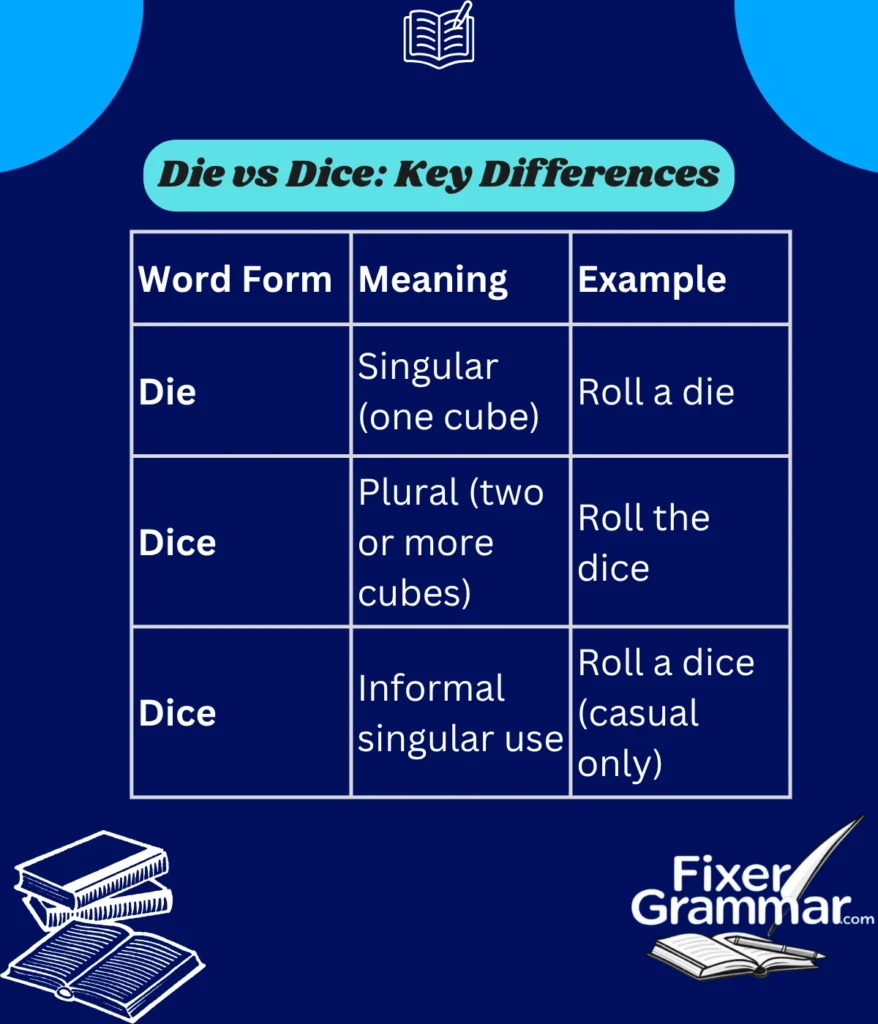
| Word Form | Meaning | Example |
|---|---|---|
| Die | Singular (one cube) | Roll a die |
| Dice | Plural (two or more cubes) | Roll the dice |
| Dice | Informal singular | Roll a dice (casual only) |
Quick memory trick: Dice rhymes with mice. Both are plural. That simple rhyme will keep you from making the error.
Verb agreement matters too
- Say “the die is” when referring to one.
- Say “the dice are” when referring to more than one.
✅ “The die is on the table.” ❌ “The dice is on the table.” (if referring to one)
When to Use “Die” vs “Dice”: Formal, Informal, and Gaming Contexts
Context decides everything. The right word depends on where and how you are writing.
| Context | Preferred Form |
|---|---|
| Academic writing | Die (singular) |
| Game rulebooks | Die (singular) |
| Casual conversation | Dice (accepted for both) |
| Online gaming forums | Dice (universal) |
| Casino / gambling | Dice (standard) |
The practical rule: When it matters — exams, formal writing, rulebooks — use die for one. Everywhere else, dice works fine.
Famous Idioms and Phrases Using “Die” and “Dice”
The English language has locked both words into powerful everyday phrases. These idioms do not change — they always use the original form.
“The die is cast” This phrase means a decision has been made and cannot be reversed. It is attributed to Julius Caesar when he crossed the Rubicon River in 49 BCE. The expression “the die is cast” preserves the older singular form, reflecting when die was the only acceptable singular.
“No dice” This means a refusal or failure — like saying “no luck” or “it didn’t work.” It became popular in early 20th-century American slang.
“Roll of the dice” Used to describe any action with an unpredictable outcome. You take a chance. The result is unknown.
More Posts:Thus Far vs So Far — What’s the Difference ? 2026
FAQ’s About Die vs Dice
Is it a die or dice?
A die is the grammatically correct singular form. “A dice” is widely used in casual speech but is considered incorrect in formal or academic writing. In British English, “die” is still strongly preferred even in everyday use, while informal contexts everywhere have largely shifted toward “dice” for both forms.
Conclusion
The difference between die and dice is small, but it matters for clear and professional writing.
Use “die” when referring to a single cube, and “dice” when talking about two or more. While modern usage accepts “dice” in casual contexts, formal writing still prefers “die” for accuracy.

At FixerGrammar.com, Johnson Isaacs shares easy grammar tips, clear examples, and helpful guidance to make writing simple, smooth, and mistake-free.
Related Posts