Mixing them up changes your meaning entirely — so knowing which word fits where matters.
What Is a Minuet?
A minuet is a slow, graceful dance performed in triple meter (3/4 time). It originated in France around the 1650s and quickly became the defining dance of European royal courts.
The word comes from the French menuet, derived from menu, meaning small or delicate — a direct reference to the dance’s small, precise steps.
Key musical characteristics of a minuet:
- Time signature: always 3/4
- Tempo: moderate and elegant, never rushed
- Structure: follows ABA form — main section, contrasting section, main section repeated
- Composers: Bach, Mozart, and Beethoven all wrote famous minuets
Mozart embedded minuets inside symphonies. Bach used them in keyboard suites. Even today, orchestras perform minuets as part of Baroque and Classical repertoire.
More Posts:Full Proof or Foolproof — What’s the Difference ? 2026
What Is a Minute?
Minute carries two distinct meanings depending on how you pronounce it.
As a time unit (pronounced MIN-it): one minute equals exactly 60 seconds. You use it in schedules, timers, meeting agendas, and everyday conversation.
As an adjective (pronounced my-NOOT): minute means extremely small, precise, or detailed. This meaning appears most in scientific, legal, and academic writing.
| Pronunciation | Meaning | Example |
|---|---|---|
| MIN-it | Unit of time | “Wait a minute.” |
| my-NOOTT | Tiny or precise | “A minute difference in dosage.” |
| my-NOOT | Musical dance form | “Bach’s Minuet in G.” |
Common minute phrases in everyday language:
- Just a minute — asking someone to wait
- Minute details — very small, precise points
- To the minute — perfectly on time
Minuet vs Minute – Key Differences at a Glance
| Feature | Minuet | Minute |
|---|---|---|
| Meaning | Classical dance / musical form | Time unit / tiny detail |
| Origin | French menuet (17th century) | Latin minūtus (to make small) |
| Pronunciation | my-NOOT | MIN-it (time) / my-NOOT (adjective) |
| Part of Speech | Noun only | Noun and adjective |
| Context | Music, dance, cultural history | Time, science, everyday speech |
| Plural | minuets | minutes |
Both words actually share a Latin root tied to the idea of smallness — minuet through French court culture, minute through medieval timekeeping.
More Posts:Continuous vs Continous — What’s the Difference ? 2026
How to Use Minuet and Minute Correctly in a Sentence
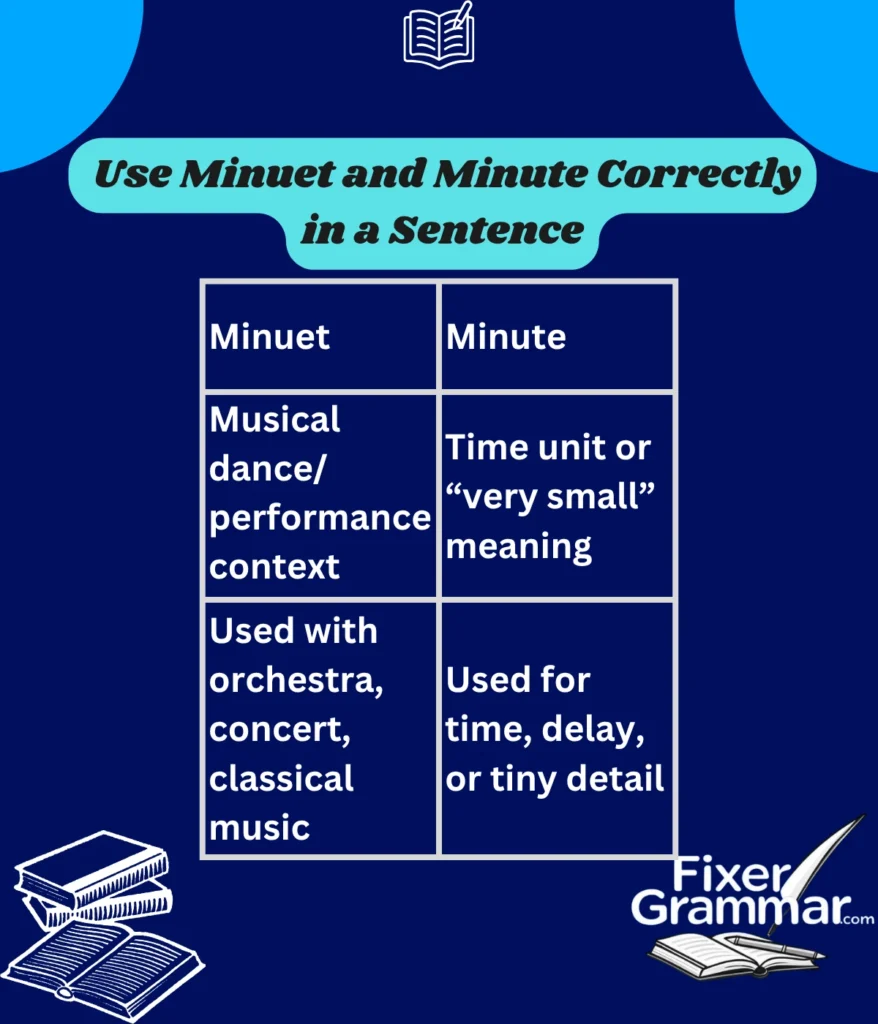
Using minuet correctly:
“The orchestra opened the concert with a minuet from Bach’s French Suite.” → Context clue: orchestra, concert, Bach — all point to musical repertoire. Minuet is the right word.
“Couples performed a formal minuet at the historical reenactment.” → Context clue: formal dance, historical — minuet fits perfectly.
Using minute correctly:
“She asked for one minute before answering the question.” → Context clue: asked, wait, time — minute as a time unit.
“The lab report noted minute traces of carbon in the sample.” → Context clue: lab report, traces — minute as an adjective meaning tiny.
Using both in one sentence:
“The conductor announced the minuet, and the performance started exactly one minute later.” → This shows how naturally the two words can coexist — different meanings, zero overlap.
Quick domain-anchor rule:
If you see words like suite, composer, score, trio, movement — choose minuet. If you see words like clock, wait, meeting, seconds, detail — choose minute.
Quick Tips to Remember the Difference
Getting these two words right becomes effortless once you have the right memory hooks.
Mnemonic: “A minuet moves neatly — a minute measures quickly.”
Visual cues:
- Picture a ballroom dancer → minuet
- Picture a clock or timer → minute
Anchor word lists:
- Suite, trio, composer, Baroque, movement, score → always minuet
- Clock, wait, seconds, meeting, detail, tiny → always minute
Pronunciation test:
Say it out loud. If you’re saying my-NOOT in a time context, stop — you likely need MIN-it. Articulating the word often catches the error before it lands on the page.
Spellcheck warning: Neither word flags as a spelling error in any document editor. You must rely on context — no software will catch this mistake for you.
FAQs About Minuet vs Minute
What is the difference between minuet and minute?
Minuet is a classical dance and musical form in 3/4 time. Minute is either a 60-second unit of time or an adjective meaning extremely small.
Are minuet and minute pronounced the same way?
No. Minuet is pronounced my-noo-ET. Minute (time) is MIN-it, while minute (tiny) is my-NOOT.
Can minute ever refer to the dance?
Never. Minute does not name the musical movement. Only minuet correctly identifies the dance or musical form.
Which word appears more often in everyday writing?
Minute dominates general writing by a wide margin. Minuet appears almost exclusively in musical, historical, and performance contexts.
Will spellcheck catch if I use the wrong word?
No. Both are valid spellings, so spellcheck ignores the error. You must read for context to catch the mistake yourself.
Is the usage different in British and American English?
No. Both varieties use minuet and minute identically in meaning. Only regional pronunciation may vary slightly.
Can minuet be used metaphorically?
Yes — carefully. Writers sometimes use minuet to describe a ritualized, back-and-forth exchange between people. Always provide clear context so readers recognize the figurative meaning.

At FixerGrammar.com, Johnson Isaacs shares easy grammar tips, clear examples, and helpful guidance to make writing simple, smooth, and mistake-free.
Related Posts