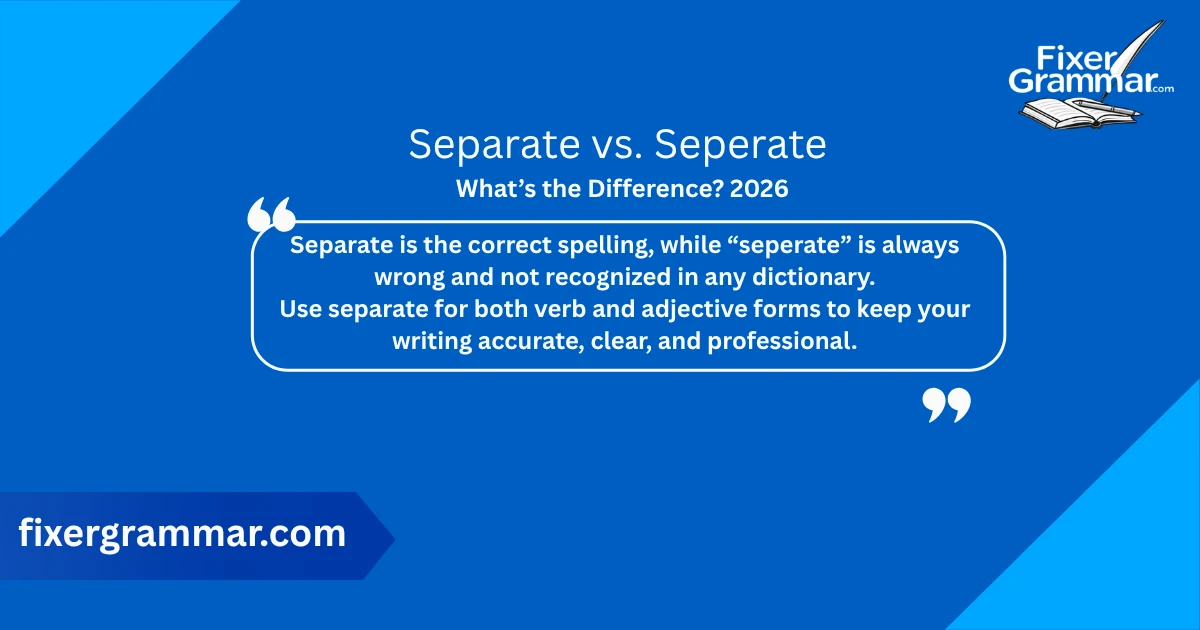
Every major dictionary — Merriam-Webster, Oxford, Cambridge — recognizes only separate as the valid spelling. No exceptions.
The Correct Spelling — “Separate” — and What It Means
The correct spelling is always separate — with an “a” in the middle, not an “e.”
It is both an action word and a describing word, depending on how you use it.
Etymology and Latin Roots of “Separate”
The word comes from the Latin separatus, meaning “set apart.” It passed through Middle English as separaten before settling into the modern spelling we use today.
Understanding the Latin root helps. The core is “par” — meaning “to part” or “to divide.” That root keeps the “a” alive in the spelling.
How “Separate” Works as a Verb and an Adjective
Separate does two jobs in a sentence — it describes an action and describes a quality.
More Posts:Do Not vs. Don’t – What’s the Real Difference? 2026
Why Do So Many People Write “Seperate” Instead of “Separate”?
This mistake is extremely common. According to Google Trends data, hundreds of thousands of people search for “seperate” every single year — proof that this confusion runs deep.
So what causes it?
The Role of Phonetics and Pronunciation
When people say the word out loud fast, it sounds like SEP-ret or SEP-er-it. The middle “a” sound gets swallowed. So naturally, people write what they hear — and write it wrong.
This is called a phonetic spelling error — one of the most common sources of misspelling in English.
The “Illusion of Truth” — Seeing the Wrong Spelling Too Often
Linguists call it the illusion of truth effect. When you see a wrong word repeated enough times — on social media, in texts, in emails — your brain slowly accepts it as normal.
The more you see “seperate,” the more it looks right. That’s exactly why this mistake keeps spreading.
| Function | Meaning | Example |
|---|---|---|
| Verb | To divide or split apart | “Please separate the files by date.” |
| Adjective | Distinct, not joined | “They work in separate departments.” |
The spelling never changes regardless of how you use it.
Easy Memory Tricks to Never Misspell “Separate” Again
Spelling rules are easier to remember when tied to a trick. These three methods work fast and stick long.
The “A Rat” Mnemonic
Look closely at the word: sep-A RAT-e
There is literally a rat hiding inside “separate.” Once you see it, you cannot unsee it. This single trick has helped millions of students and writers lock in the correct spelling permanently.
Syllable Breakdown — Sep-a-rate
Say it slowly: Sep — a — rate.
Three clear syllables. The middle one is “a” — short, clean, unmistakable. Pronouncing it this way while writing trains your muscle memory to spell it right every time.
Linking It to the Root Word “Par”
Think of “par” as in “to part ways” or “to divide.” Separate means to set apart — and the root par sits right in the middle of the word.
Connecting meaning to spelling is one of the most powerful orthographic memory techniques used by language experts.
More Posts:Elegy vs. Eulogy – What’s the Real Difference? 2026
Real-World Examples of “Separate” Used Correctly
Seeing a word used correctly across different contexts makes it easier to internalize. Here are practical examples across real settings.
In Academic Writing
Correct spelling in academic work is not optional — it directly affects how your work is graded.
- “The study used separate control groups for each variable.”
- “Students submitted separate reports for each module.”
In Professional and Business Communication
A single misspelling in a business document can quietly signal carelessness to a reader.
- “Please send separate invoices for each project.”
- “The legal team filed separate motions for both cases.”
In Everyday Speech
- “We took separate flights to save money.”
- “They went their separate ways after college.”
FAQs — Separate vs. Seperate
Why is “seperate” wrong?
It is a misspelling with no dictionary recognition. The correct form is always separate, used as both a verb and adjective.
How can I remember the spelling of “separate”?
Use the “a rat” trick — there’s a rat hiding in sep-a-rat-e. Or break it slowly: sep-a-rate.
Is “seperate” ever acceptable in formal writing?
Never. In any professional, academic, or public-facing document, “seperate” is always an error.
Why do so many people make this mistake?
Because of how the word sounds when spoken quickly. The middle “a” gets dropped in casual speech, leading to a phonetic spelling error.
Does the misuse of “seperate” really matter?
Yes. Even one misspelling can affect how readers judge your attention to detail, especially in business or academic settings.
Conclusion
Separate is always correct. Seperate is always wrong — no exceptions, no regional variations. Use the “a rat” trick, break the word into syllables, and connect it to its Latin root. Small habits like these keep your writing clean, credible, and professional.

At FixerGrammar.com, Johnson Isaacs shares easy grammar tips, clear examples, and helpful guidance to make writing simple, smooth, and mistake-free.
Related Posts