Knowing which word to use makes your writing sharper, more vivid, and more accurate.
What does spatter mean?
Spatter means to scatter liquid in small, fine drops. The action is usually light, gentle, or accidental. Think of rain tapping a window or a few drops of oil jumping from a pan.
The word has roots in Dutch and Low German — spatten, meaning to burst or spout. It has been in the English language since the 16th century.
What does splatter mean?
Splatter is louder, messier, and more dramatic. It means liquid hits a surface in large amounts with force. Think of a water balloon bursting or a can of paint hitting the floor.
Splatter is widely believed to be a blend of splash and spatter — making it naturally more intense than either word alone.
More Posts:Prescribe vs. Proscribe – What’s the Real Difference? 2026
Spatter vs. Splatter — Key Differences Explained
Size, scale, and intensity: the core distinction
The biggest difference comes down to volume and force.
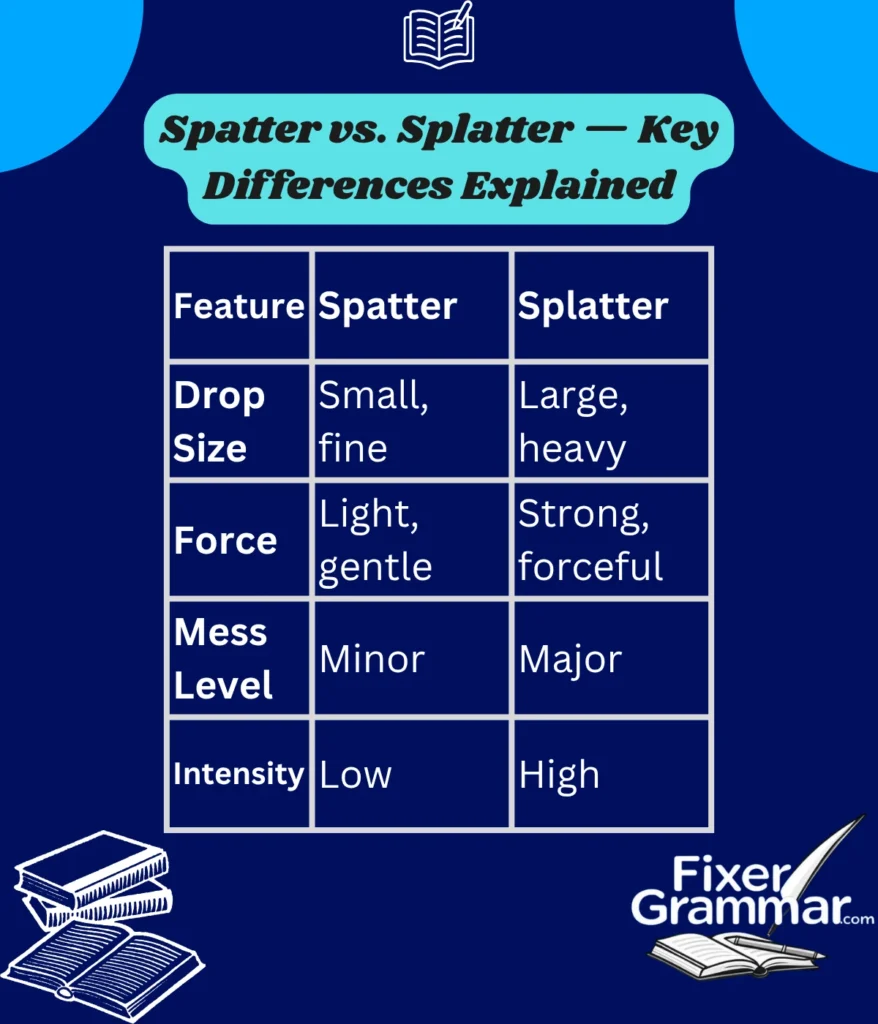
| Feature | Spatter | Splatter |
|---|---|---|
| Drop Size | Small, fine | Large, heavy |
| Force | Light, gentle | Strong, forceful |
| Mess Level | Minor | Major |
| Common Context | Rain, grease, paint mist | Blood, mud, thick paint |
| Intensity | Low | High |
One easy rule to remember:
Small drops spatter. Big messy blobs splatter.
How to Use Spatter and Splatter Correctly
Example sentences using spatter:
- Rain spattered softly against the windshield.
- Grease spattered onto the stovetop while she fried the eggs.
- The brush spattered tiny flecks of white across the canvas.
Example sentences using splatter:
- Mud splattered all over his jeans when the truck drove through the puddle.
- The ketchup bottle burst and splattered the entire counter.
- Red paint splattered across the wall in thick, uneven streaks.
Notice the pattern. Spatter feels controlled or accidental in a small way. Splatter feels explosive and hard to contain.
Synonyms, Antonyms & Related Words
Synonyms for spatter:
- Sprinkle
- Fleck
- Spray lightly
- Dot
- Drizzle
Synonyms for splatter:
- Splash
- Dash
- Scatter
- Smear
- Fling
Antonyms for both:
- Absorb
- Collect
- Contain
- Gather
Semantically related terms that often appear near these words: droplets, residue, liquid dispersion, surface impact, spray pattern, fluid dynamics, mist, burst.
More Posts:Elegy vs. Eulogy – What’s the Real Difference? 2026
Easy Memory Trick: Never Confuse Them Again
Here is one simple trick that works every time.
“SPAT” is in spatter — think of a small spit or speck. Tiny. Controlled. Light.
“SPLAT” is in splatter — think of something hitting the ground hard. Loud. Messy. Big.
If the mess is small → spatter. If the mess is big and dramatic → splatter.
FAQ’s – About Spatter vs. Splatter
Is spatter and splatter the same thing?
No. Spatter involves small, scattered drops while splatter involves larger amounts of liquid spread with more force and mess.
When should I use spatter vs. splatter?
Use spatter for light, fine drops. Use splatter when the liquid hits hard, spreads wide, and makes a bigger mess.
Is splatter more intense than spatter?
Yes. Splatter always implies more volume, more force, and more chaos than spatter.
How are spatter and splatter pronounced differently?
Spatter is pronounced SPAT-er. Splatter is pronounced SPLAT-er. The “spl” in splatter gives it a heavier, more forceful sound — which matches its meaning.
Can spatter and splatter be used interchangeably?
Not precisely. While some people treat them as synonyms, careful writers use spatter for small drops and splatter for large, forceful messes. In British English, the distinction may feel looser, but in standard usage the difference is clear and worth maintaining.
Final Verdict: Spatter or Splatter?
Both words describe liquid going where it shouldn’t — but they are not equal.
Spatter = small, light, fine drops. Splatter = large, forceful, messy spread.
Use the right word and your writing instantly becomes more vivid and precise. Whether you’re writing a recipe, a thriller novel, or a news report — the difference matters.

At FixerGrammar.com, Johnson Isaacs shares easy grammar tips, clear examples, and helpful guidance to make writing simple, smooth, and mistake-free.
Related Posts