The correct spelling depends on one simple rule, and once you know it, you’ll never second-guess yourself again.
What’s the Difference Between Traveling and Travelling?
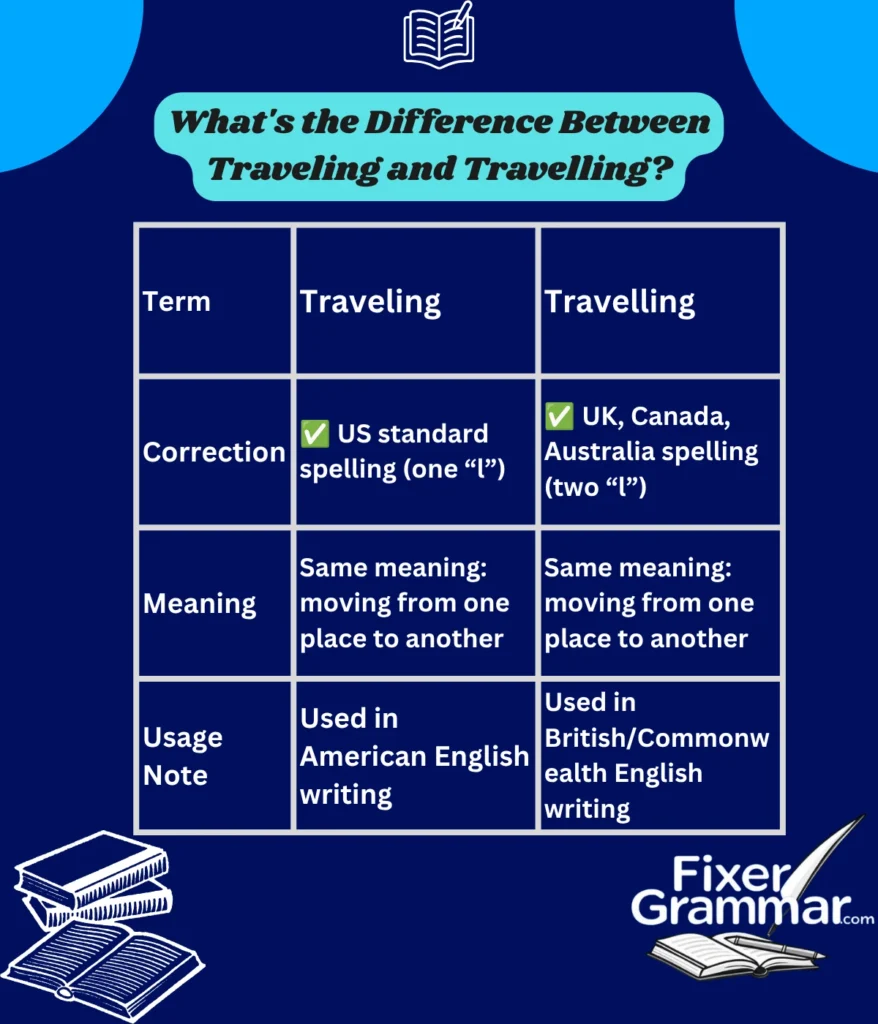
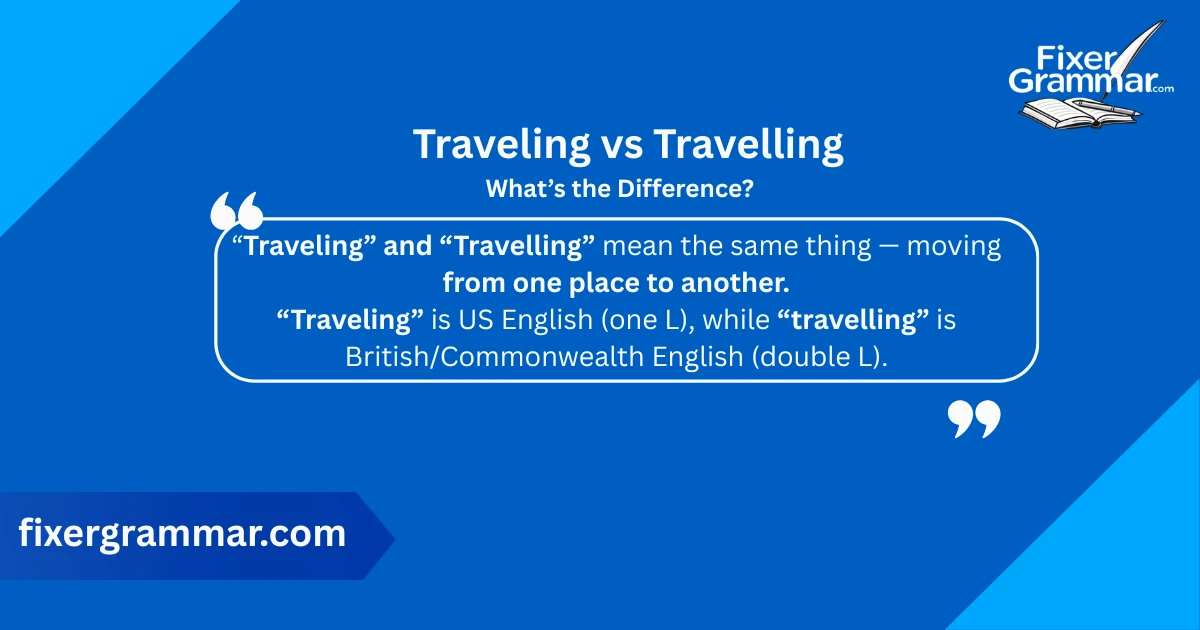
Both words mean exactly the same thing. There’s no difference in meaning, pronunciation, or grammar. The only difference is spelling — and that difference comes down to regional convention.
Traveling (one L) is standard in the US. Travelling (two L’s) is used in the UK, Canada, Australia, and most Commonwealth countries.
The Spelling Rule Behind the Extra “L”
This isn’t random — there’s a clear consonant doubling rule that explains it.
In standard English, you double the final consonant before adding -ing or -ed only when the stress falls on the last syllable of the base word.
Take the word travel — the stress falls on the first syllable: TRAV-el. Since the final syllable is unstressed, you don’t double the “L.”
Why We Write “Traveling” With One L
The rule is straightforward: no stress on the final syllable = no doubling.
| Base Word | Correct Spelling | Stressed Syllable |
|---|---|---|
| travel | traveling | TRAV-el |
| cancel | canceled | CAN-cel |
| model | modeled | MOD-el |
| label | labeled | LA-bel |
All of these follow the same pattern — first syllable stressed, so the consonant stays single.
Words That Do Double the Consonant
When stress falls on the last syllable, the consonant doubles. This is where the rule gets clear:
- admit → admitting (stress on -MIT)
- begin → beginning (stress on -GIN)
- regret → regretting (stress on -GRET)
See the difference? Stress = doubling. No stress = no doubling. That’s the whole rule.
More Posts:Fair vs Good – What’s the Difference ? 2026
Traveling vs Travelling — Side-by-Side Comparison
| Word Form | Standard US Spelling | British/Commonwealth |
|---|---|---|
| Present participle | traveling | travelling |
| Past tense | traveled | travelled |
| Person who travels | traveler | traveller |
The pattern is consistent — every related form follows the same single-L rule.
Which Spelling Should You Use (And When)?
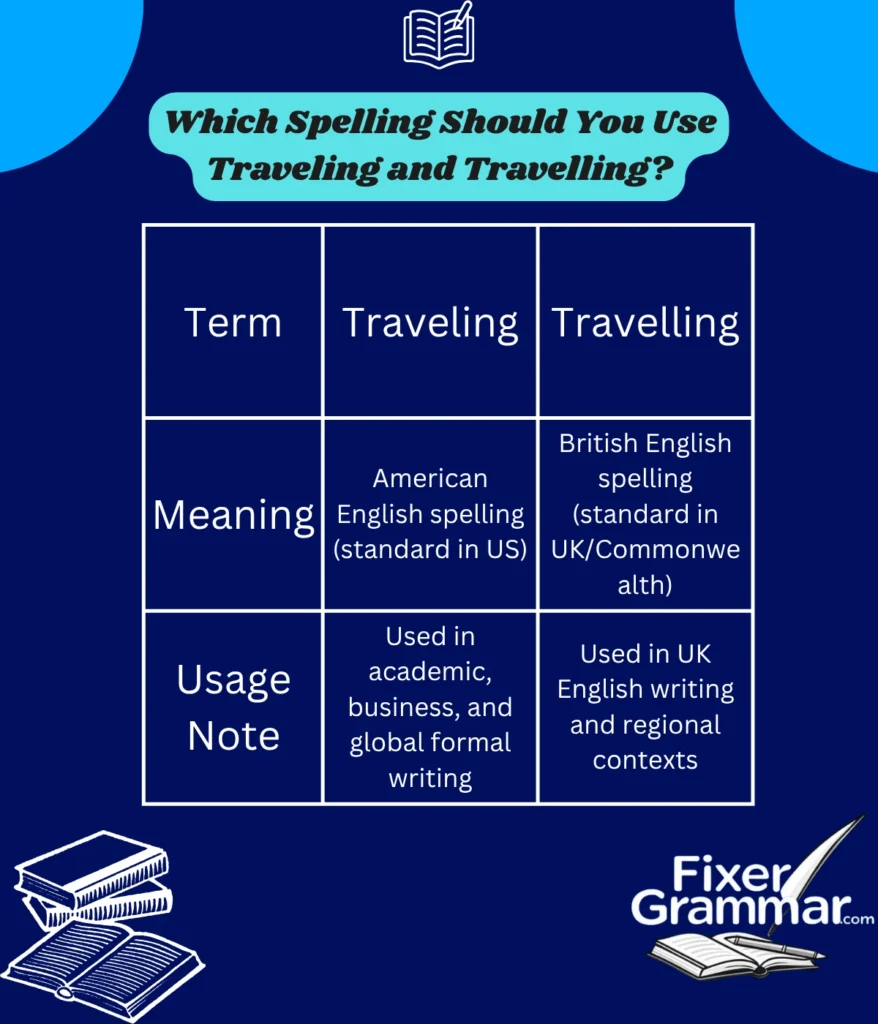
Use traveling in every standard writing context:
- Academic papers (APA, MLA, Chicago all follow this)
- Business emails and reports
- Blog posts and web content
- Social media captions
- Everyday writing
One important rule: Never mix both spellings in the same piece of writing. Pick one and stay consistent throughout.
Other Words That Follow the Same Pattern
Once you understand the rule, these all make sense:
- traveled / traveler ✓
- canceled / canceling ✓
- modeled / modeling ✓
- labeled / labeling ✓
If you see “cancelling” or “modelling” — that’s British spelling. Both are correct in their respective contexts, but for standard US writing, the single-L form is always the right call.
FAQs — Traveling vs Travelling
What is correct, traveling or travelling?
Both are grammatically correct. Traveling (one L) is the standard spelling used in the US, while travelling (two L’s) follows British English conventions used in the UK, Canada, and Australia.
Is traveled or travelled correct?
Traveled is the correct form for standard US writing. The same single-L rule applies to all verb forms — traveled, traveling, traveler.
Why does British English use two L’s?
British English doubles the final consonant in words like travel regardless of stress placement. It’s a different spelling tradition — neither version is wrong, just regional.
Can I use “travelling” in a US school essay?
It’s best to avoid it. Most US style guides and teachers expect traveling with one L. Using two L’s may be flagged as a spelling error even though it’s technically valid in British English.
Conclusion
The rule is simple — traveling is the correct, standard spelling for everyday US writing. One L, every time. The double-L form isn’t wrong, but it belongs to a different regional spelling system. Stick with traveling, stay consistent, and you’ll never have to second-guess this word again.

At FixerGrammar.com, Johnson Isaacs shares easy grammar tips, clear examples, and helpful guidance to make writing simple, smooth, and mistake-free.
Related Posts