These two spellings confuse writers every day. Let’s clear it up once and for all — simply and clearly.
What Do Analog and Analogue Actually Mean?
Both words trace back to the Greek word analogia, meaning proportion or relationship. The core meaning has never changed across centuries or regions.
The word carries two distinct uses in modern English:
- Technological meaning — A system or signal that changes continuously, not in steps. Example: an analog clock uses moving hands to show time, unlike a digital display.
- General meaning — Something that closely resembles or corresponds to something else. Example: “This compound is an analogue of insulin.”
| Term | Spelling Origin | Primary Use | Example |
|---|---|---|---|
| Analog | Simplified (U.S.) | Tech, engineering, everyday writing | Analog signal, analog circuit |
| Analogue | French-influenced | Science, chemistry, academic writing | Insulin analogue, structural analogue |
Both words function as a noun and an adjective. The meaning never changes — only the spelling does.
The Story Behind the Two Spellings
The word entered English from French around 1800, spelled analogue — carrying its French form directly.
In the 19th century, lexicographer Noah Webster launched a sweeping effort to simplify English spelling. Words like colour became color, theatre became theater, and analogue was trimmed to analog.
By the time the electronics and computing boom hit in the mid-20th century, analog was already locked into technical vocabulary, engineering standards, and science textbooks across the country.
| Century | Key Event | Result |
|---|---|---|
| 18th | French analogue enters English | Original spelling retained |
| 19th | Webster’s spelling reforms | Analog adopted in the U.S. |
| 20th | Tech and computing boom | Analog becomes dominant in engineering |
| 21st | Globalization | Both spellings coexist worldwide |
Analog – The Standard Spelling
Analog is the go-to spelling in standard usage — in tech writing, engineering, everyday content, and major style guides.
You’ll see it consistently across U.S. institutions and industries:
- Analog Devices Inc. — a major semiconductor company founded in 1965
- IEEE documentation — the world’s largest technical standards organization
- Merriam-Webster Dictionary — lists analog as the primary entry
- AP Style, APA, and Chicago Manual of Style — all recommend analog
More Posts:Analog vs Analogue – What’s the Real Difference? 2026
Analogue – When This Spelling Still Matters
Even in standard writing, analogue has a specific, legitimate home — and it’s not going away.
In chemistry, pharmacology, and biology, the word analogue is used to describe a compound that shares a structural similarity with another molecule. This usage is consistent across scientific literature regardless of geography.
- Insulin analogue — a modified molecule used in diabetes treatment
- Structural analogue — compounds with similar molecular frameworks
- Synthetic analogue — lab-created versions of naturally occurring substances
If you’re writing in an academic or scientific context, analogue is not only acceptable — it’s often the preferred form even in U.S.-published research journals.
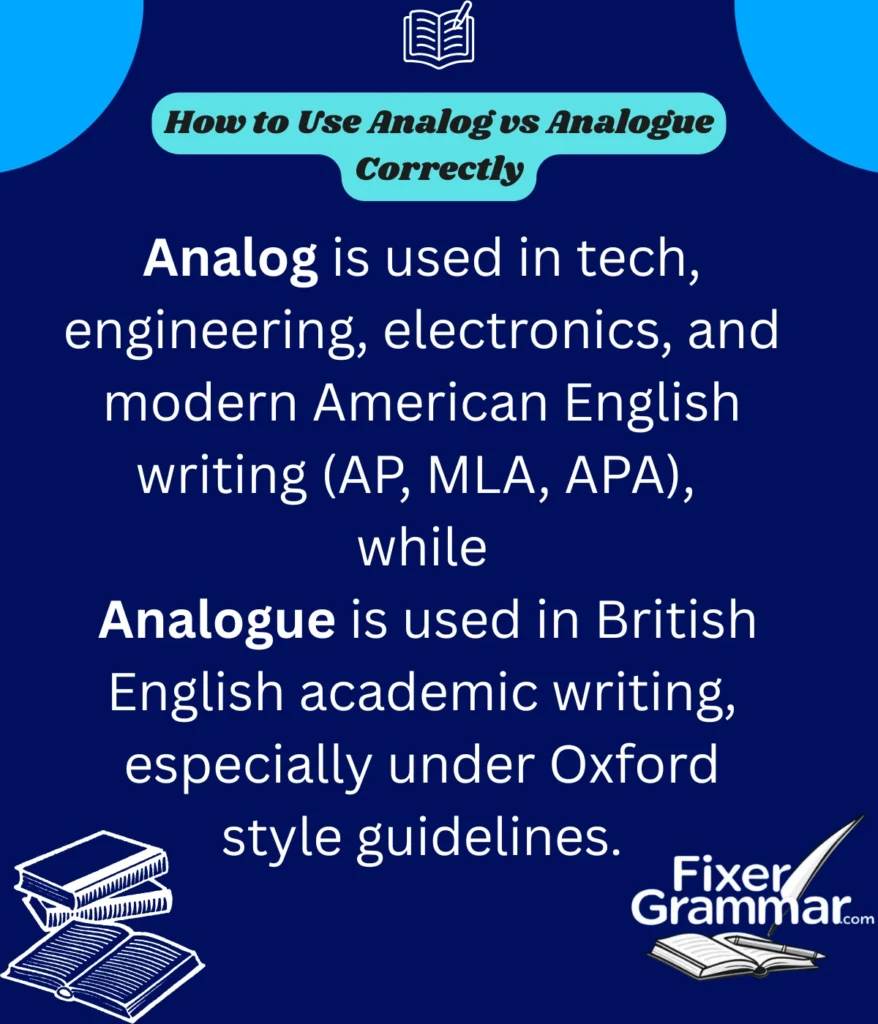
How to Use Analog vs Analogue Correctly
When to Write Analog
Use analog in:
- Tech, engineering, and electronics writing
- Everyday articles and blog posts
- Content following AP, MLA, or APA style
- Product descriptions, marketing copy, and news writing
When to Write Analogue
Use analogue in:
- Scientific papers involving molecular or chemical comparisons
- Academic writing for international publications
- Content following Oxford Style Manual guidelines
- Biological or pharmaceutical contexts
Quick Memory Trick to Never Confuse Them Again
Analog = short. America = short spelling. Analogue = longer. British tradition = longer spelling.
Another way to think about it: analog fits naturally in tech and everyday writing because it’s clean and direct. Analogue fits in scientific writing where precision and established terminology matter most.
The golden rule: pick one spelling and stay consistent throughout your entire document. Switching back and forth — even once — signals a lack of attention to detail.
FAQs About Analog vs Analogue
Are analog and analogue the same word?
Yes, completely. They share identical meaning — the only difference is spelling, shaped by regional and contextual conventions.
Which spelling is correct in standard usage?
Analog is the standard spelling used in everyday writing, technology, and major style guides like AP, APA, and Chicago.
Is analogue ever correct to use?
Absolutely. In scientific and academic writing — especially chemistry and biology — analogue is the widely accepted and preferred form.
What is the difference between analog and digital?
An analog signal is continuous and flows smoothly (like sound waves or clock hands). A digital signal is broken into discrete binary steps — zeros and ones.
Does the spelling affect the meaning?
Never. Whether you write analog or analogue, the meaning is identical. Spelling reflects convention and context, not definition.
Why does analogue have a “ue” at the end?
The -ue ending comes directly from the French word analogue, which entered English in the early 1800s. British English kept the French spelling; the simplified form analog developed later in the U.S.
Is analog vs analogue a British vs American English difference?
Yes — this is the core distinction. Analog is standard in U.S. English; analogue is standard in British, Canadian, and Australian English. However, in scientific writing, analogue is used globally regardless of region.
Conclusion
The analog vs analogue debate comes down to one thing: context, not correctness.
Use analog for tech, everyday content, and standard writing. Use analogue when your subject matter is scientific or your publication demands it. Both are valid — just never mix them in the same piece. Nail the spelling once, stay consistent, and your writing instantly feels more polished and professional.

At FixerGrammar.com, Johnson Isaacs shares easy grammar tips, clear examples, and helpful guidance to make writing simple, smooth, and mistake-free.
Related Posts