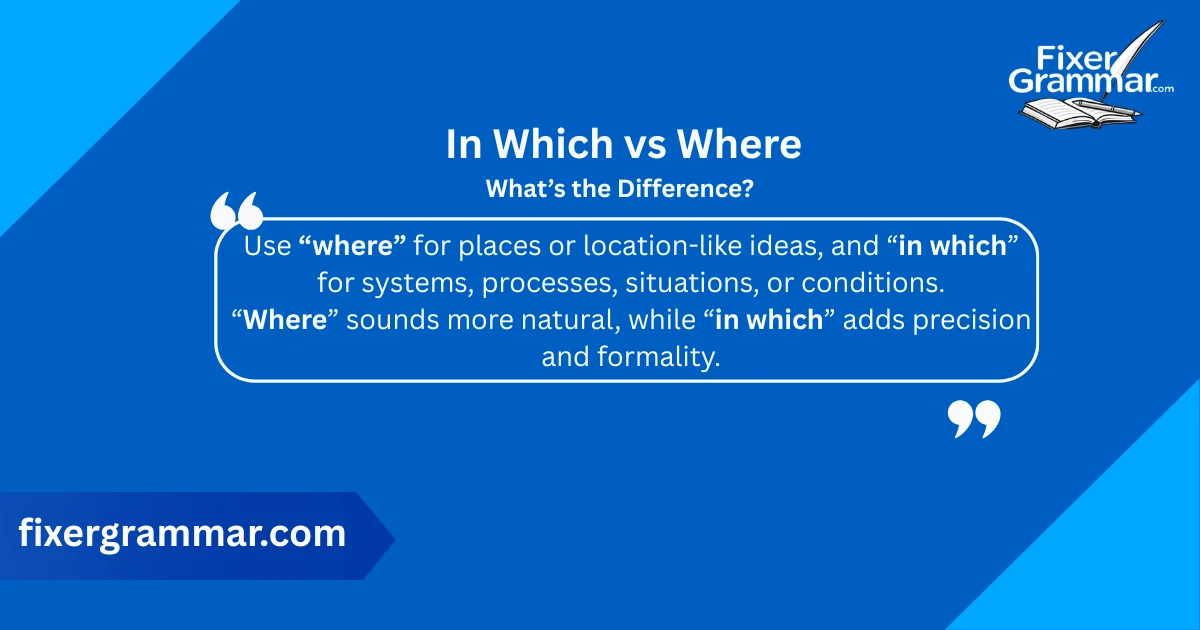
The difference comes down to meaning and tone. Where feels natural and conversational. In which sounds more precise and formal. Once you understand that, choosing the right one becomes easy.
What Does “Where” Mean — And When Should You Use It?
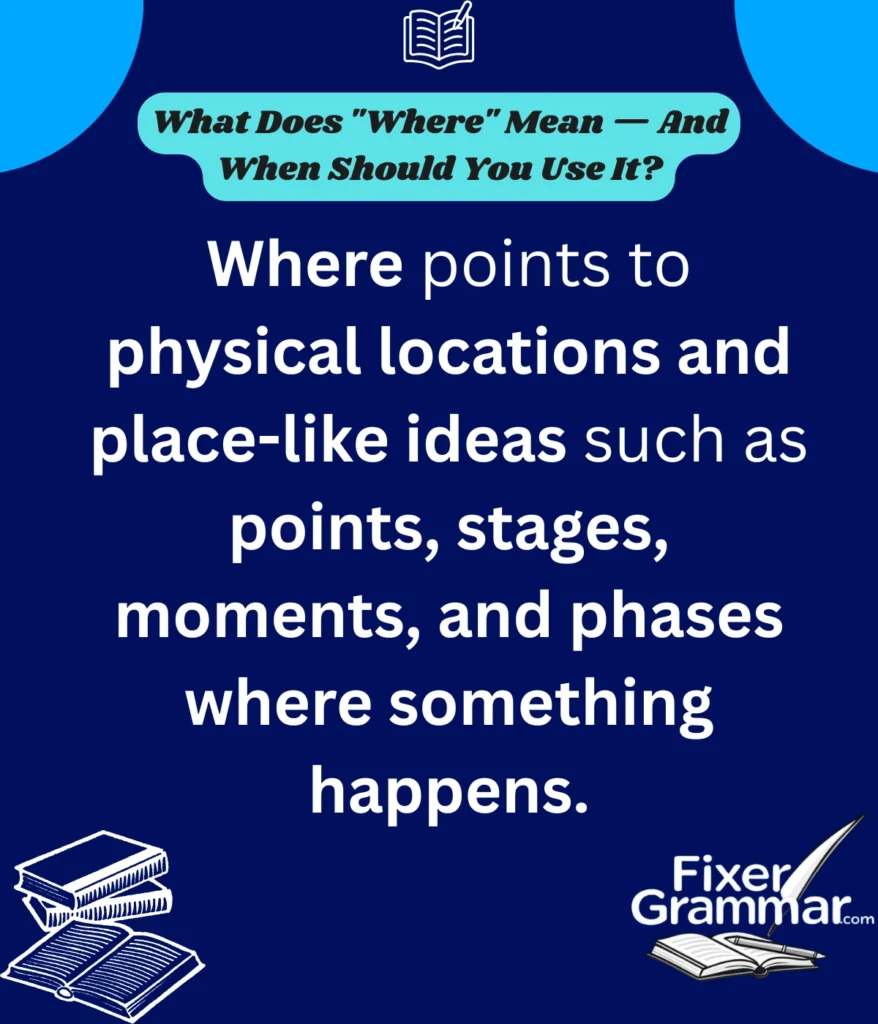
Where is a relative adverb. Its natural job is to point to a location, physical or implied.
Where With Physical Places and Locations
This is the clearest use. No debate, no confusion.
- The school where she studied is downtown.
- The park where they met was quiet.
- The office where he works overlooks the river.
The noun before where is a real, physical place. That makes the choice simple.
Where With Place-Like Abstractions
Some nouns feel spatial even when they aren’t physical. Words like point, stage, moment, and phase behave like locations in language.
- We reached a point where progress slowed.
- There comes a moment where patience matters most.
Most style guides accept this usage because it reads naturally.
When “Where” Starts to Stretch Too Far
Problems start when where gets applied to nouns with no spatial logic at all.
- ❌ A policy where exceptions apply.
- ✅ A policy in which exceptions apply.
A policy is not a place. Nothing exists inside it spatially. That logical mismatch is exactly where in which becomes necessary.
What Does “In Which” Mean — And When Is It Necessary?
In which combines a preposition (in) and a relative pronoun (which). Together, they signal that something happens inside a structure, system, or condition.
The Grammar Behind “In Which”
Think of in which as a replacement for phrases like “within that system“ or “under those conditions.”
- This is a situation in which mistakes compound quickly.
Expanded: “This is a situation — in that situation — mistakes compound quickly.”
Clunky when expanded. Clean and precise when condensed into in which.
So Do I vs So Am I — What’s the Real Difference? 2026
Nouns That Require “In Which”
| Noun Type | Example | Correct Choice |
|---|---|---|
| System | A system in which rules apply | in which |
| Process | A process in which cells divide | in which |
| Situation | A situation in which trust matters | in which |
| Policy | A policy in which rights are protected | in which |
| Framework | A framework in which outcomes vary | in which |
| Place | A city where they grew up | where |
| Stage | A stage where growth happens | where |
Why Replacing “In Which” With “Where” Fails Here
A system isn’t a place. You don’t stand inside a policy or walk through a framework. You operate within its rules.
- ❌ A method where researchers analyze data.
- ✅ A method in which researchers analyze data.
The noun method describes a process, not a location.
In which restores the logical alignment.
In Which vs Where — Core Differences at a Glance
| Feature | Where | In Which |
|---|---|---|
| Meaning | Place or location | Context, system, or condition |
| Tone | Casual, natural | Formal, precise |
| Best Use | Everyday writing | Academic, professional writing |
| Frequency | Very common | Moderately common |
| Works With | Places, spatial nouns | Processes, situations, frameworks |
FAQs — In Which vs Where
Q1. What is the main difference between “in which” and “where”?
Where refers to places or location-like nouns. In which refers to systems, processes, or conditions. The difference is about spatial logic, not just formality.
Q2. Can “where” be used in formal writing?
Yes, when the noun is a physical place or clearly spatial. But for abstract nouns like situation or framework, in which is the stronger formal choice.
Q3. When should I use “in which” instead of “where”?
Use in which when the noun has no spatial quality — such as a policy, method, process, or agreement. These nouns describe structure, not place.
Q4. Is it wrong to use “where” for abstract nouns?
In casual writing, it often passes. In formal or professional writing, it weakens precision. Editors and professors will notice the mismatch.
Q5. How do I remember which one to use?
Ask one simple question: Is this noun a place? If yes, use where. If no, use in which. That single test covers most cases instantly. British English tends to use in which more strictly across all contexts, while everyday usage here is more flexible — but the core rule stays the same.

At FixerGrammar.com, Johnson Isaacs shares easy grammar tips, clear examples, and helpful guidance to make writing simple, smooth, and mistake-free.
Related Posts