Loved fits everyday speech. Beloved carries weight, history, and formality.
Knowing which one to use helps your writing land exactly the way you intend.
What Does “Loved” Mean?
Loved is the past participle of the verb love. It also works as an adjective describing someone who receives affection.
It’s the everyday word for care and attachment — warm, simple, and universally understood.
Common examples:
- “She is loved by everyone around her.”
- “He loved his dog more than anything.”
- “Your work is loved by the whole team.”
Loved works across almost every context — casual conversations, emails, social media, and even light professional writing. It never sounds out of place.
More Posts:Marquee vs. Marquis — What’s the Difference? 2026
What Does “Beloved” Mean?
Beloved comes from Old English belufod — meaning dearly loved or highly valued. It functions as both an adjective and a noun.
It carries a sense of reverence, depth, and lasting emotional significance that loved simply doesn’t.
Common examples:
- “She returned to her beloved hometown after twenty years.”
- “The poet wrote for the beloved.” (noun use)
- “Our beloved founder shaped everything we stand for.”
Beloved naturally appears in memorials, literature, religious texts, speeches, and formal tributes. It signals that something — or someone — is held with extraordinary depth of feeling.
Beloved vs. Loved — Key Differences
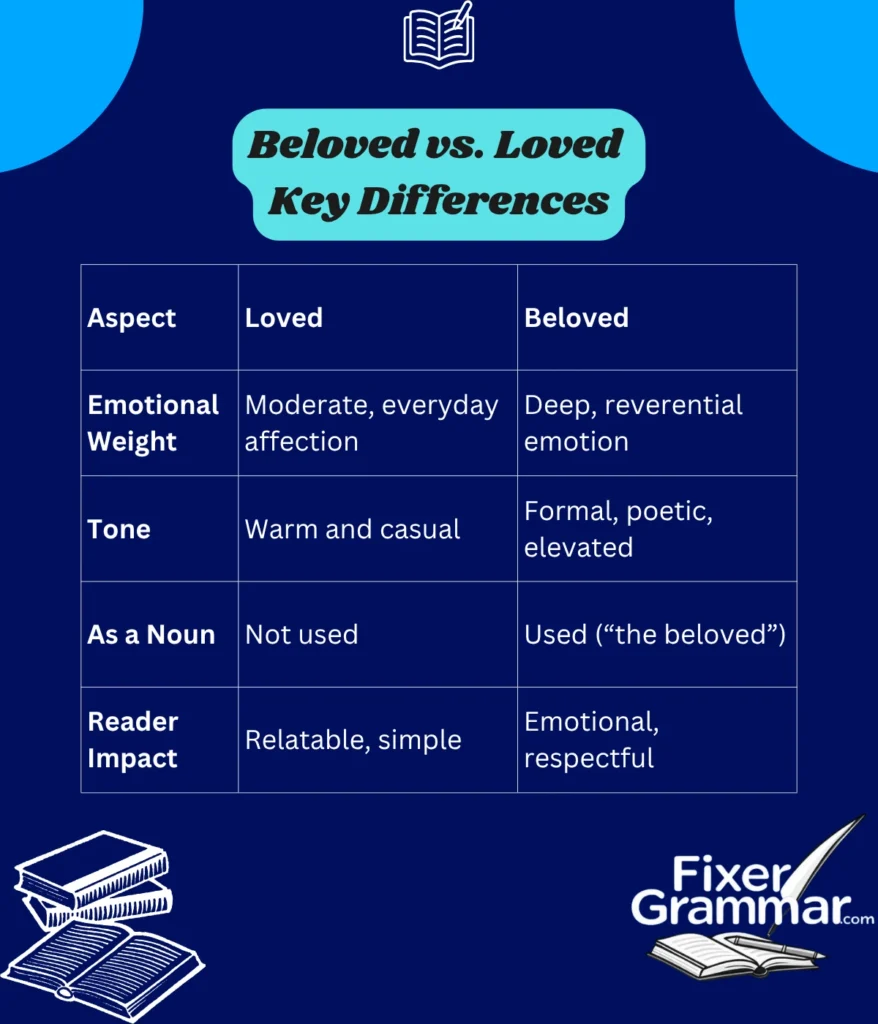
This is where most people get confused. Both words express affection, but their register, tone, and emotional weight are very different.
| Aspect | Loved | Beloved |
|---|---|---|
| Emotional Weight | Moderate, everyday | Deep, reverential |
| Tone | Warm, casual | Formal, poetic, elevated |
| Common Usage | Conversation, emails, social media | Tributes, literature, memorials |
| As a Noun | No | Yes (the beloved) |
| Reader Impact | Relatable, approachable | Emotionally resonant, respectful |
| Do | Don’t |
|---|---|
| Use loved for everyday warmth | Use beloved in trivial or casual settings |
| Use beloved in formal tributes | Assume loved is always the weaker word |
| Match word choice to tone | Interchange them without considering context |
More Posts:Appal vs. Appall — What’s the Difference ? 2026
When to Use Beloved or Loved — Real Examples
The context decides everything. Here’s a practical breakdown:
Everyday conversation → Always use loved “I loved that restaurant.”
Professional email → Use loved “Your ideas are loved by the entire department.”
Formal tribute or speech → Use beloved “We honor our beloved mentor, whose guidance shaped generations.”
Creative or literary writing → Use beloved for emotional depth “She walked through her beloved garden, where every flower held a memory.”
Obituary or eulogy → Beloved is almost always the right choice “He was a beloved husband, father, and friend.”
Quick rule: Ask yourself — am I expressing simple affection or deep reverence? That single question guides the right choice every time.
Literary and Cultural Significance of Beloved
Beloved carries history that loved simply doesn’t.
Shakespeare used it to express deep emotional bonds. Religious texts — including the Bible — use beloved to signify reverence: “This is my beloved Son.” That sacred, elevated register stayed with the word through centuries.
Toni Morrison’s 1987 novel Beloved gave the word even greater cultural weight — connecting it to trauma, memory, and profound human love. It won the Pulitzer Prize and cemented beloved as a word with literary gravitas far beyond ordinary affection.
That history is exactly why beloved resonates in eulogies, memorials, and formal writing in a way that loved cannot fully replicate.
FAQs — Beloved vs. Loved
Can “Beloved” and “Loved” be used interchangeably?
No. Beloved carries formal, literary, and reverential weight. Loved is casual and conversational. Context determines which one fits.
Which word is better for letters or tributes?
For memorials, eulogies, or heartfelt tributes, beloved is the stronger, more resonant choice. Loved suits warmer, everyday letters.
How do I know which word elevates my message?
Ask yourself: simple affection or deep reverence? Use loved for warmth, beloved for lasting emotional significance.
Does using the wrong word change how a message is received?
Yes. Using beloved casually can sound exaggerated or pretentious. Using loved in a formal tribute may feel too plain and emotionally flat.
Is there a rule for using either word in formal writing?
Formal writing — tributes, speeches, memorials — favors beloved for its depth and historical resonance. Loved works best in everyday and professional communication.

At FixerGrammar.com, Johnson Isaacs shares easy grammar tips, clear examples, and helpful guidance to make writing simple, smooth, and mistake-free.
Related Posts