Understanding when to use each form will make your communication clearer and more natural.
What Does “Any Problem” Mean?
“Any problem” uses the singular form and typically refers to one possible issue. When you ask someone “Is there any problem?” you’re checking if a single difficulty exists. This phrase works well in formal settings like business emails or professional conversations.
The singular form suggests you expect either no issues at all or just one specific concern. For example, a manager might say “Let me know if you have any problem with the new system.” Here, the focus is on one particular obstacle that might arise.
More Posts: Passerbyers or Passersby or Passerby? The Right Guide to Getting It Right
What Does “Any Problems” Mean?
“Any problems” uses the plural form and feels more natural in everyday conversation. This version assumes multiple issues could exist, even if you’re not sure how many. When someone asks “Did you have any problems?” they’re opening the door to discuss several difficulties.
Any Problem or Any Problems Grammar Rules Explained
The word “problem” is a countable noun, which means it has both singular and plural forms. The key here is understanding how “any” behaves with these forms. Technically, “any” can mean “one or more,” making both options grammatically sound.
Subject-verb agreement matters greatly here. With the singular form, use “is” — “Is there any problem?” With the plural form, use “are” — “Are there any problems?” Mixing these up creates obvious errors like “Is there any problems?” which sounds wrong to native ears.
| Form | Verb | Example |
| Any problem | is / was | Is there any problem with your order? |
| Any problems | are / were | Are there any problems we should discuss? |
When to Use “Any Problem” vs “Any Problems”
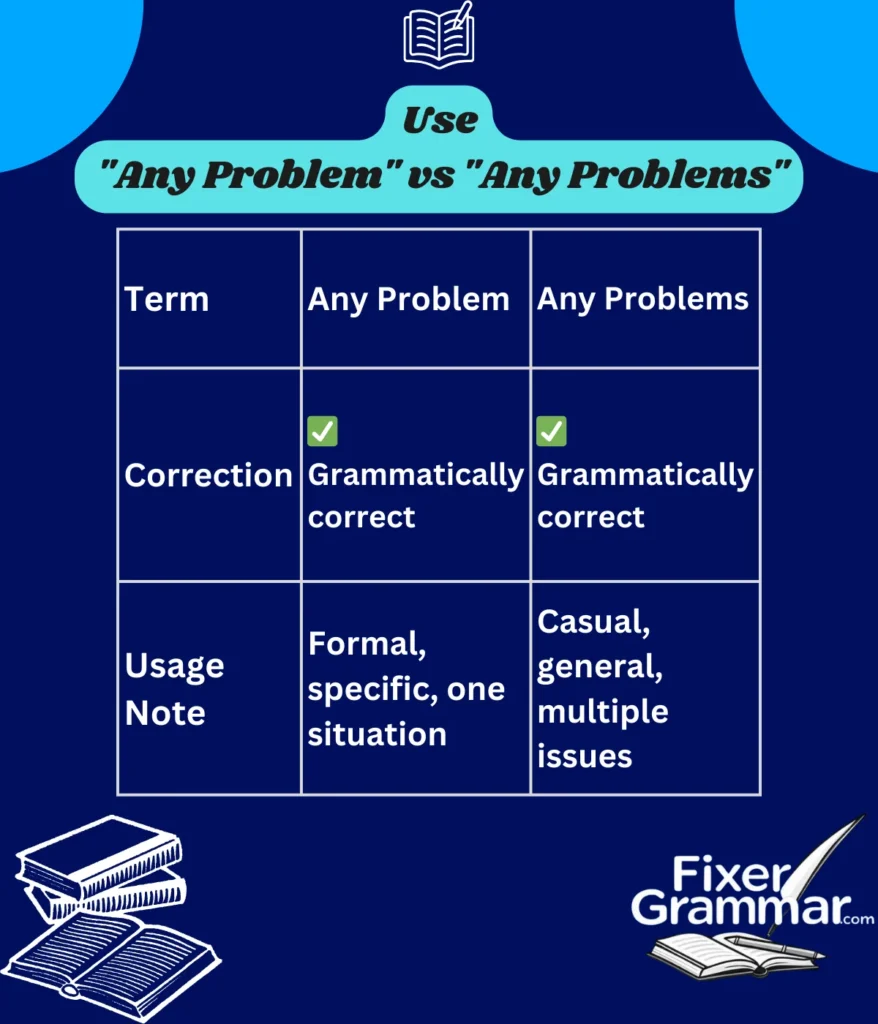
Use “any problem” when you’re being formal or specific. Professional emails, official documents, and polite inquiries often favor the singular form. It works best when discussing one particular task or situation.
Use “any problems” for casual conversations and when expecting various possible issues. Customer service representatives, teachers, and friends typically choose this form. It feels warmer and more approachable in everyday speech.
The context determines your choice. If you’re troubleshooting one specific feature, “any problem” fits better. If you’re asking generally about someone’s experience, “any problems” sounds more natural.
More Posts: Brite vs Bright – Correct Spelling and Usage Guide
Common Mistakes with “Any Problem” and “Any Problems”
The biggest error people make involves subject-verb agreement. Saying “If there’s any problems” is grammatically incorrect. The contraction “there’s” means “there is,” which only works with singular nouns. The correct version is “If there are any problems.”
Another mistake is using “any problem” when discussing clearly multiple situations. For example, “Did you face any problem during the three-hour trip?” sounds awkward. The long duration suggests various possible issues, so “any problems” works better here.
- Never write: “Is there any problems?” ✗
- Always write: “Are there any problems?” ✓
- Never write: “There’s any problems” ✗
- Always write: “There are any problems” ✓
Examples of “Any Problem or Any Problems” in Sentences
Professional Email Examples
➢”Please contact our support team if you encounter any problem with the software installation.”
This formal tone suits business communication perfectly.
Everyday Conversation
➢”Hey, did you have any problems finding the place?”
This casual question expects potentially several navigation issues.
Customer Service:
➢“We’re here to help if there are any problems with your purchase.”
This welcoming approach invites customers to share all concerns.
Workplace Communication
➢”Let me know immediately if there’s any problem with the deadline.”
Here, the singular form emphasizes one specific issue about timing.
Text Messages
➢”Everything good? Any problems?”
This quick check-in uses the plural because it’s informal and open-ended.
FAQ‘s
Is it “any problem” or “any problems”?
Both are correct. Use “any problem” for formal contexts or single issues, and “any problems” for casual conversation or multiple concerns.
Which is grammatically correct: any problem or any problems?
Both follow proper grammar rules. “Any problem” is technically traditional, while “any problems” sounds more natural to modern speakers.
Can I use “any problem” in formal writing?
Yes, “any problem” works excellently in formal writing, business emails, and professional documents. It conveys politeness and precision.
Why does “any problems” sound more natural?
Because “any” suggests uncertainty about quantity, the plural form “problems” feels more inclusive and conversational to most speakers.
Is “if there’s any problems” correct?
No, this is incorrect. Use “if there are any problems” because “there’s” (there is) requires singular nouns, not plural ones.
How do I know which one to use?
Consider formality and context. For one specific issue or formal settings, choose “any problem.” For general questions or casual talk, pick “any problems.”
What’s the difference between any problem and any problems?
“Any problem” refers to one possible issue (singular), while “any problems” suggests multiple potential difficulties (plural). Both mean essentially the same thing.
Can “any problem” refer to multiple issues?
Technically yes, since “any” can mean “one or more.” However, “any problems” sounds more natural when discussing multiple concerns.
Final Verdict
Both “any problem” and “any problems” serve valid purposes in English communication. The singular form brings formality and precision, while the plural form offers conversational ease.
Master both versions by paying attention to your context, maintaining proper subject-verb agreement, and choosing what sounds natural for your situation. With practice, you’ll instinctively know which form fits each conversation perfectly.

At FixerGrammar.com, Johnson Isaacs shares easy grammar tips, clear examples, and helpful guidance to make writing simple, smooth, and mistake-free.
Related Posts