What Does “Spell” Mean?
The verb spell means to write or say the letters of a word in the correct order. It’s one of those everyday words we use without thinking — until we need its past tense.
Beyond letters, spell also means a period of time (“a cold spell”) or a magical charm (“cast a spell”). But for this article, we’re focused on the grammar side.
More Posts:No Difference vs No Different – What’s the Difference ? 2026
What Does “Spelled” Mean?
Spelled is the past tense and past participle of the verb spell. It follows the regular verb pattern — you simply add -ed to form the past tense.
It’s the standard, widely accepted form in everyday writing and speech.
“Spelled” in a Sentence
Here are a few natural examples:
- She spelled her last name for the receptionist.
- He had always spelled it wrong — two L’s, not one.
- The broken contract spelled trouble for both companies.
- The teacher spelled out every word slowly for the class.
Notice that last example? “Spelled out” is also a common idiom meaning to explain something clearly. That idiomatic use always takes spelled, never spelt.
What Does “Spelt” Mean?
Spelt is the irregular past tense form of spell. It’s widely used in the UK, Australia, and parts of Canada.
But here’s something worth knowing — spelt has a second meaning entirely. It’s also the name of an ancient grain, a type of hulled wheat used in artisan breads and health foods.
“Spelt” in a Sentence
- Her name was Anna, but it was spelt differently on the form.
- He realized he had spelt the client’s name wrong in the email.
- I baked this loaf using spelt flour — it has a nuttier flavor. (noun — the grain)
Spelled vs. Spelt — What’s the Difference?
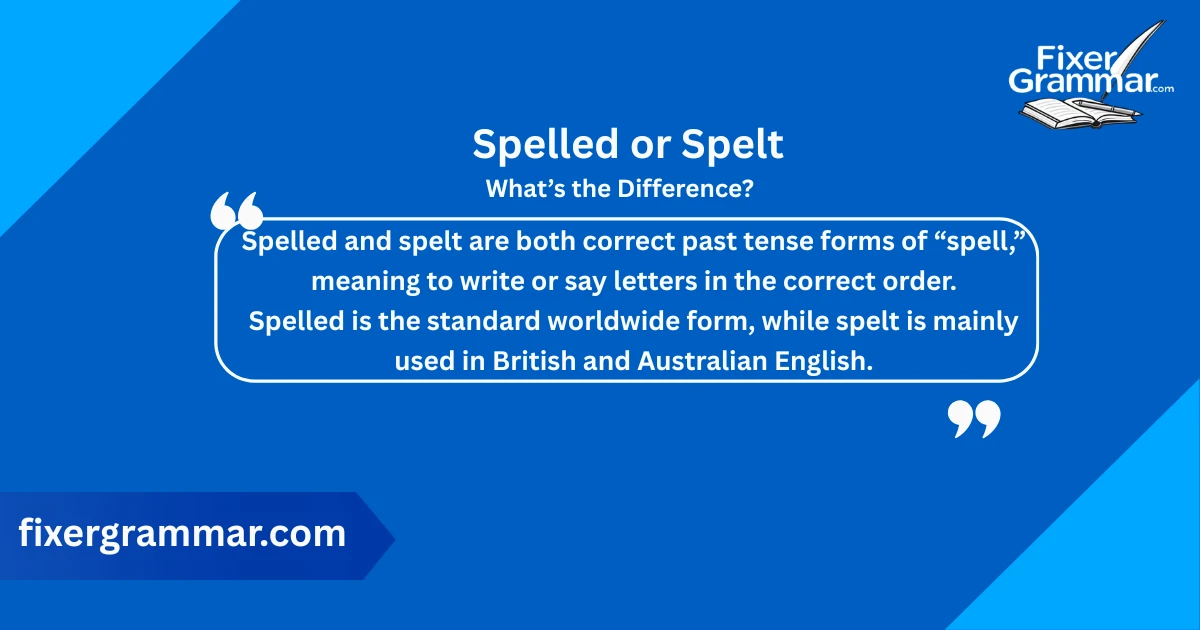
Both words are correct past tense forms of spell. The difference comes down to regional usage, not right versus wrong.
| Form | Where It’s Used | Accepted? |
|---|---|---|
| Spelled | Standard usage globally | Yes |
| Spelt | British & Australian English | Yes |
| Spelled | Formal and informal writing | Always safe |
| Spelt | As a noun (grain) | Yes, entirely different meaning |
The simplest rule: spelled is the safe, universally understood choice. Spelt is correct too — but mostly in British-influenced writing.
Similar Word Pairs You Already Know
This isn’t the only word that works this way. The same pattern shows up with other common verbs:
- Burned vs. burnt
- Learned vs. learnt
- Dreamed vs. dreamt
In each pair, the -ed form is standard in everyday and formal usage, while the -t form appears more in British English. Once you see the pattern, it sticks.
Spelled or Spelt — Which Should You Use?
Use spelled. It’s correct, standard, and understood everywhere.
If you’re writing for a global audience, academic purposes, or professional settings — spelled is always the right call. You’ll never be wrong with it.
A quick rule to remember:
“When in doubt, go with spelled.”
FAQ’s — Spelled or Spelt
Is “spelt” wrong to use?
No, it’s not wrong — but it’s non-standard in most everyday usage. Stick with spelled to be safe in any context.
Is “spelled” used in British English?
Yes. Both spelled and spelt are accepted in British English, though spelt has historically been more common there.
What is the past tense of “spell”?
The past tense of spell is spelled (standard) or spelt (used mainly in British English). Both are grammatically valid.
Does “spelt” have another meaning?
Yes — spelt is also an ancient variety of wheat, commonly used in health breads and flour. Context makes it clear which meaning is intended.
Which form should non-native speakers learn?
Learn spelled first — it works everywhere. Once comfortable, you can recognize spelt when you encounter it in British or Australian writing.
Are “spelled” and “spelt” interchangeable?
As verb forms, largely yes — but spelled is the safer and more universally standard choice. The word spelt as a grain is a completely separate meaning.
The Bottom Line
Spelled and spelt are both past tense forms of the verb spell. Spelled is the standard form — correct, clear, and accepted everywhere. Spelt is valid in British-influenced writing, and also doubles as the name of an ancient grain.
If you’re writing anything — an email, an essay, a blog post — spelled is the word you want. It’s the form recognized everywhere, carries no ambiguity, and keeps your writing clean and professional.

At FixerGrammar.com, Johnson Isaacs shares easy grammar tips, clear examples, and helpful guidance to make writing simple, smooth, and mistake-free.
Related Posts