This one distinction matters more than most people realize — especially in science, mathematics, and formal writing.
Maximal vs Maximum
What Does Maximum Mean?
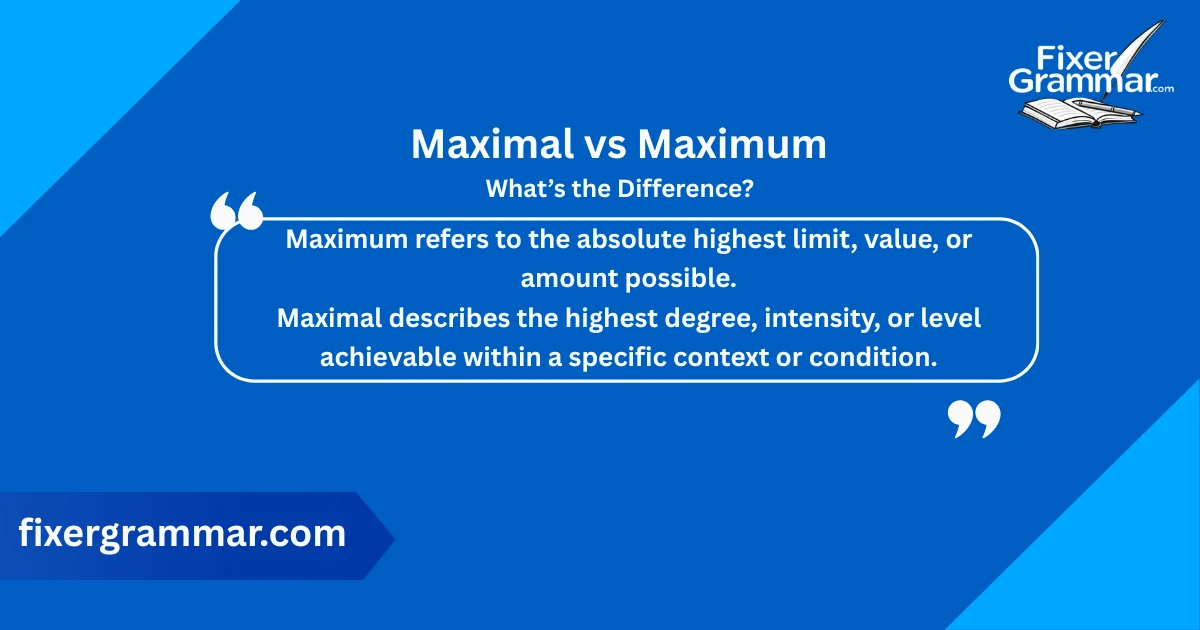
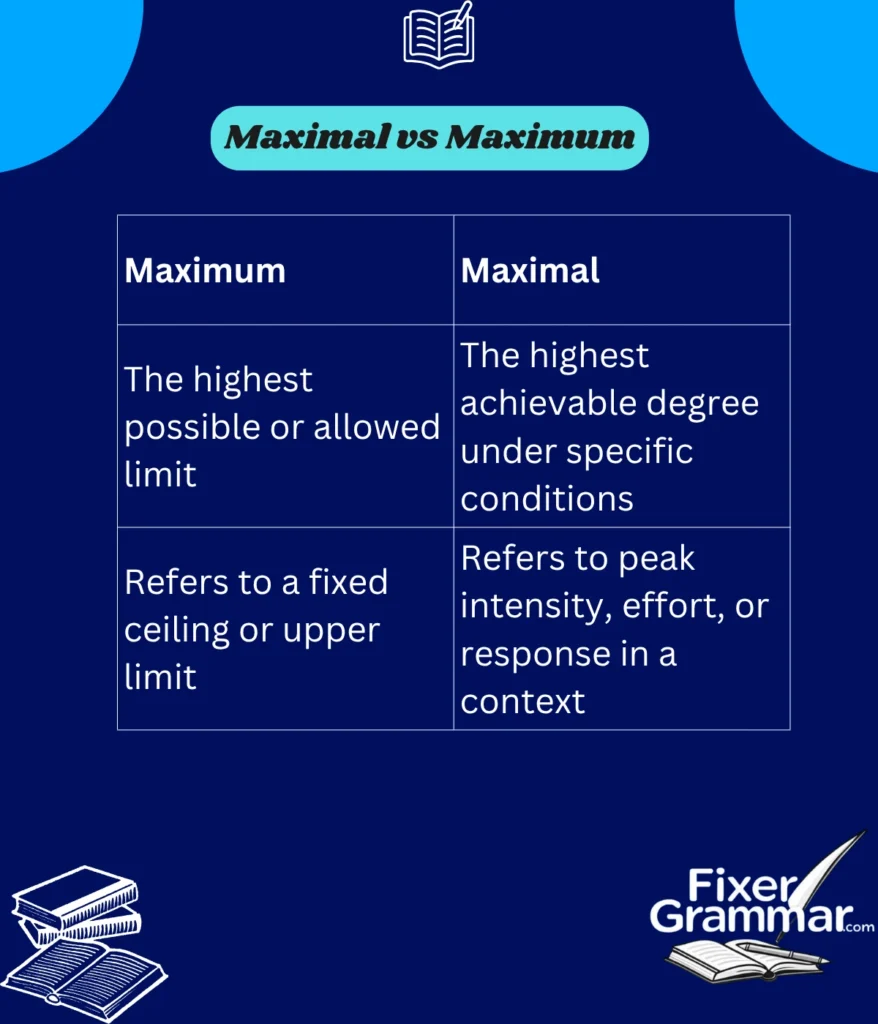
Maximum means the greatest amount, value, or level that is possible or allowed. It works as both a noun and an adjective.
It points to a fixed ceiling — a measurable upper limit.
Examples:
- The maximum speed on the highway is 65 mph.
- The room holds a maximum of 200 people.
- She scored the maximum of 100 points.
What Does Maximal Mean?
Maximal is an adjective only. It describes something that is at the highest possible degree or intensity within a specific situation or set of conditions.
It does not always refer to an absolute limit. It refers to the best achievable under given rules.
Examples:
- The athlete trained with maximal effort.
- The drug produced a maximal response in clinical trials.
- Researchers noted maximal oxygen uptake during the test.
More Posts:Smelled or Smelt — Which One Is Correct? 2026
Maximal vs Maximum
| Feature | Maximum | Maximal |
|---|---|---|
| Part of Speech | Noun or Adjective | Adjective only |
| Meaning | Absolute highest limit | Highest degree under conditions |
| Can be a noun? | Yes | No |
| Used in everyday speech? | Very common | Less common |
| Used in technical writing? | Yes | More frequently |
| Multiple possible? | Only one | Can be several |
| Example | Maximum capacity: 500 | Maximal effort during the test |
Maximal and Maximum — Core Differences Explained
When to Use Maximum
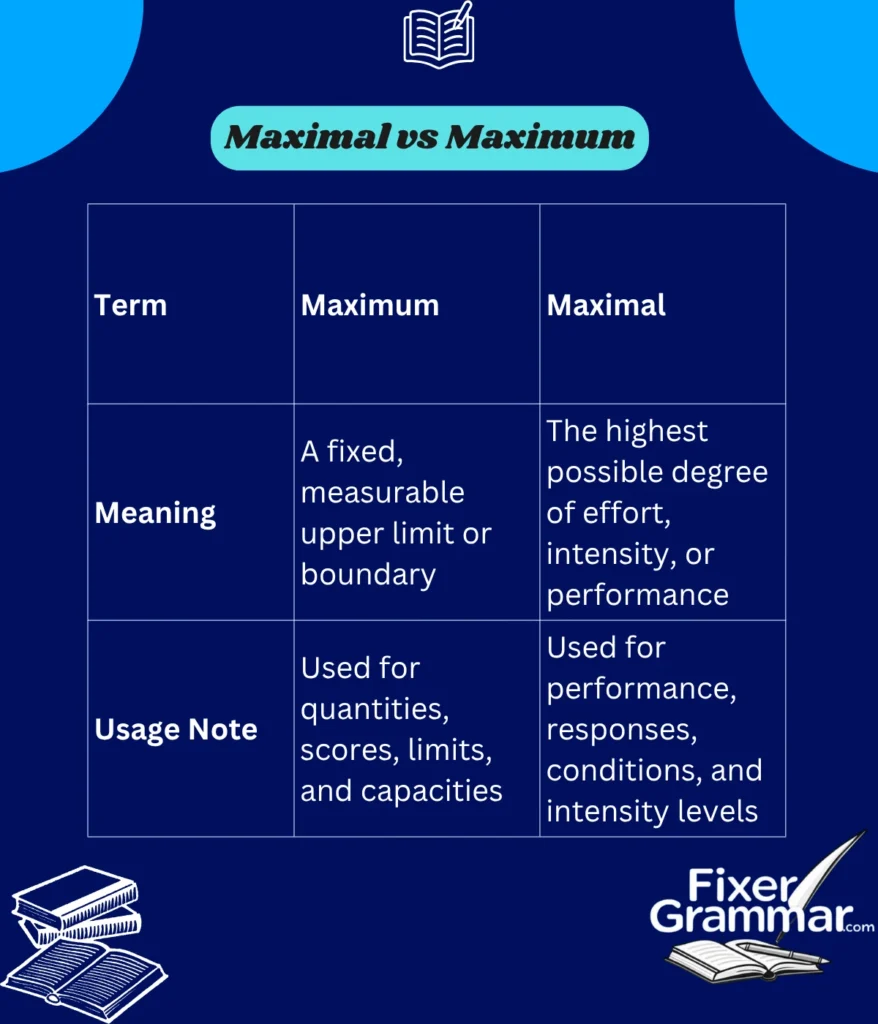
Use maximum when you are talking about a fixed, measurable upper limit. This could be a number, a quantity, a score, or a legal boundary.
Ask yourself: Is there a hard ceiling here? If yes, use maximum.
- Maximum dosage: 4 grams per day
- Maximum load: 10,000 lbs
- Maximum temperature: 98°F
When to Use Maximal
Use maximal when you are describing performance, intensity, effort, or a condition that has reached its highest possible point within a specific framework.
Ask yourself: Am I describing how intense or how complete something is? If yes, maximal is the right fit.
- Maximal muscle contraction during the lift
- Maximal response to the treatment
- Maximal cognitive performance during the exam
Maximal vs Maximum in Grammar and Parts of Speech
Maximum as a Noun
Maximum can stand alone as a noun in a sentence. This is something maximal can never do.
- “We reached the maximum.”
- “The maximum is 25 miles per hour.”
It names a thing — the upper boundary itself.
Maximum as an Adjective
Maximum also modifies nouns directly, acting as a descriptor.
- Maximum security prison
- Maximum efficiency output
- Maximum benefit allowed
Maximal as an Adjective Only
Maximal always needs a noun to describe. It cannot stand alone.
✅ “She gave maximal effort.”
❌ “She gave a maximal.” — This is incorrect.
This grammatical boundary is one of the clearest ways to separate the two words.
More Posts:State vs. Status — Which One Is Correct? 2026
Maximal vs Maximum in Mathematics, Science, and Everyday Use
Maximal vs Maximum in Mathematics (Sets and Partial Orders)
In mathematics, this distinction is critical — not just stylistic.
In a totally ordered set (like the set of real numbers), every element can be compared. Here, the maximum is the single largest element.
- Set: {3, 7, 11, 14} → Maximum = 14
In a partially ordered set (poset), not every element can be compared. Multiple maximal elements can exist because no single element beats all others.
- Subsets of {1, 2, 3}: both {1,2} and {2,3} are maximal subsets — neither contains the other. But there is no single maximum subset unless {1,2,3} itself is included.
This distinction drives results in graph theory, abstract algebra, and Zorn’s Lemma in set theory — all of which depend on maximal elements, not maximum ones.
Key mathematical fact:
- A set can have multiple maximal elements but only one maximum (if it exists at all).
Real-World Examples of Maximal vs Maximum Across Different Contexts
Examples in Sports and Fitness
Sports science uses both terms, but with specific intent.
- “His maximum recorded sprint speed was 23 mph.” — a measurable number
- “He trained at maximal intensity for 30 minutes.” — a description of effort level
- “VO₂ max measures maximal oxygen uptake during peak exertion.” — physiological degree, not a hard cap
Maximal effort in fitness means pushing as hard as possible within your physical ability at that moment. It’s not a fixed number. It’s a description of a state.
Examples in Business and Professional Writing
In professional settings, maximum is almost always the correct choice for limits, budgets, timelines, and capacities.
- “The maximum project budget is $500,000.”
- “Staff may work a maximum of 48 hours per week.”
- “The building has a maximum floor load of 75 lbs per square foot.”
Maximal works in performance-focused professional language:
- “The team operated at maximal efficiency during Q4.”
- “She demonstrated maximal engagement throughout the quarter.”
Examples in Academic and Technical Writing
Academic writing demands the sharpest distinction between these two terms.
In graph theory: A maximal clique cannot be extended by adding another vertex — but it may not be the largest clique in the graph. The maximum clique is the largest one possible.
In calculus: A function has a maximum value at its single highest point. But local peaks — points higher than their neighbors but not the global top — are described as locally maximal.
In set theory: Zorn’s Lemma guarantees the existence of a maximal element in a partially ordered set — not a maximum. This distinction is foundational in proving the existence of algebraic structures like maximal ideals and vector space bases.
FAQs About Maximal vs Maximum
Is maximal the same as maximum?
No. Maximum refers to an absolute highest limit or value. Maximal describes something at the highest degree within specific conditions — which may not be the overall greatest.
Which word is more common in everyday English?
Maximum is far more common in daily speech and general writing. Maximal appears mostly in scientific, academic, and technical contexts.
Can maximum and maximal be used interchangeably?
Not in technical or academic contexts. In casual everyday use, swapping them rarely causes confusion — but in math, medicine, and science, they carry distinct and non-interchangeable meanings.
Is “maximum effort” wrong?
No, it’s widely understood and commonly used. However, maximal effort is more precise in scientific or performance contexts because effort describes intensity, not a fixed numerical ceiling.
Why do scientists often use maximal?
Scientists describe performance levels, physiological responses, and experimental outcomes — all of which are degrees of intensity, not fixed caps. Maximal captures that nuance more accurately than maximum.
Should I use maximal in business writing?
Stick to maximum for limits, caps, budgets, and quantities. Use maximal only when describing the highest degree of performance, output, or effort in a context where precision matters.
Conclusion
The difference between maximal vs maximum is small but meaningful. Maximum points to the absolute highest limit — a fixed ceiling with a measurable value. Maximal describes the highest degree achievable within a given set of conditions — which may vary by context.
For everyday writing, maximum is almost always correct. For technical, scientific, and academic work, knowing when to use maximal sets precise writing apart from imprecise writing.
One rule covers everything: If it’s a limit, use maximum. If it’s a degree, use maximal.

At FixerGrammar.com, Johnson Isaacs shares easy grammar tips, clear examples, and helpful guidance to make writing simple, smooth, and mistake-free.
Related Posts