Choosing between “at the house” and “in the house” can confuse many English speakers.But both phrases are correct and have their own characteristics.
- Think of “at the house” as a broad location marker. When you say someone is at the house, they could be in the driveway, at the front door, in the backyard, or inside the building. The phrase doesn’t tell you exactly where they are.
- On the other hand, “in the house” is very specific. It only means inside the four walls of the building. If someone is in the garden or on the porch, you wouldn’t say they’re in the house.
When to Use “At the House”
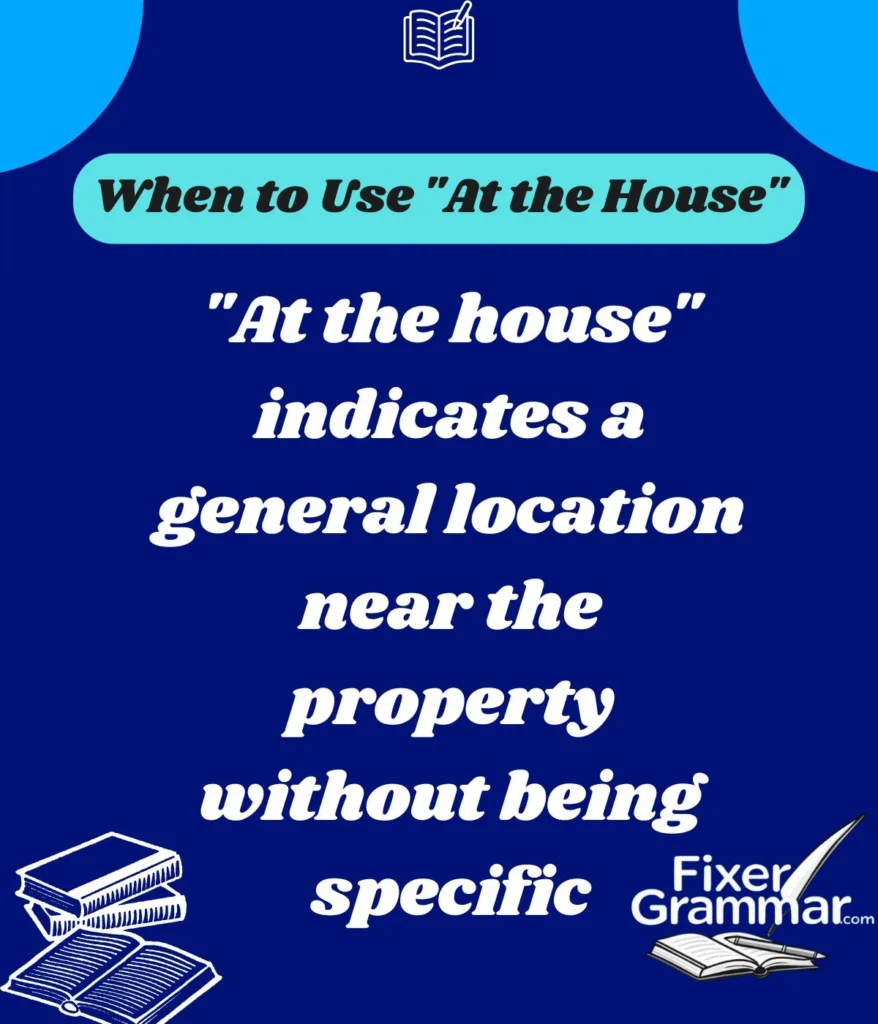
“At the house” works as a general location reference. It tells people that someone or something is near the property without being specific about the exact spot.
This phrase is perfect when the precise location doesn’t matter. For example, if you’re meeting friends, you might say “I’ll meet you at the house” without specifying whether you’ll be at the front door, in the garage, or in the living room.
examples of “at the house”
- The delivery driver left the package at the house because no one answered the door.
- We’re having a barbecue on Saturday, so everyone should arrive at the house around noon.
- She works from home twice a week, so she’s usually at the house on Tuesdays and Thursdays.
- The plumber said he’d be at the house between 2 PM and 4 PM to fix the leaking pipe.
- They decided to meet at the house first before heading to the concert together.
- Turn left at the house with the red mailbox, then drive straight for two miles.
- My parents aren’t home, but my brother should be at the house to let you in.
Notice how these examples show flexibility in meaning. The person or thing could be anywhere on or near the property.
When to Use “In the House”

“In the house” specifically means inside the building. This phrase excludes any outdoor spaces like the yard, garden, patio, or driveway.
Use this phrase when you want to emphasize that something or someone is indoors. It’s especially useful when contrasting with being outside. For instance, “The kids are playing in the house” tells you they’re not in the yard.
Examples of “in the house”
- It’s too cold outside, so we’ll have the birthday party in the house instead.
- Please remove your shoes before coming in the house to keep the floors clean.
- The cat stays in the house during winter because she doesn’t like the cold weather.
- We found a spider in the house last night and had to catch it carefully.
- They spent the entire weekend in the house watching movies because of the heavy rain.
- No smoking is allowed in the house under any circumstances.
- The Wi-Fi only works properly when you’re in the house, not in the backyard.
These examples show how “in the house” creates a clear boundary between inside and outside spaces.
“At the House” vs “In the House” Usage Comparison
| Phrase | Meaning | Common Usage |
|---|---|---|
| At the house | General location (inside, outside, or nearby) | Meeting points, general reference |
| In the house | Specifically inside the building | Indoor activities, contrasting with outside |
| Outside the house | Not inside the building | Yard work, outdoor events |
| Around the house | Various locations near the property | Chores, general activities |
According to linguistic research, prepositions like “in” provide more precise information than “at,” which explains why speakers prefer “in the house” when clarity matters.
The phrase “at the house” works best for casual conversation when exact location isn’t important. But “in the house” wins when you need to be clear about indoor versus outdoor spaces.
FAQ’s
Which is correct at house or in house?
Both are correct, but “at the house” refers to a general location while “in the house” means specifically inside. Choose based on how precise you need to be.
Are you in the house or at the house?
Say “in the house” if you’re inside the building. Use “at the house” if you’re anywhere on the property, including outside areas like the driveway or yard.
Is it correct to say “at my house”?
Yes, “at my house” is perfectly correct. It’s commonly used for invitations or meeting locations, like “Come over at my house” or “The party is at my house.”
Final Thoughts
Understanding the difference between “at the house” and “in the house” helps you communicate more clearly. Remember that “at” gives a general location, while “in” specifies the interior.
Use “at the house” for broad references and “in the house” when you need to emphasize that something is specifically indoors. Both phrases serve important purposes in everyday English conversation.

At FixerGrammar.com, Johnson Isaacs shares easy grammar tips, clear examples, and helpful guidance to make writing simple, smooth, and mistake-free.
Related Posts