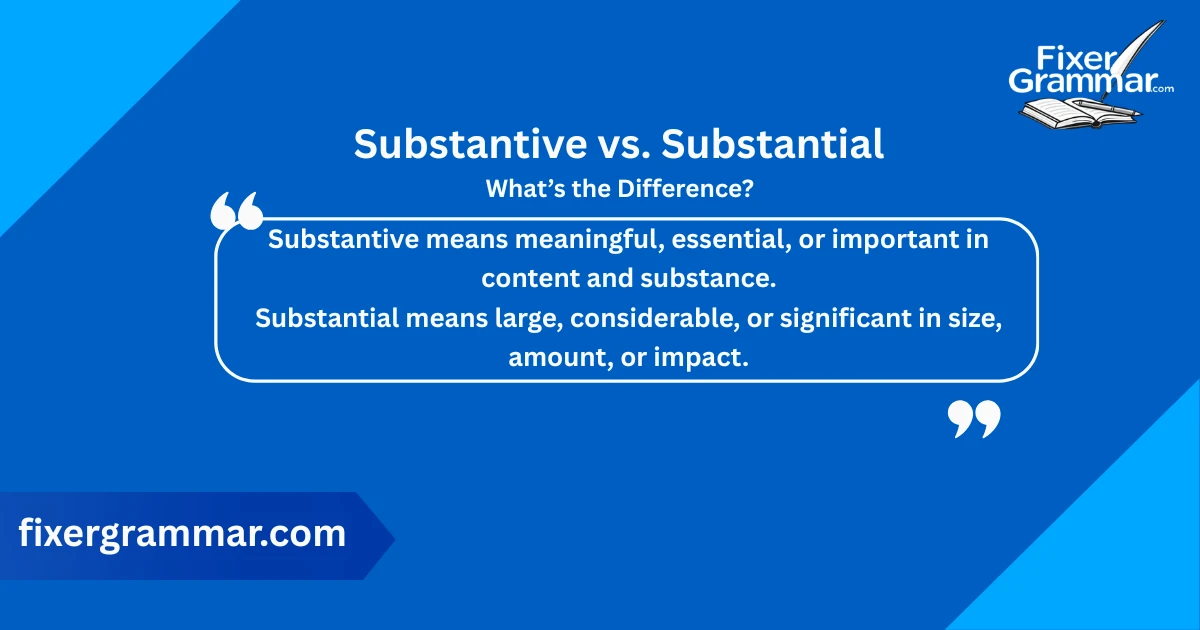
Mixing them up is one of the most common word errors in professional, academic, and legal writing. This guide breaks the difference down clearly so you never confuse them again.
Substantive vs. Substantial at a Glance
| Feature | Substantive | Substantial |
|---|---|---|
| Core meaning | Depth, meaning, essence | Size, amount, scale |
| Focus | Quality of content | Quantity or magnitude |
| Common fields | Law, academia, policy | Finance, business, everyday use |
| Key question | Does it have real meaning? | Is it large or significant in scale? |
| Memory tip | Think: substance = depth | Think: size = scale |
The one-line rule: If you mean how meaningful, use substantive. If you mean how much, use substantial.
What Does “Substantive” Mean?
Substantive describes something with real depth, core importance, or fundamental meaning.
It comes from the Latin substantivus, meaning “having substance.” It is most common in law, academic writing, and policy discussions.
Example sentences:
- “The court addressed the substantive rights of the accused.”
- “Her research made a substantive contribution to the field.”
- “We need a substantive discussion — not just talking points.”
What Does “Substantial” Mean?
Substantial describes something large, considerable, or measurable in size, amount, or impact.
Its Latin root is substantia, meaning physical existence or material. It fits situations where you can quantify or measure something.
Example sentences:
- “The company reported a substantial increase in revenue.”
- “He received a substantial raise after the project.”
- “There was substantial evidence against the defendant.”
More Posts:Maximal vs Maximum — What’s the Real Difference? 2026
Key Differences Between Substantive and Substantial
Substantive is qualitative. Substantial is quantitative. That one distinction covers almost every case.
When to Use “Substantive” — Examples in Context
Use substantive when the focus is on meaning, depth, or core importance — not size.
- In law: “Substantive law defines rights and duties — what people can legally do or not do.”
- In academia: “The paper offered substantive insights into neural development.”
- In policy: “The committee moved past procedure and into substantive debate.”
- In business: “HR asked for substantive feedback, not vague comments.”
Pro tip: If you can replace the word with “meaningful” and the sentence still makes sense — use substantive.
When to Use “Substantial” — Examples in Context
Use substantial when the focus is on size, scale, or measurable significance.
- In finance: “The startup secured substantial funding in its Series B round.”
- In everyday use: “That was a substantial meal — enough for two people.”
- In reports: “The audit found substantial discrepancies in the records.”
- In impact: “The storm caused substantial property damage across the region.”
Pro tip: If you can replace the word with “large” or “considerable” and the sentence still works — use substantial.
Substantive vs. Substantial in Professional Settings
Word choice in professional writing signals credibility. One wrong word can change the entire meaning of a sentence.
Precision matters most in legal, academic, and corporate writing — the three fields where these words appear most often.
In Law: Substantive Law vs. Substantial Evidence
These two legal phrases are completely different — and confusing them is a serious error.
Substantive law defines what people’s rights and obligations are. It tells you what is legal or illegal — like contract law, criminal law, and property rights.
Substantial evidence, on the other hand, is a legal standard. Courts use it to decide whether there is enough proof to support a ruling. It is about quantity and weight of evidence — not its core meaning.
| Legal Term | What It Means |
|---|---|
| Substantive law | Defines rights, duties, and legal obligations |
| Substantial evidence | Enough proof to support a reasonable conclusion |
| Substantive rights | Core legal protections a person holds |
| Substantial damages | A large or significant monetary award |
In Business and Academia
In business, a CEO reports substantial profits — that means large, measurable financial results.
But an HR manager asks for substantive feedback — that means meaningful, in-depth evaluation, not just a number on a form.
In academia, a researcher may secure substantial funding (a large grant) while also making a substantive contribution (advancing knowledge in the field). Both can be true at the same time — and both words are correct in their own context.
Frequently Asked Questions
What’s the main difference between substantive and substantial?
Substantive refers to depth and meaning. Substantial refers to size and amount. One is qualitative, the other is quantitative.
Can substantive and substantial be used interchangeably?
Rarely in casual speech — but never in legal, academic, or business writing. Swapping them changes the meaning of your sentence.
What does “substantive law” mean?
Substantive law defines the actual rights and duties people have under the law — what is legal, what is illegal, and what obligations exist between parties.
Is “substantial evidence” the same as “substantive evidence”?
No. Substantial evidence means there is enough proof to support a conclusion. Substantive evidence means the proof is directly relevant and meaningful to the core issue.
How can I quickly remember which word to use?
Ask: “How much or how meaningful?” — Substantial = size, Substantive = substance and depth. That one question settles it every time.
Is this difference only relevant in formal writing?
It matters most in formal contexts — but using the wrong word in everyday writing also makes the sentence subtly unclear. Good habit to know in any context.
Do British and American English treat these words differently?
No significant difference. Both words carry the same meanings across both varieties of English — the distinction between them is universal, not regional.
Final Thoughts
Both words carry weight — just in different ways.
Substantial tells you something is big, considerable, or measurable. Substantive tells you something has real meaning, depth, or importance. They are not interchangeable, and in formal writing, swapping them quietly changes what you are actually saying.
Use precise language. It signals expertise, builds trust, and makes your writing sharper in every setting — from a courtroom brief to a business email.

At FixerGrammar.com, Johnson Isaacs shares easy grammar tips, clear examples, and helpful guidance to make writing simple, smooth, and mistake-free.
Related Posts