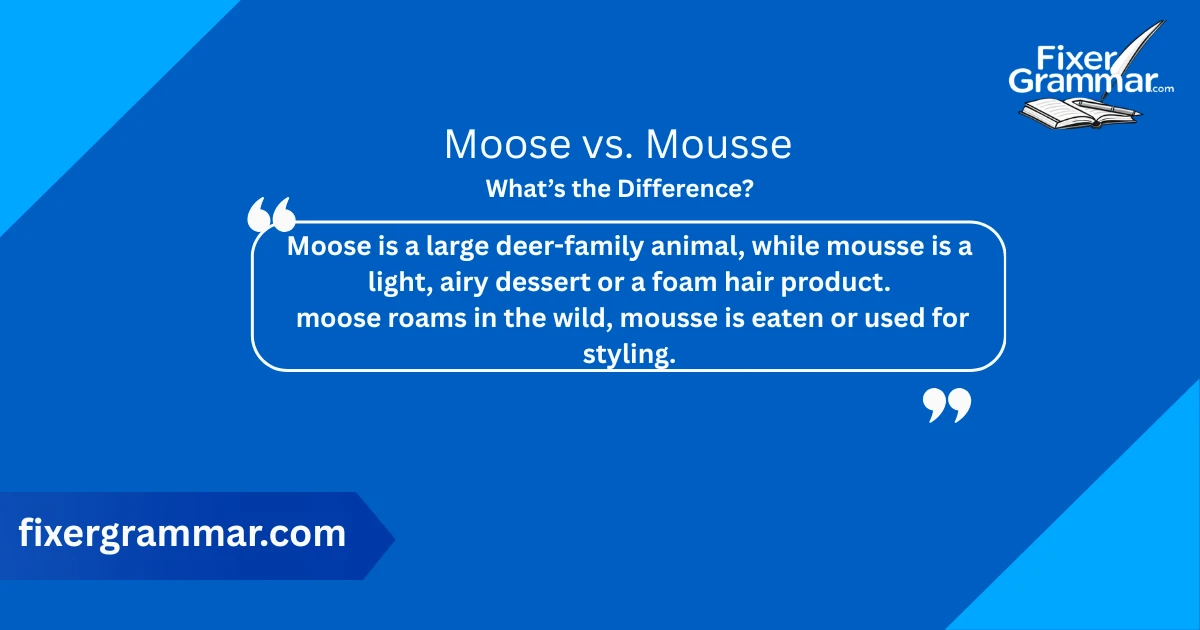
Moose vs. mousse is a classic case of homophones — words that sound alike but have different spellings and meanings. Knowing which one to use keeps your writing clean and credible.
What Is a Moose? Meaning, Origin, and Usage
Moose is the largest member of the deer family. Its scientific name is Alces alces. An adult male moose can weigh up to 1,500 pounds and stand over 6 feet tall at the shoulder.
The word comes from the Eastern Abenaki word mos, meaning “twig eater” — a nod to the animal’s diet of bark, twigs, and aquatic plants.
One important grammar rule: the plural of moose is moose — not “mooses.”
Example sentences:
- We spotted a moose standing at the edge of the lake in Maine.
- Three moose were grazing near the trail this morning.
- A bull moose can be dangerous during rutting season.
| Feature | Detail |
|---|---|
| Scientific name | Alces alces |
| Average weight | 800–1,500 lbs |
| Plural form | Moose (never “mooses”) |
| Habitat | North America, Alaska, Canada, Northern states |
| Part of speech | Noun |
What Is Mousse? Meaning, Origin, and Usage
Mousse is a French word that literally means foam or froth. It entered English in the 19th century as a culinary term for light, airy dishes made by folding whipped cream or egg whites into a base.
Today, mousse has two main meanings — a dessert and a hair product.
Types of mousse:
- Chocolate mousse — a rich, airy dessert made with whipped cream and melted chocolate
- Savory mousse — think smoked salmon mousse or chicken liver mousse
- Hair mousse — a foam styling product that adds volume and hold
Example sentences:
- She served a silky chocolate mousse at the dinner party.
- He rubbed hair mousse through his curls before blow-drying.
- The chef’s salmon mousse was the highlight of the appetizer course.
| Feature | Detail |
|---|---|
| Origin | French — “foam/froth” |
| First use in English | 19th century |
| Meanings | Dessert, savory dish, hair product |
| Part of speech | Noun |
| Plural form | Mousses |
More Posts:Fair vs Good – What’s the Difference ? 2026
Moose vs. Mousse: Key Differences Side by Side
If it’s alive and in the wild, it’s a moose. If you eat it or style your hair with it, it’s mousse.
| Feature | Moose | Mousse |
|---|---|---|
| Meaning | Large deer-family animal | Airy food or hair product |
| Origin | Algonquian (Native American) | French |
| Category | Animal / Wildlife | Food / Beauty |
| Plural | Moose | Mousses |
| Example | A moose crossed the road. | She made chocolate mousse. |
Common real-world errors:
- ❌ “I made a chocolate moose for dessert.” → ✅ mousse
- ❌ “A mousse was spotted near the campsite.” → ✅ moose
- ❌ “We used moose to style our hair.” → ✅ mousse
Easy Tricks to Remember the Difference Every Time
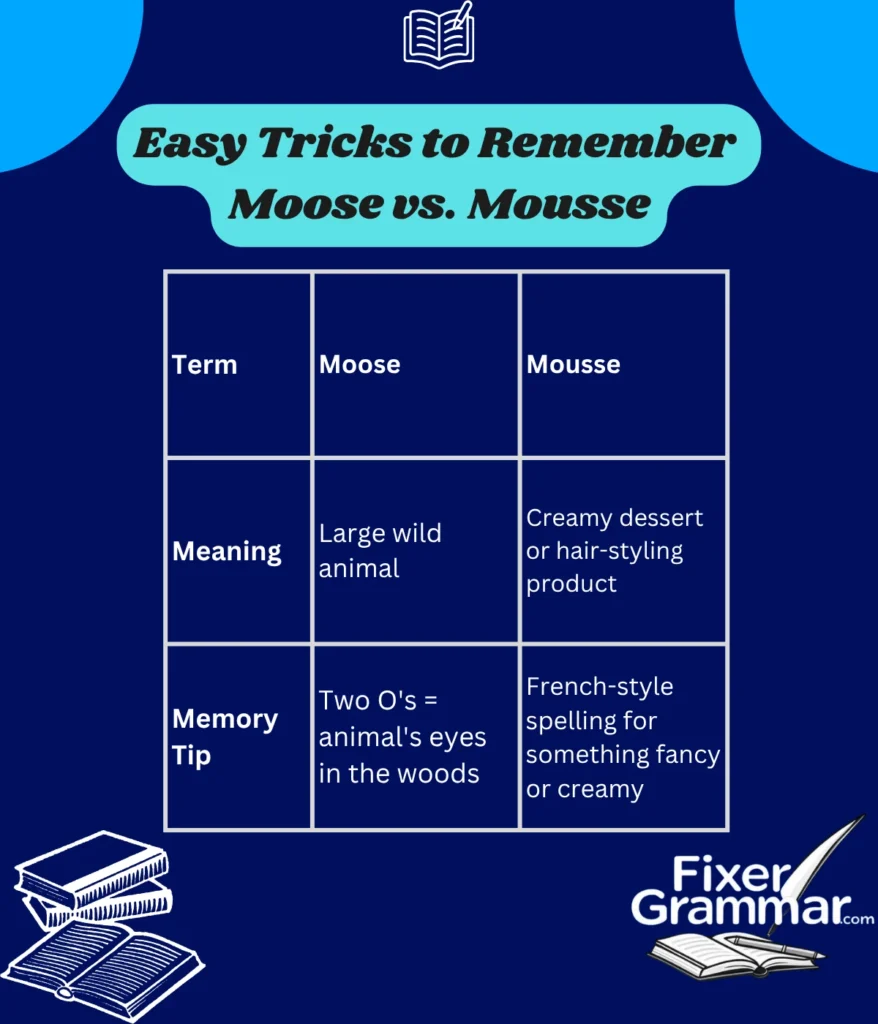
The double-O trick: Look at the two O’s in moose. Picture them as the wide eyes of the animal staring at you from the woods. Two round eyes = wild animal = moose.
The French spelling signal: Mousse has that “ou” spelling — a giveaway it’s borrowed from French. If it sounds fancy, creamy, or salon-ready, it’s mousse.
The fastest mnemonic: “Moose roam. Mousse foams.”
Quick mental test:
- Is it alive? → moose
- Can you eat it or style with it? → mousse
That test takes less than two seconds and works every.
FAQ: Moose vs. Mousse
What is the difference between moose and mousse?
Moose is a large wild animal from the deer family. Mousse is either a light, airy dessert or a foam hair product. They sound identical but have completely different meanings, origins, and uses.
Is the plural of moose “mooses”?
No. The correct plural is moose — same as the singular. “Mooses” is not a standard word in English.
Where does the word mousse come from?
Mousse comes from the French word for foam. It entered English in the 1800s as a cooking term and later became common in the beauty industry too.
Can spell-check catch moose vs. mousse errors?
No. Both words are correctly spelled — so spell-check won’t flag the wrong choice. You have to catch this one yourself.
Is there a British vs. American difference in usage?
No. Both moose and mousse are spelled and used the same way in both British and American English. There’s no regional difference here.
Why do people confuse moose and mousse?
Because they’re homophones — words that sound exactly the same but have different spellings and meanings. The only way to avoid the mix-up is to remember what each word refers to.
The Bottom Line
Moose is a powerful wild animal. Mousse is something you eat or put in your hair. They share the same sound but nothing else.
Remember: moose roam, mousse foams. That one line is all you need to keep them straight — every time.

At FixerGrammar.com, Johnson Isaacs shares easy grammar tips, clear examples, and helpful guidance to make writing simple, smooth, and mistake-free.
Related Posts