This blog breaks down the exact difference between patron vs. benefactor — with real examples, correct usage, and a simple comparison table so you never mix them up again.
What Is a Patron? Meaning, Origin & Modern Usage
The word patron comes from the Latin patronus, meaning “protector” or “advocate.” It has carried that meaning for centuries — someone who stands beside you, not just behind you.
A patron gives ongoing support. That support can be money, loyalty, influence, or simply showing up again and again. The size of the gift matters less than the consistency of the relationship.
Key traits of a patron:
- Provides regular, repeated support
- Stays involved over time
- Often influences creative or organizational direction
- Can support the arts, a business, a cause, or a community
- May receive recognition in exchange for continued involvement
More Posts:When I Can or When Can I – Which Is Correct? 2026
What Is a Benefactor? Meaning, Origin & Modern Usage
The word benefactor traces back to the Latin benefacere — meaning “to do good.” The emphasis has always been on the act of giving, not the relationship that follows.
A benefactor provides help — usually financial — with no expectation of ongoing involvement or control. The gift stands on its own. It transforms. It uplifts. And then the benefactor often steps back.
Key traits of a benefactor:
- Gives generously, often in a single large contribution
- Rarely stays involved in day-to-day decisions
- Focuses on helping, not influencing
- Often connected to education, healthcare, or charitable causes
- May remain anonymous or accept formal recognition (a named wing, a scholarship)
Patron vs. Benefactor: Key Differences Explained
At first glance, these words look like synonyms. They are not.
The core rule is simple: patrons sustain. Benefactors transform.
Patron vs Benefactor Comparison
| Feature | Patron | Benefactor |
|---|---|---|
| Type of support | Ongoing, relational | One-time or large-scale |
| Level of involvement | High — stays engaged | Low — gives and steps back |
| Gift size | Consistent, often smaller | Often large or transformational |
| Primary context | Arts, culture, business | Philanthropy, education, charity |
| Intent | Sustain and participate | Uplift and enable |
| Famous example | Medici Family | Andrew Carnegie |
How to Use Patron and Benefactor Correctly in a Sentence
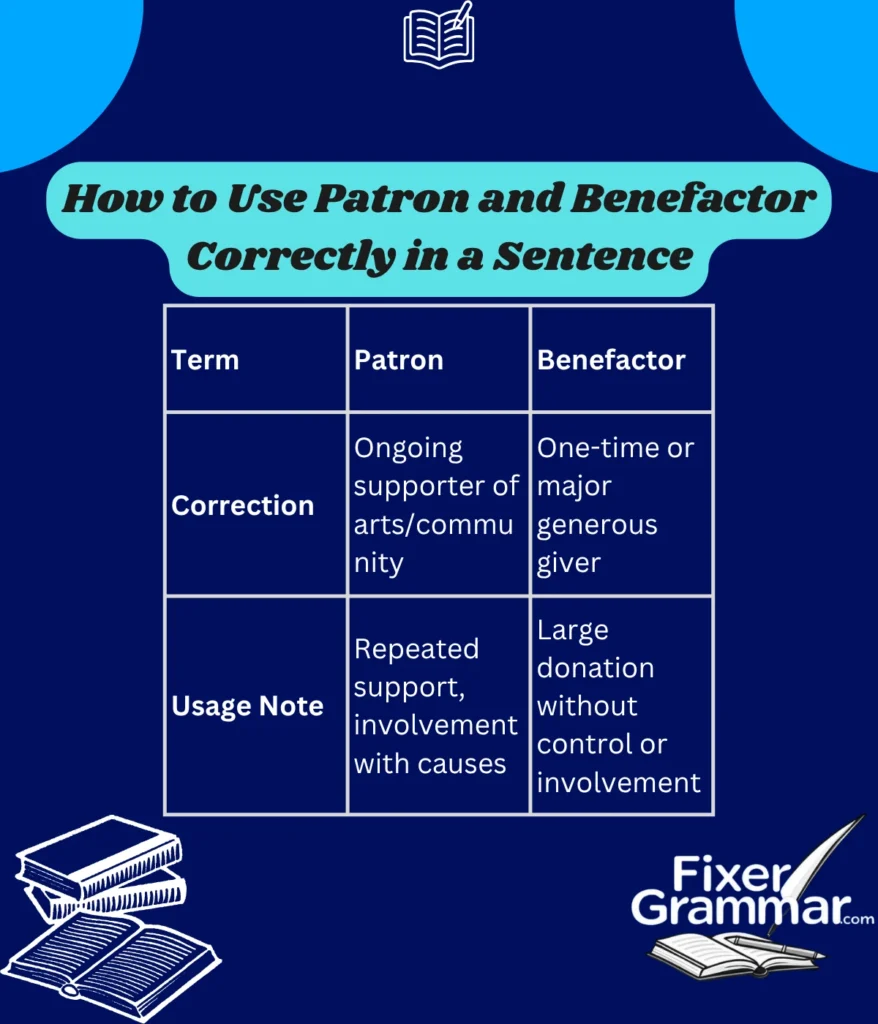
Seeing these words in context makes the difference click instantly.
“Patron” in sentences:
- The gallery survived difficult years because of its loyal patrons.
- She became a patron of the local theater, attending every opening night.
- Regular patrons of the café received invitations to exclusive tastings.
- The orchestra honored its longest-serving patron at the anniversary gala.
- He acted as a patron for three emerging painters, commissioning new work each season.
“Benefactor” in sentences:
- The university named its new science wing after an anonymous benefactor.
- Thanks to a generous benefactor, the shelter was rebuilt after the fire.
- A mysterious benefactor funded the artist’s first solo exhibition.
- The hospital’s new research center exists because of a single benefactor’s gift.
- MacKenzie Scott is widely considered one of the most impactful benefactors of her generation.
Quick usage guide:
- Ongoing relationship + arts or community = patron
- Large gift + generosity without control = benefactor
More Posts:As Evidenced By or As Evident By – Which Is Correct? 2026
FAQ’s About Patron vs. Benefactor
What is the main difference between a patron and a benefactor?
A patron provides consistent, ongoing support and stays involved over time. A benefactor gives — usually in a large or one-time way — without expecting long-term engagement.
Can patron and benefactor be used interchangeably?
No. The relationship, intent, and type of support differ. Using the wrong word can misrepresent the donor’s role and undermine trust in professional writing.
Is a patron always involved in art or culture?
Not at all. Patrons appear in business (loyal customers), religion (patron saints), education (program sponsors), and digital media (Patreon supporters). The arts connection is strong historically but not exclusive.
Are benefactors only focused on money?
Mostly, yes — but a benefactor can also provide land, equipment, services, or resources. The key is that their contribution is significant and not tied to ongoing involvement.
Why does correct usage of patron vs. benefactor matter?
It affects tone, accuracy, and professional credibility. In donor communications and nonprofit writing, the right word shows respect for the contribution and avoids confusion. There is also a minor spelling difference worth noting: British English uses “benefactor” identically, but “patronize” carries a condescending connotation in both varieties — context always matters.
Final Verdict
The answer is straightforward. Use patron when someone stays involved. Use benefactor when someone gives big and steps back.
Both roles carry enormous value. Both shape institutions, communities, and creative work in ways that last for generations. But they describe different relationships — and language that respects that difference communicates more clearly, more professionally, and more honestly.
When in doubt, ask one simple question: Is this person still here? If yes — patron. If they gave and moved on — benefactor.

At FixerGrammar.com, Johnson Isaacs shares easy grammar tips, clear examples, and helpful guidance to make writing simple, smooth, and mistake-free.
Related Posts