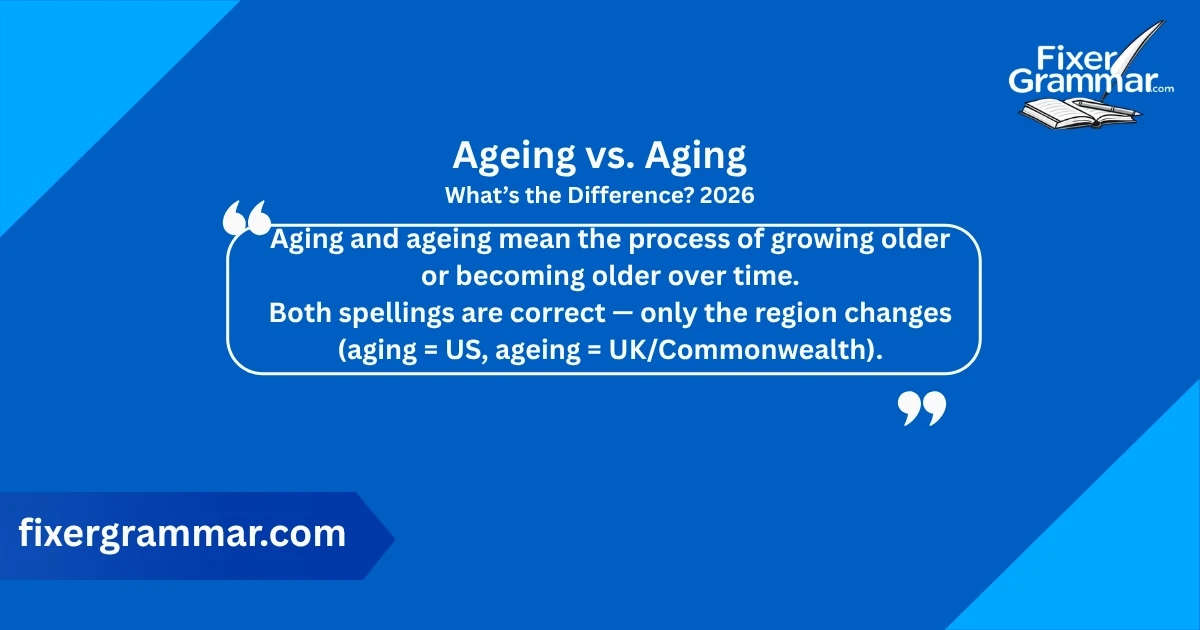
This blog breaks down what each spelling means, when to use it, how grammar works, and a simple trick to never get confused again.
What Do Ageing and Aging Actually Mean?
Both words refer to the process of growing older. This applies to people, animals, objects, and even systems like infrastructure or technology.
The word comes from the verb “to age” — meaning to grow older or develop over time. As a noun, adjective, or verb, the meaning never changes. Only the spelling does.
How it works in sentences:
As a noun — “Aging is a natural part of life.” As an adjective — “The aging bridge needs repairs.” As a verb — “She was aging gracefully.”
Ageing — The British English Spelling
Ageing is the standard spelling used in the UK, Australia, New Zealand, and most Commonwealth countries.
British English tends to keep the silent “e” before adding “-ing.” That’s why you see ageing, cueing, and likeable — they all preserve the extra letter.
Where you’ll commonly see it:
The BBC, The Guardian, UK government health reports, and World Health Organization publications all use ageing as their default spelling.
More Posts:Company-Wide or Companywide– Which Is Correct? 2026
Aging — The Go-To Standard Spelling
Aging is the clean, simplified spelling used in standard everyday writing. It follows the basic English grammar rule — drop the silent “e” before adding “-ing.”
This is the spelling used by the National Institute on Aging, the Wall Street Journal, CNN, USA Today, and most major publications.
Quick grammar rule:
Age → drop the “e” → add “-ing” → Aging
Same rule applies to: stage → staging, cage → caging, wage → waging
Aging vs Ageing — Quick Comparison
| Feature | Aging | Ageing |
|---|---|---|
| Spelling | Without “e” | With “e” |
| Region | Standard / US | UK, Australia, NZ |
| Style Guides | AP, Chicago, MLA | Oxford, OUP |
| Publications | CNN, WSJ, USA Today | BBC, The Guardian |
| Formal Usage | Yes ✓ | Yes ✓ |
| Grammar Role | Noun, Verb, Adjective | Noun, Verb, Adjective |
Both spellings are 100% grammatically correct. The difference is purely regional — not a matter of right or wrong.
How to Use Aging and Ageing Correctly in a Sentence
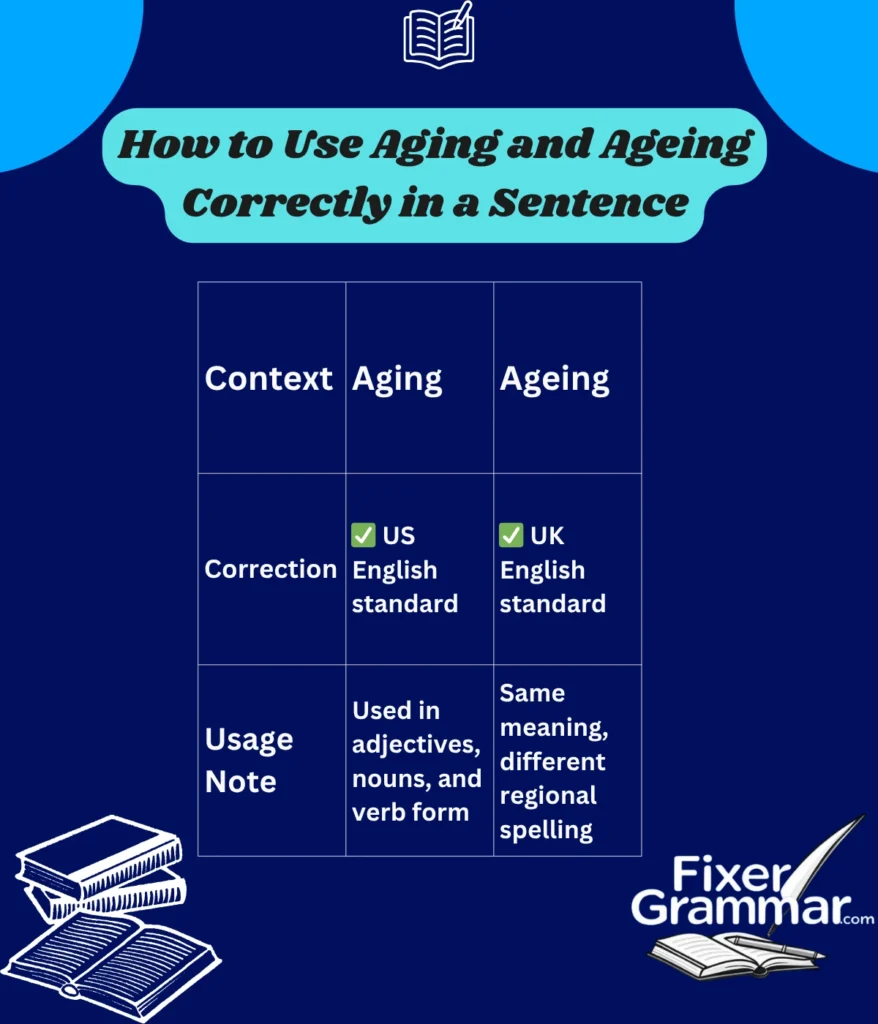
Aging works in three grammatical roles. Here’s how to use it properly:
As an adjective: “The aging population puts pressure on the healthcare system.” “Anti-aging creams are popular in the skincare industry.”
As a noun: “Aging affects everyone differently.” “Scientists are researching ways to slow the aging process.”
As a verb (present participle): “He was aging faster than expected.” “The infrastructure is aging rapidly.”
Common mistakes to avoid:
❌ Mixing both spellings in the same document ❌ Using ageing in a document set to US English spellcheck ❌ Spelling it ageging, agining, or ageing when you mean the US standard form
The rule is simple — pick one spelling and stay consistent throughout your writing.
More Posts:Heard vs Herd vs Hurd– What’s the Difference? 2026
The Trick to Never Confuse Ageing vs. Aging Again
Here’s the memory trick that works every time:
“E for England → Ageing” “No E, no fuss → Aging”
Noah Webster — the man who built American spelling standards in the 1800s — believed spelling should be simple and logical. He removed unnecessary silent letters from dozens of words. That’s how ageing became aging in standard everyday usage.
Another easy way to remember:
Think of similar word pairs: Colour → Color Honour → Honor Ageing → Aging
The pattern is always the same — British English keeps extra letters, simplified spelling drops them.
FAQ’s About Ageing vs. Aging
Is ageing or aging correct?
Both are correct. Aging is the standard everyday spelling, while ageing is preferred in British English. The difference is purely regional — not a grammar error.
Which spelling do most dictionaries use?
Merriam-Webster (the leading US dictionary) lists aging as the primary entry. Oxford lists ageing as the British standard. Both recognize the other form as valid.
Is it anti-aging or anti-ageing?
Anti-aging is the standard form used in most skincare, health, and wellness writing. Anti-ageing appears in British publications. Both are accepted.
Can I use ageing in formal writing?
Yes — ageing is fully accepted in formal writing, especially in Commonwealth countries. In standard US-based formal writing, aging is preferred.
Does the spelling change the meaning?
No. The meaning is identical. Both refer to the process of growing older — whether describing people, objects, or biological processes.
Which spelling should I use for SEO?
Use aging as your primary keyword for general and US-focused content. You can include ageing naturally as a variation to capture both audiences.
Is ageism spelled differently too?
Interestingly, no. The word ageism — meaning discrimination based on age — is spelled the same in both British and standard English. No “e” variation exists for this word.
The Bottom Line
Aging and ageing mean the same thing. One letter does not change the meaning — it only reflects where the word is being used.
Stick with aging for standard everyday writing. Use ageing when writing for a British or Commonwealth audience. Most importantly — stay consistent. Pick one spelling and use it throughout your entire piece.
That’s the only rule that truly matters.

At FixerGrammar.com, Johnson Isaacs shares easy grammar tips, clear examples, and helpful guidance to make writing simple, smooth, and mistake-free.
Related Posts