This guide breaks down the difference clearly, with real examples, a simple memory trick, and answers to the most common questions people have about this confusing word pair.
What Does Checkup Mean? & What Does Check Up Mean?
What is the meaning of checkup?
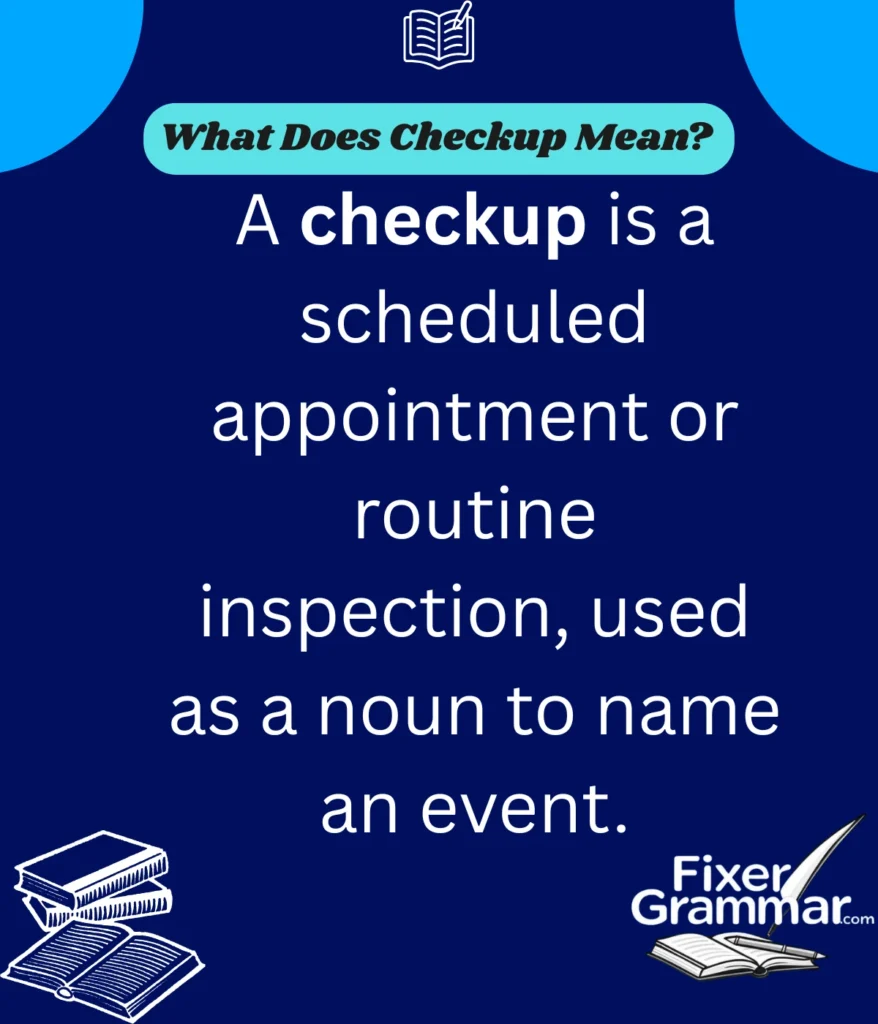
A checkup is a thing — a scheduled appointment or routine inspection. It names an event, not an action. You can place “a” or “the” in front of it.
Checkup vs Check up vs Check-up
| Form | Part of Speech | Example |
|---|---|---|
| checkup | Noun | I have a checkup at 9 AM. |
| check up | Phrasal Verb | She will check up on the patient. |
| check-up | Adjective (old form) | My check-up appointment is Thursday. |
What does check up mean as a verb?
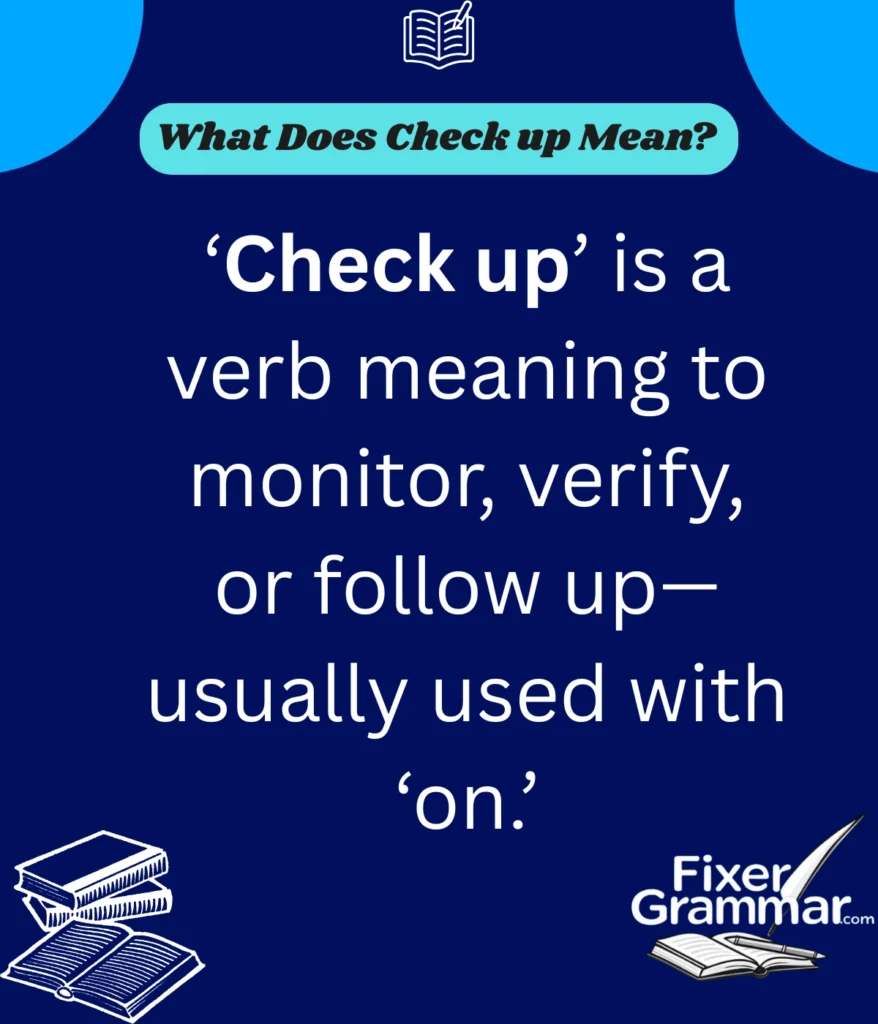
Check up describes the action of monitoring, following up, or verifying something — usually paired with “on.” It is never a noun. You cannot say “I have a check up tomorrow” and mean a scheduled appointment.
- The doctor checked up on her patients every morning.
- Can you check up on the report before the meeting?
Checkup vs Check Up — The Core Grammatical Difference
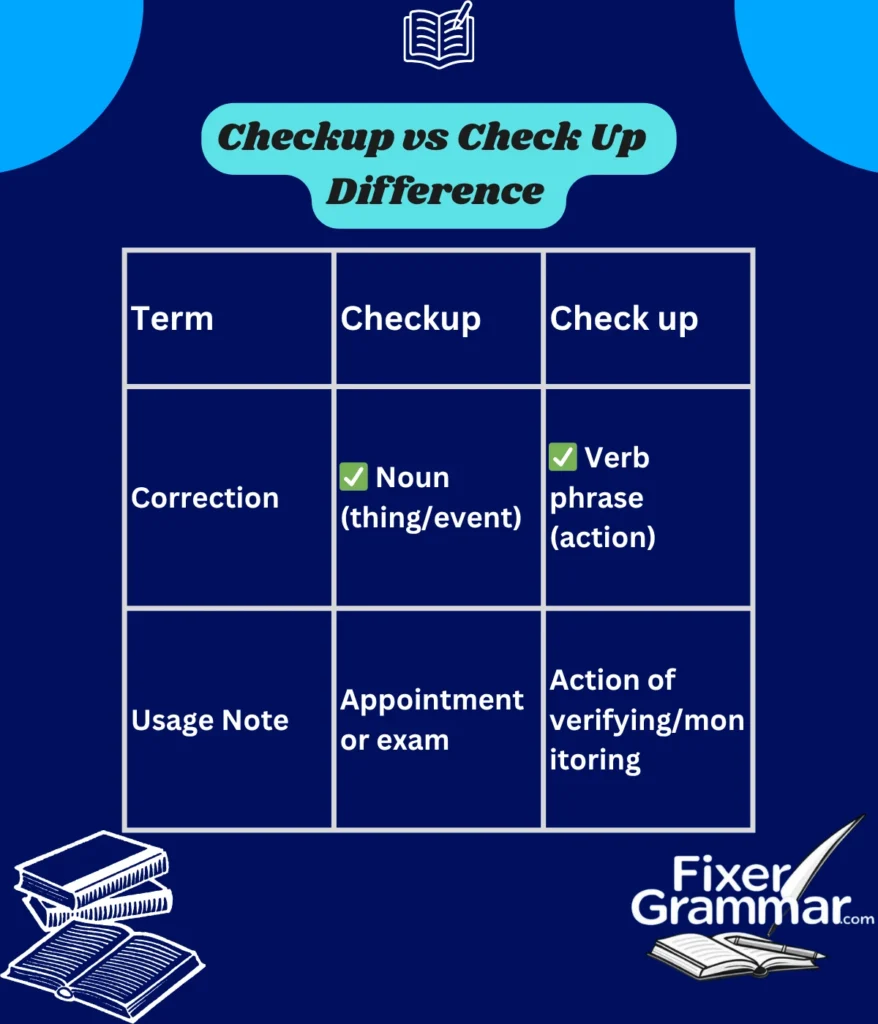
What is the difference between checkup and check up?
The difference is grammar. One is a noun. One is a verb phrase. That single distinction determines everything.
- ❌ “I need to checkup on him.” → Wrong — checkup cannot be a verb.
- ✅ “I need to check up on him.” → Correct — two words for the action.
- ❌ “My check up is at noon.” → Wrong — the appointment needs the noun form.
- ✅ “My checkup is at noon.” → Correct — one word for the event.
Quick tip: Ask yourself — am I naming a thing or describing an action?
If it’s a thing, write checkup. If it’s an action, write check up.
More Posts:Unregister vs Deregister– What’s the Difference? 2026
Real-World Uses of Checkup in Everyday English
Where do we use the word checkup most?
The noun checkup appears across several everyday contexts — not just at the doctor’s office.
Medical checkups are the most familiar use. The CDC recommends adults schedule an annual checkup to catch conditions like hypertension or high cholesterol early. Studies show that people who attend yearly physicals are 35% more likely to detect health problems before they become serious.
- “The pediatrician completed a routine checkup and confirmed healthy development.”
- “My dental checkup revealed I needed a small filling.”
Financial checkups are growing in popularity too. Financial advisors recommend a yearly financial checkup to review savings, debt, and retirement goals — especially 401(k) contributions and credit scores.
Vehicle checkups are equally important. Mechanics perform a car checkup to inspect brakes, fluids, and tires. Skipping regular vehicle checkups can lead to costly repairs down the road.
- Tech checkup — IT teams run system checkups to catch software vulnerabilities.
- Vision checkup — Optometrists suggest once-a-year eye checkups, especially for contact lens wearers.
Real-World Uses of Check Up in Everyday English
When should you use check up as a phrasal verb?
Use check up when someone is taking action — following up, verifying, or monitoring someone or something.
It almost always appears with the preposition “on”:
- A manager might check up on an employee’s progress.
- A nurse will check up on patients after surgery.
- “I called to check up on my elderly neighbor after the storm.”
You can occasionally drop “on” when the meaning stays clear:
- “The doctor stopped by to check up.”
Check up naturally fits roles involving care, supervision, or verification. Parents check up on children. Teachers check up on struggling students. Friends check up on each other after tough times.
Easy Trick to Remember — Checkup or Check Up Every Time
How do you remember when to use checkup vs check up?
Here is the simplest rule:
One word = one event. Two words = taking action.
Try this three-step test before you write:
- Step 1: Can you put “a” or “the” in front of it? → Use checkup (noun)
- Step 2: Are you describing something someone is doing? → Use check up (verb)
- Step 3: Are you modifying another noun? → Use check-up as an adjective
This same pattern applies to many similar word pairs in English:
Noun vs Verb (One Word vs Two Words)
| Noun (One Word) | Verb (Two Words) |
|---|---|
| checkup | check up |
| backup | back up |
| setup | set up |
| checkout | check out |
| makeup | make up |
The pattern is consistent. Once you learn it for checkup, you know it for all of them.
Common mistakes to avoid:
- ❌ “I will checkup on the files.” → Use two words when it’s a verb
- ❌ “She booked a check up.” → Use one word when it’s a noun
- ❌ “She checked up her team.” → Always add “on” — “checked up on her team”
More Posts:Heard vs Herd vs Hurd– What’s the Difference? 2026
FAQ’s About Checkup and Check Up
Is checkup one word or two words?
As a noun, it is one word: checkup. As a phrasal verb, it is two words: check up. The form depends entirely on how you use it in the sentence.
Can I write check-up with a hyphen?
Yes, but it is considered old-fashioned. Modern usage strongly prefers checkup for the noun. The hyphenated form check-up is still technically correct but declining in everyday writing.
Which is correct — “get a checkup” or “get a check-up”?
Get a checkup is the preferred modern form. Both are understood, but the single-word noun is cleaner and more widely accepted today.
How do I use the verb form correctly?
Use check up as two words and pair it with “on” when referring to a person or thing: “I will check up on the project by Friday.”
Do I need an article before checkup?
Most of the time, yes. You would say “a checkup,” “the checkup,” or “an annual checkup.” It is a countable noun, so articles apply naturally.
Is there a difference between American and British English?
British English traditionally used check-up with a hyphen. Standard usage in both countries now increasingly favors the single-word checkup, especially in medical and professional writing.
Is checkup countable? Can I say “two checkups”?
Yes. Checkup is fully countable. “I had two checkups this year” is grammatically correct and natural.
Can checkup be used for machines or cars?
Absolutely. The word extends beyond medicine. “The mechanic gave the car a quick checkup” is a common and correct use of the noun form.
The Bottom Line
The rule is simple: checkup (one word) is always a noun. Check up (two words) is always a verb phrase. Keep that single distinction in mind and you will never confuse them again.
When you are naming an appointment or inspection, write checkup. When you are describing the action of monitoring or following up, write check up on. That is all you need to know.

At FixerGrammar.com, Johnson Isaacs shares easy grammar tips, clear examples, and helpful guidance to make writing simple, smooth, and mistake-free.
Related Posts