In this blog, you’ll learn exactly when to use each phrase, the grammar rules behind them, common mistakes to avoid, and the best alternatives for both.
What Do “Thus Far” and “So Far” Actually Mean?
Both phrases are adverbial expressions. They describe how much has happened up to the present moment.
Thus far comes from Old English þus, meaning “in this way.” It has always carried a serious, deliberate weight. You’ll find it in academic papers, legal documents, and formal speeches.
So far comes from Old English swa, meaning “in like manner.” Over centuries, it became the lighter, everyday version. It’s what most people say naturally in conversation, emails, and casual writing.
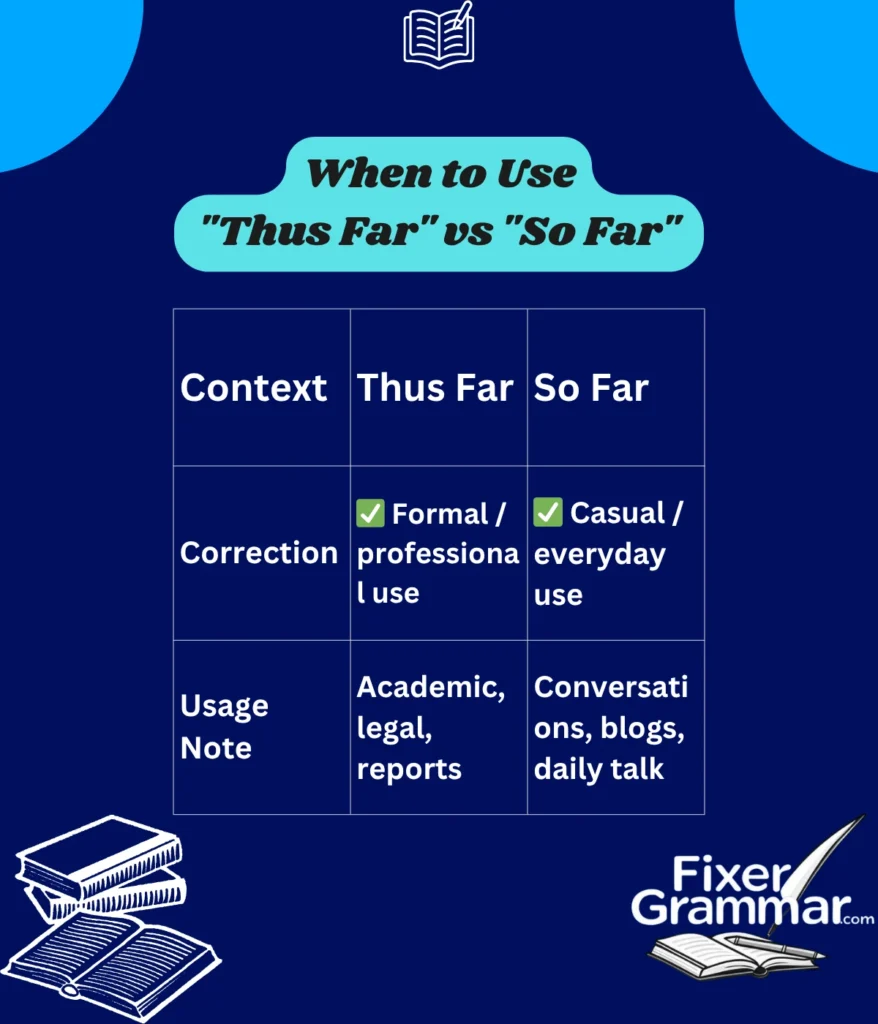
Thus Far vs So Far
| Phrase | Core Meaning | Tone | Most Common In |
|---|---|---|---|
| Thus Far | Up to this point | Formal, polished | Reports, academic writing, speeches |
| So Far | Up to now | Casual, conversational | Everyday speech, texts, blogs |
The Key Difference: Formality and Tone
Think of it this way — thus far is the tuxedo. So far is the T-shirt. Both cover you, but only one fits the occasion.
Thus far signals authority and precision. So far signals warmth and approachability.
Readers pick up on these cues instantly, even if they can’t explain why.
Quick rule:
- Writing a report, thesis, or formal email? → Use thus far
- Talking to a friend, writing a blog, or sending a Slack message? → Use so far
More Posts:Full Proof or Foolproof — What’s the Difference ? 2026
When to Use “Thus Far” vs “So Far” — Real-World Examples
Knowing the rule is one thing. Seeing it in action is another.
Academic / Professional → Use Thus Far
- “Thus far, the research supports our original hypothesis.”
- “The negotiations have, thus far, remained productive.”
- “Thus far, no violations have been recorded.”
Casual / Everyday → Use So Far
- “So far, I’m really enjoying this book.”
- “So far, so good — no complaints!”
- “We’ve raised $5,000 so far.”
The wrong phrase in the wrong place:
❌ “Thus far, I’m loving this pizza!” (too stiff for casual talk) ❌ “So far, the defendant has shown no remorse.” (too casual for legal writing)
The moment you match the phrase to the setting, your writing instantly improves.
Grammar Rules: Placement, Punctuation & Tense
Where you place these phrases matters — and so does the comma.
Both thus far and so far work in three positions in a sentence:
- Beginning: “So far, everything looks great.”
- Middle: “We have, thus far, met every deadline.”
- End: “No problems have come up thus far.”
Comma Usage with “So Far” / “Thus Far”
| Position | Comma Needed? | Example |
|---|---|---|
| Beginning of sentence | ✅ Yes | “Thus far, the plan is working.” |
| Middle of sentence | ✅ Yes (both sides) | “The team has, so far, exceeded targets.” |
| End of sentence | ❌ No | “Everything is going well so far.” |
Tense tip: Always pair these phrases with the present perfect tense — have/has + past participle.
✅ “We have completed all tasks thus far.” ❌ “We completed all tasks thus far.” (incorrect — past simple doesn’t work here)
Synonyms & Alternatives for Both Phrases
Formal alternatives for “thus far”:
- To date — “To date, no issues have been reported.”
- As yet — “As yet, the results remain inconclusive.”
- Hitherto — “The policy has hitherto been ignored.”
- Up to this point — “Up to this point, progress has been strong.”
Casual alternatives for “so far”:
- Until now — “Until now, things have been smooth.”
- Up till now — “Up till now, no one has complained.”
- By now — “By now, you should have the email.”
- At this stage — “At this stage, we’re on track.”
Pro tip: In reports or presentations, “to date” is a sharp, clean swap for thus far. In friendly emails, “until now” works perfectly in place of so far.
More Poosts:Ingrained or Engrained – Which Is Correct? 2026
FAQ — How to Use Thus Far in a Sentence?
How to use thus far in a sentence?
Place thus far at the beginning, middle, or end of a sentence with present perfect tense. Example: “Thus far, the results have been promising.” Always add a comma when it opens the sentence.
Is “thus far” the same as “so far”?
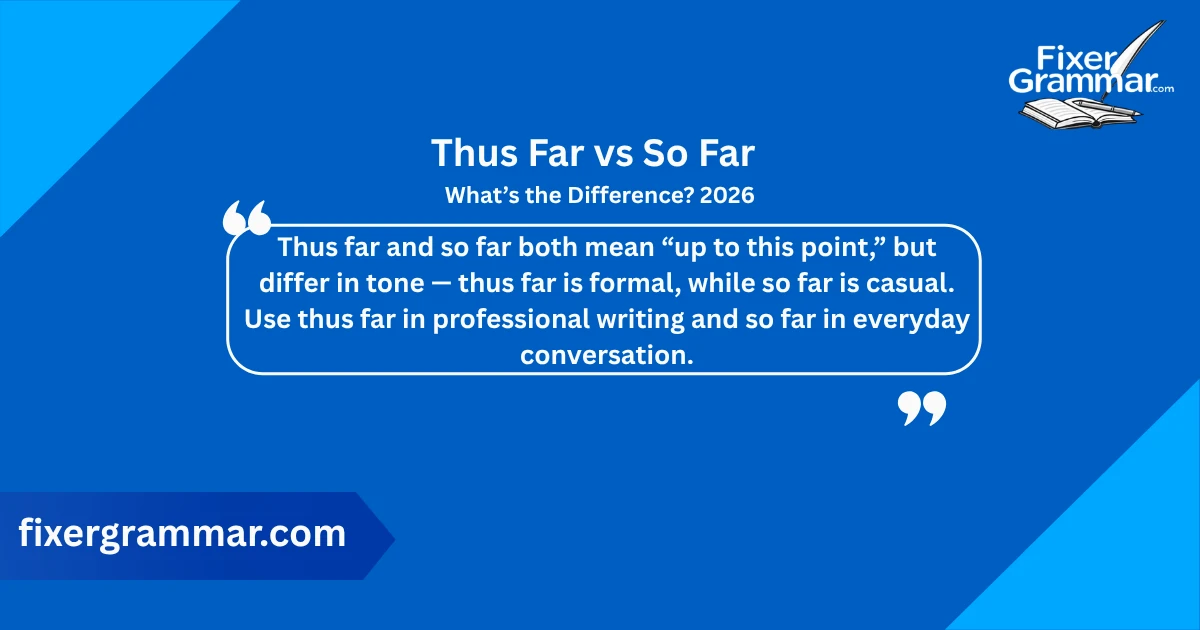
They share the same core meaning — “up to this point” — but differ in tone. Thus far is formal; so far is casual. They are not always interchangeable.
Can I use “thus far” in everyday conversation?
Technically yes, but it will sound overly stiff. Most people naturally say “so far” in speech. Save thus far for written, formal contexts.
Is “thus far” outdated?
Not at all. It’s alive and well in academic writing, legal documents, formal speeches, and professional reports. It’s simply formal — not old-fashioned.
What is the difference between “thus far” and “this far”?
Thus far = time (up until now). This far = distance (this much distance traveled). They are completely different phrases despite looking similar.
Does British English use these phrases differently?
This is one area where regional usage differs slightly. British English still uses thus far more frequently in formal circles, while standard usage today leans heavily toward so far across most contexts — especially in speech and informal writing.
Conclusion
The choice between thus far vs so far comes down to one thing — tone. If the moment calls for formality, thus far delivers precision and authority. If the setting is casual, so far keeps your message natural and relatable.
Both phrases are grammatically correct. Both mean the same thing at the core. The only question is: how do you want to sound?
Match the phrase to your audience, and your writing will always feel right.

At FixerGrammar.com, Johnson Isaacs shares easy grammar tips, clear examples, and helpful guidance to make writing simple, smooth, and mistake-free.
Related Posts