This guide explains the grammar rules, examine real-world examples, and give you practical tools for confident communication.
Who to Contact or Whom to Contact – Which One Is Correct?

The grammatically correct phrase is “whom to contact.” Grammar rules state that “whom” functions as an object pronoun, meaning it receives the action in a sentence.
You (the subject) are doing the contacting, and “whom” is the person receiving that contact. The structure follows subject-verb-object order.
“Who to contact” breaks traditional grammar rules because “who” is a subject pronoun. Using two subject pronouns (“who” and “I”) in the same sentence creates confusion about which one performs the action.
That said, modern usage has made “who to contact” acceptable in casual conversations, emails to friends, and informal workplace communication. Language evolves, and strict grammar rules have relaxed over time.
| Phrase | Grammatical Status | Best Used For |
| Whom to contact | Formally correct | Business letters, academic writing, professional emails |
| Who to contact | Informally accepted | Casual emails, everyday speech, friendly conversations |
More Posts: “At the House” vs “In the House” – Which Is Correct?
“Who” vs. “Whom” – The Grammar Rule Behind It
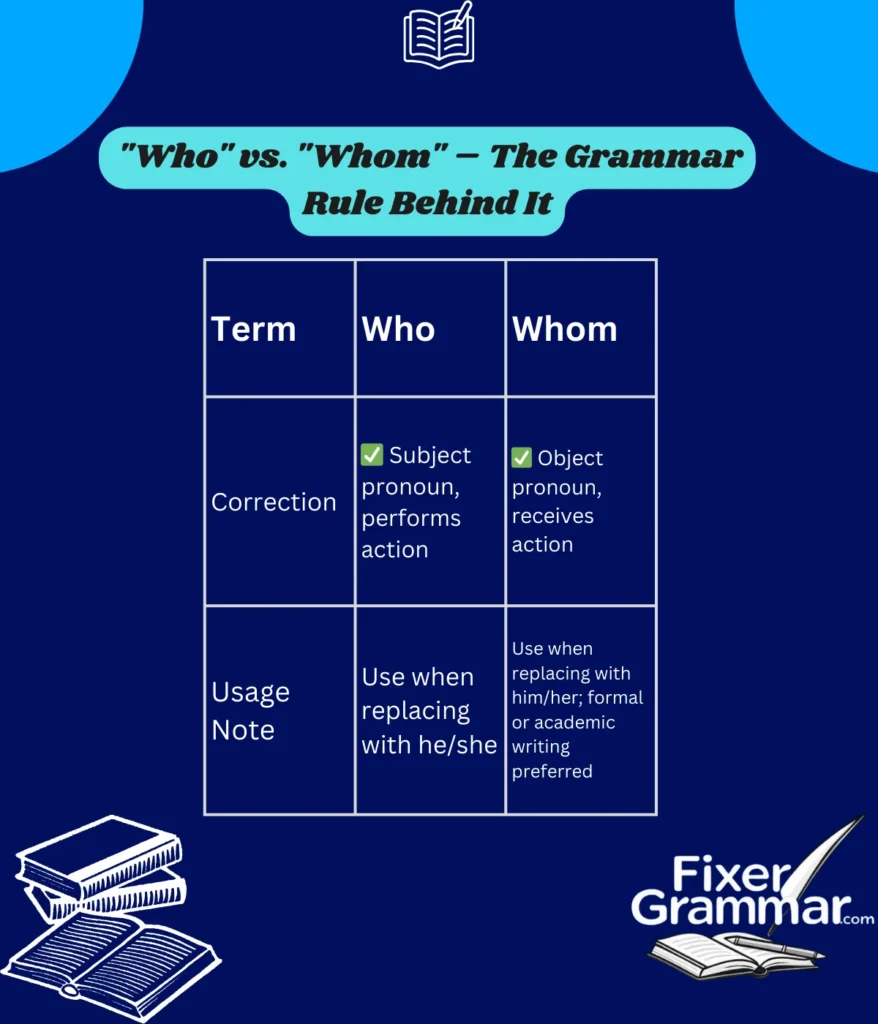
Subject pronouns (who, I, he, she, they) perform actions in sentences.
Object pronouns (whom, me, him, her, them) receive actions.
The word “whom” serves as the object receiving the verb’s action. When you contact someone, that person becomes the object of your action. Therefore, “whom” fits the object position.
“Who” performs actions rather than receives them. Saying “who should I contact” puts two subjects in one sentence without clearly identifying the object.
If you can replace the word with “him” or “her,” use “whom.” If you can replace it with “he” or “she,” use “who.”
English has gradually simplified over decades. The word “whom” appears less frequently in spoken language because it sounds formal or old-fashioned to many speakers. Business writing and academic contexts still prefer grammatical precision.
The He/Him Trick – Never Confuse Who and Whom Again
This simple replacement method works every time. Rephrase your question as a statement using “him” or “he.”
If “him” fits naturally, use “whom.” If “he” sounds correct, use “who.” Both words end in “m,” making this an easy memory tool.
Example 1: Should I contact him? (Him works → Use whom)
- Correct: Whom should I contact?
Example 2: He will contact me. (He works → Use who)
- Correct: Who will contact me?
The him/he replacement never fails because both sets follow identical grammatical patterns.
When to Use “Who to Contact” vs. “Whom to Contact”
| Scenario | Recommended Phrase | Reason / Notes |
| Professional business emails | Whom to contact | Shows attention to grammatical detail; expected in formal correspondence with clients and supervisors |
| Academic writing | Whom to contact | Required in research papers, dissertations, and scholarly articles; strict grammatical standards |
| Customer service | Who to contact | Sounds friendlier and more approachable; clarity is prioritized over strict grammar |
| Casual workplace communication | Who to contact | Suitable for team chats, quick emails, and internal memos; matches relaxed office tone |
| Job applications / cover letters | Whom to contact | Creates a professional impression; hiring managers notice grammatical choices |
| Everyday conversations | Who to contact | Aligns with spoken language trends; “whom” is rarely used in casual speech |
More Posts: By Which or In Which? Meaning, Usage Rules & Examples Explained
Real Examples
Business correspondence:
- “Please advise whom to contact regarding the contract renewal.”
- “Could you tell me whom to contact in the accounting department?”
Customer service scenarios:
- “I’m not sure who to contact about my order status.”
- “Can you help me figure out who to contact for technical support?”
Job application contexts:
- “I would appreciate knowing whom to contact for follow-up questions.”
- “The job posting doesn’t specify whom to contact with additional materials.”
Email templates:
- Formal: “I am writing to inquire whom to contact about partnership opportunities.”
- Casual: “Hey, do you know who to contact about the office party?”
Professional networking:
- “I need to know whom to contact at your company regarding consulting services.”
- “Could you share whom to contact for media inquiries?”
Notice how formal contexts naturally accommodate “whom” while casual settings work better with “who.” Your audience and purpose determine the best choice.
FAQ‘s
Is it “who to contact” or “whom to contact” in formal writing?
“Whom to contact” is correct for formal writing. Use it in business letters, academic papers, and professional emails where grammatical precision matters.
Can I use “who to contact” in professional emails?
Yes, “who to contact” works in most professional emails, especially for internal communication. Save “whom” for extremely formal situations or when writing to executives.
Is “whom” outdated in modern English?
“Whom” isn’t outdated, but it’s used less frequently in casual speech. Formal writing and professional contexts still value grammatical correctness.
What’s the difference between who and whom?
“Who” is a subject pronoun that performs actions. “Whom” is an object pronoun that receives actions. Use the him/he test to decide.
How do I remember when to use whom?
Replace the word with “him.” If “him” sounds right, use “whom.” Both end in “m,” making this trick easy to remember.
Final Verdict
Choose “whom to contact” for maximum grammatical correctness. This choice demonstrates strong writing skills and attention to detail in professional settings.
Choose “who to contact” for casual conversations and informal emails. Modern usage accepts this phrasing, and it sounds more natural to most speakers.
Quick reference guide:
- Formal business letter → Whom to contact
- Email to your boss → Whom to contact
- Academic paper → Whom to contact
- Text to coworker → Who to contact
- Casual conversation → Who to contact
The him/he trick remains your most reliable tool. When in doubt, rephrase the sentence and test which pronoun fits naturally.Both options convey your message effectively when used in appropriate contexts.

At FixerGrammar.com, Johnson Isaacs shares easy grammar tips, clear examples, and helpful guidance to make writing simple, smooth, and mistake-free.
Related Posts