Let’s break down exactly when and why “she has” is correct, explore common mistakes, and give you practical examples you can use right away.
The Quick Answer: She Has vs. She Have
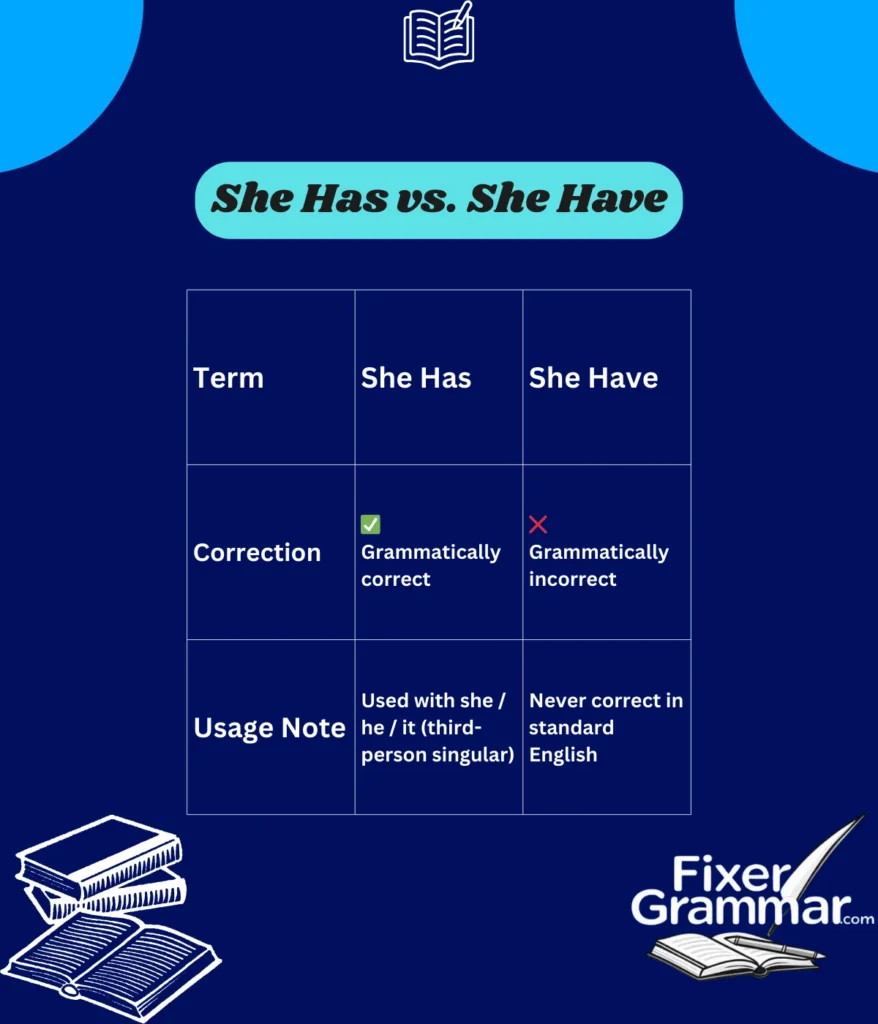
The correct phrase is always “she has.” The form “she have” is grammatically incorrect in standard English.
This rule applies whether you’re talking about possession, experiences, obligations, or actions. The verb “to have” changes to “has” when paired with third-person singular subjects like she, he, or it.
Has vs Have – Subject Verb Agreement
| Subject | Correct Verb | Example |
| She | has | She has a meeting today |
| He | has | He has three sisters |
| It | has | It has stopped raining |
| I / You / We / They | have | They have arrived early |
More Posts: Time Slot vs Timeslot: Which is Correct, Usage and Common Mistakes
Why “She Has” Is Always Correct (Understanding Subject-Verb Agreement)
The English language follows strict subject-verb agreement rules. When your subject is a third-person singular pronoun (she, he, it), the verb “to have” must change to “has.”
This isn’t random – it’s a fundamental grammar pattern. Think of it like this: the verb must “agree” with who’s doing the action. With singular third-person subjects, verbs typically add an “s” or change form.
Common situations where “she has” appears:
- Possession: She has a beautiful voice.
- Characteristics: She has brown eyes and curly hair.
- Obligations: She has to finish the report by Friday.
- Experiences: She has visited Paris three times.
- Current states: She has a headache right now.
The verb “has” works exactly the same whether you’re talking about physical objects, qualities, responsibilities, or completed actions.
She Has vs. She Have in Different Tenses and Forms
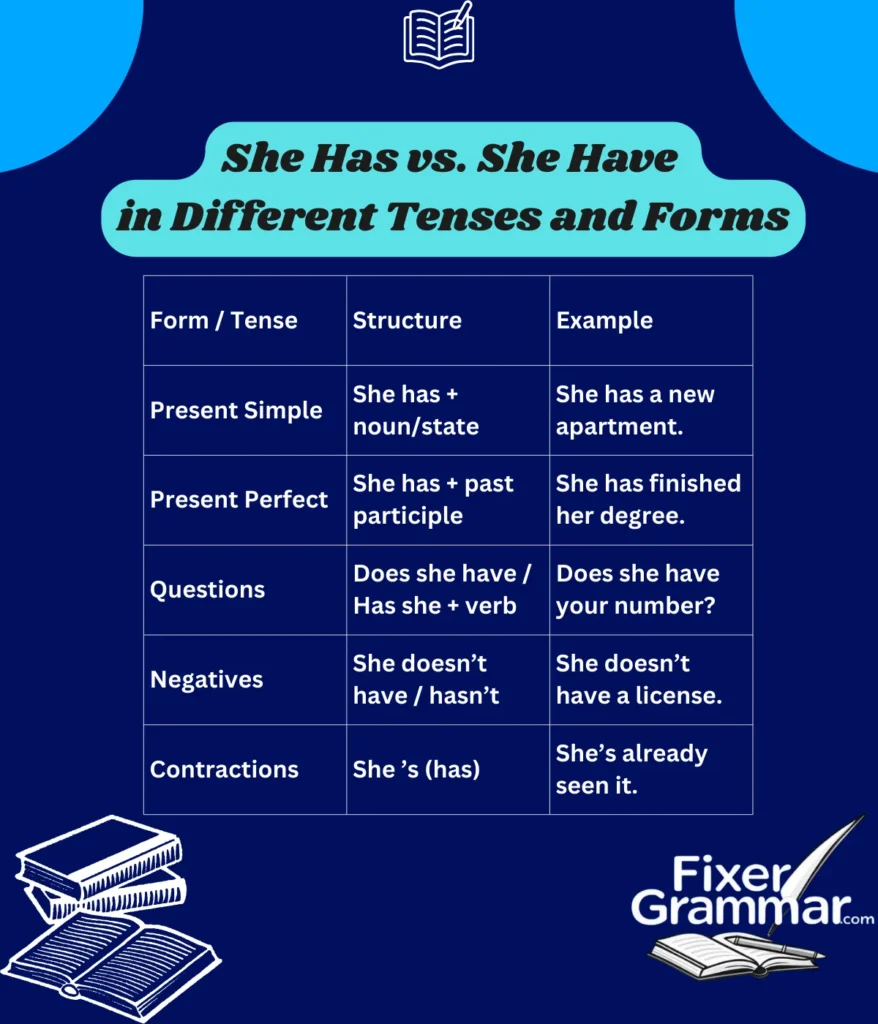
Understanding how “she has” works across different sentence types will make you confident in any writing situation.
Present Simple (Possession & States) Use “has” to show what someone owns or their current condition.
- She has a new apartment downtown.
- She has incredible talent for music.
- She has two younger brothers.
Present Perfect (Completed Actions) Use “has” + past participle to show actions completed before now.
- She has finished her degree in engineering.
- She has worked here for five years.
- She has never tried sushi before.
Questions with “have” Questions use “does” + “have” or invert “has” in perfect tense.
- Does she have your phone number?
- Has she called you back yet?
- Has she ever mentioned moving abroad?
Negative Forms Negatives use “doesn’t have” or “hasn’t” depending on tense.
- She doesn’t have a driver’s license.
- She hasn’t received the email yet.
- She hasn’t been feeling well lately.
Contractions (Informal Writing) In casual writing and speech, “has” contracts to “‘s.”
- She**’s** got an important meeting.
- She**’s** been waiting for an hour.
- She**’s** already seen that movie.
| Form | Construction | Example |
| Statement | She has | She has a question |
| Question (present) | Does she have | Does she have time? |
| Question (perfect) | Has she | Has she arrived? |
| Negative (present) | She doesn’t have | She doesn’t have cash |
| Negative (perfect) | She hasn’t | She hasn’t responded |
| Contraction | She’s | She‘s right here |
The key is recognizing that “has” appears in statements and perfect tense questions, while “have” appears after “does” in present tense questions and after modal verbs.
More Posts: “At the House” vs “In the House” – Which Is Correct?
Examples Using “She Has” Correctly in Sentences
Seeing “she has” in realistic contexts helps you internalize the pattern naturally. Here are practical examples you’ll encounter in everyday communication.
Professional contexts:
- She has ten years of experience in marketing.
- She has scheduled the client presentation for Tuesday.
- She has exceeded her sales targets this quarter.
- She has submitted all required documentation.
Personal descriptions:
- She has an infectious laugh that fills the room.
- She has the same sense of humor as her father.
- She has beautiful handwriting, almost like calligraphy.
- She has a photographic memory for faces.
Daily activities and states:
- She has yoga class every Wednesday evening.
- She has a dentist appointment tomorrow morning.
- She has been learning Spanish for six months.
- She has finally mastered that difficult recipe.
Common phrases and expressions:
- She has a point about the budget concerns.
- She has her heart set on studying abroad.
- She has the final say in hiring decisions.
- She has what it takes to succeed.
Notice how “has” works identically whether describing possessions, qualities, appointments, or idiomatic expressions. The grammar rule never changes based on meaning – if the subject is “she,” the verb is “has.”
FAQ’s
Is it “she has” or “she have” in a question?
In questions, use “Does she have…?” for present simple or “Has she…?” for present perfect. Never use “she have” in questions.
When do you use “she have” in English?
You never use “she have” as a standalone construction. Use “have” only after modal verbs (should/could/would have) or in questions with “does.”
Why is “she have” incorrect?
“She have” violates subject-verb agreement rules. Third-person singular subjects (she, he, it) require “has” in present tense, not “have.”
Can “she have” ever be correct?
Only in two cases: questions (“Does she have…?”) and after modals (“She should have…”). Otherwise, it’s always “she has.”
What about “she have to” vs. “she has to”?
“She has to” is correct for obligations. Example: “She has to submit the form today.” “She have to” is always wrong.
Is “she has got” the same as “she has”?
Yes, “she has got” and “she has” mean the same thing when showing possession. “She’s got a car” = “She has a car.” Both are correct.
Conclusion
The rule is simple: always use “she has,” never “she have.” This applies to all situations except questions with “does” or sentences with modal verbs.
Master this basic grammar pattern, and you’ll write with confidence in any professional or personal context. The subject-verb agreement rule isn’t complicated – third-person singular subjects need “has,” and that’s a fact you can rely on every single time.
Practice recognizing “she has” in the content you read, and it will become second nature in your own writing.

At FixerGrammar.com, Johnson Isaacs shares easy grammar tips, clear examples, and helpful guidance to make writing simple, smooth, and mistake-free.
Related Posts