This guide breaks down everything you need to know about leapt vs leaped, including pronunciation differences, common spelling errors, and practical usage tips.
Is It Leaped or Leapt? The Quick Answer
Yes, both spellings are completely acceptable. The verb “leap” has two standard past tense forms that grammar experts recognize as correct.
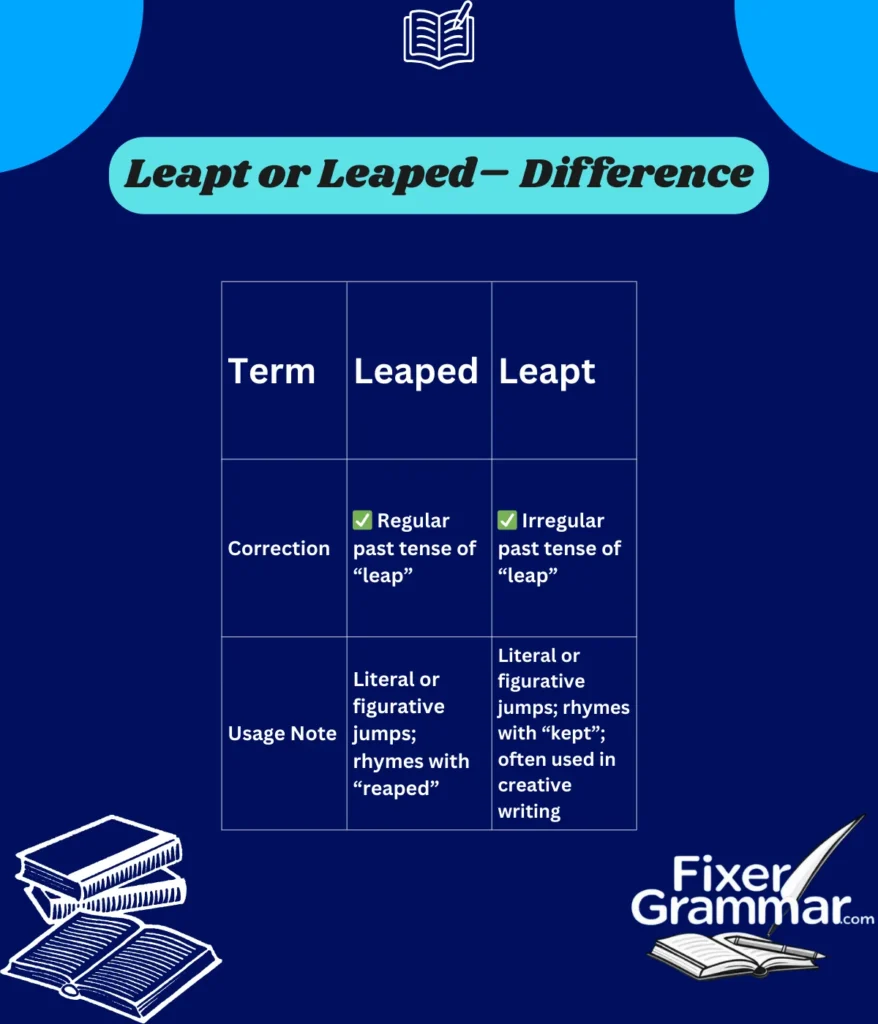
Leaped (pronounced “LEEPD”) is the more traditional regular verb form. It follows the standard pattern of adding “-ed” to create the past tense, just like “jumped” or “walked.”
Leapt (pronounced “LEPT”) is the irregular form. It belongs to a smaller group of verbs that change their spelling in the past tense, similar to “slept” or “kept.”
Neither form is wrong. Your choice between leaped or leapt depends on how the word sounds in your sentence. Some writers prefer the crisp sound of “leapt,” while others like the flowing rhythm of “leaped.”
Understanding the Difference
What Does Leaped Mean?
Leaped is the regular past tense form of “leap.” It means to have jumped, hopped, or moved quickly from one position to another.
The word rhymes with “reaped,” “peeped,” and “beeped.” This pronunciation makes it sound like a two-syllable word with emphasis on the first syllable.
Here are practical examples:
- The cat leaped onto the counter when she heard the can opener.
- Stock prices leaped 15% after the announcement went public.
- Children leaped with joy when they saw the surprise birthday cake.
Leaped works in both literal and figurative contexts. You can use it to describe physical jumping or metaphorical jumps like assumptions, conclusions, or sudden changes.
What Does Leapt Mean?
Leapt is the irregular past tense form of “leap.” It carries the exact same meaning as “leaped” but sounds completely different when spoken aloud.
This version rhymes with “kept,” “slept,” and “wept.” The pronunciation creates a single, sharp syllable that feels more abrupt and energetic.
Consider these examples:
- The dancer leapt across the stage with incredible grace.
- My heart leapt when I saw the acceptance letter in the mail.
- The tiger leapt through the burning hoop without hesitation.
Leapt often appears in creative writing because its compact sound creates rhythm. Poets and fiction writers frequently choose this form for its punchy, dynamic quality.
More Posts:Time Slot vs Timeslot: Which is Correct, Usage and Common Mistakes
How to Pronounce Leaped and Leapt Correctly
Pronunciation creates the main distinction between these two forms. Getting the sounds right helps you choose which version feels natural in your writing.
For “leaped,” say “LEEPD” with two distinct parts. The first syllable sounds like “leep” (rhyming with “sheep”), followed by a quick “d” sound at the end.
For “leapt,” say “LEPT” as one syllable. It’s a short, sharp sound that begins with “l” and ends with “pt,” similar to how you’d say “kept” or “slept.”
Common pronunciation mistakes include:
- Saying “leaped” as “lept” (mixing up the spellings)
- Pronouncing “leapt” as “lee-apt” (adding extra syllables)
- Using “lept” as a spelling because it sounds like “leapt”
Read your sentence aloud before choosing. If “LEEPD” sounds smooth and natural, write “leaped.” If “LEPT” feels more energetic and fits better, write “leapt.”
Most people develop a preference based on their reading habits. Writers who read classic literature often favor “leapt,” while those who consume modern journalism typically use “leaped.”
Which Should You Use?

Choose based on rhythm and personal preference, not strict rules. Both forms work equally well in all types of writing, from casual emails to academic papers.
Usage statistics show “leaped” appears more frequently in newspapers, magazines, and online content. The Associated Press Stylebook accepts both but notes that “leaped” aligns with standard verb conjugation patterns.
Professional writing standards offer this guidance:
- Business writing: Either works fine; consistency matters more than choice
- Academic papers: Both are acceptable in formal writing
- Creative writing: Use whichever creates better rhythm and flow
- Journalism: “Leaped” appears slightly more often but “leapt” is never wrong
Consider your sentence structure. Sometimes one form simply sounds better than the other in context.
Compare these examples:
- “She leaped over the fence” (flows smoothly)
- “She leapt into action” (feels more dynamic)
The best approach: Let your ear guide you. Read the sentence aloud and pick whichever sounds more natural. There’s no wrong choice between these two correct forms.
Consistency within your document matters more than which form you choose. If you start with “leaped,” stick with it throughout. Mixing both forms randomly can distract careful readers.
More Posts:Propose vs Purpose: Understanding,Definition And Usage
FAQ’s
Is “leapt” or “leaped” more common in the US?
Leaped appears more frequently in modern writing, showing up in about 60% of published content, while leapt accounts for the remaining 40%.
Can I use leapt and leaped interchangeably?
Yes, absolutely. Both are correct past tense forms of “leap” and mean exactly the same thing. Choose based on how each sounds in your sentence.
Is “lept” ever correct?
No, “lept” is always a misspelling. The correct irregular form requires the “a” to make “leapt,” even though you don’t hear that vowel when pronouncing it.
Which form is preferred in formal writing?
Both leaped and leapt work perfectly in formal writing. Academic style guides, business manuals, and professional publications accept either form without preference.
How do you spell the past tense of leap?
The past tense of “leap” can be spelled either “leaped” or “leapt.” Both spellings are standard in dictionaries and grammar references.
Is leaped a real word?
Yes, leaped is the regular past tense form of “leap.” It follows the standard pattern of adding “-ed” to verbs and appears in all major dictionaries.
Final Thoughts
You can’t make a wrong choice between these two correct forms. Whether you write “leaped” or “leapt,” you’re using proper grammar that any editor will accept.
The key takeaway: Trust your instincts. If “leaped” feels natural when you read your sentence aloud, use it. If “leapt” sounds better, go with that instead.
Let the rhythm of your writing guide your decision. The beauty of having two acceptable forms means you can choose the one that makes your prose flow smoothly. Focus on creating clear, engaging content rather than worrying about which past tense form is “better.”

At FixerGrammar.com, Johnson Isaacs shares easy grammar tips, clear examples, and helpful guidance to make writing simple, smooth, and mistake-free.
Related Posts