Wondering whether to say “an hilarious” or “a hilarious”? The correct answer is “a hilarious.”
You’ll learn why “a” is correct, when to use “an” with H-words, and avoid common mistakes that trip up many writers.
The Quick Answer

The correct form is always “a hilarious.” This follows the fundamental article rule in English grammar.
You choose between “a” and “an” based on the sound that follows, not the spelling. The word “hilarious” starts with a hard H sound (/hɪˈleriəs/), so it takes “a.”
Here are clear examples of correct usage:
- That was a hilarious joke.
- She told a hilarious story at dinner.
- We watched a hilarious comedy last night.
The mistake “an hilarious” sounds awkward and breaks the natural rhythm of English speech.
Why “A Hilarious” Is Correct
The Sound-Based Rule Explained
English articles follow a simple pronunciation rule. Use “a” before consonant sounds and “an” before vowel sounds.
The word “hilarious” begins with a pronounced H sound. This makes it a consonant sound, which requires “a” instead of “an.”
Think of it this way: when you say “hilarious” out loud, you clearly hear the H at the beginning. Your mouth and tongue create that distinct H sound.
Hard H vs Silent H Difference
Not all H-words follow the same pattern. Some H-words have a silent H, while others have a hard H.
Hard H words (use “a”):
- A hilarious moment
- A happy ending
- A huge mistake
- A helpful friend
- A historical event
Silent H words (use “an”):
- An hour ago
- An honest answer
- An honor to meet you
- An heir to the throne
More Posts: “At the House” vs “In the House” – Which Is Correct?
Quick Reference Table
| Article | H-Word | Reason |
|---|---|---|
| A | hilarious | Hard H sound |
| A | hotel | Hard H sound |
| A | hero | Hard H sound |
| An | hour | Silent H (sounds like “our”) |
| An | honest | Silent H (sounds like “onest”) |
| An | honor | Silent H (sounds like “onor”) |
Notice how silent H words sound like they start with a vowel. When you say “hour,” it sounds like “our.” This vowel sound triggers the “an” article.
When Do You Use “An” Before H-Words?
The Silent H Exception
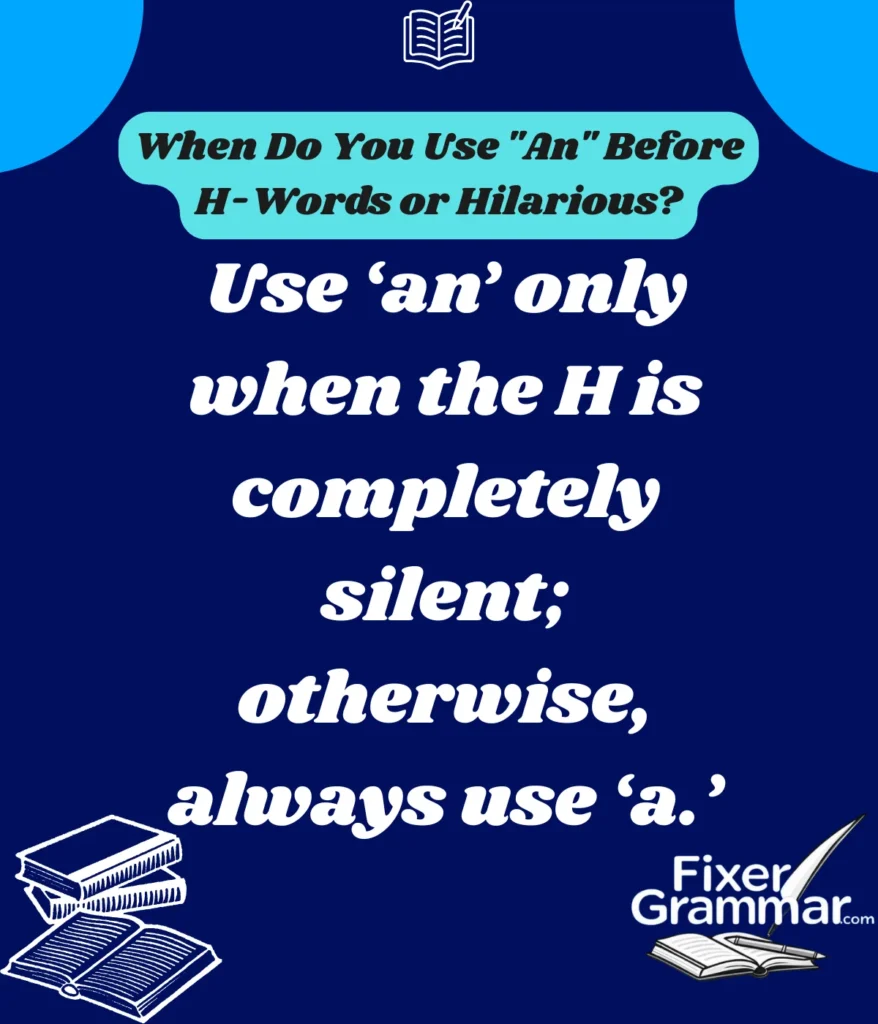
You use “an” only when the H is completely silent. This happens with specific words borrowed from French or Latin.
Common silent H words include:
- An hour: The H is silent, so it sounds like “an our”
- An honest person: Pronounced “on-est,” not “hon-est”
- An honorable mention: Sounds like “on-or-able”
- An heir apparent: Pronounced “air,” not “hair”
These words are exceptions, not the rule. Most H-words in English have a pronounced H sound.
The Simple Memory Trick
Say the word out loud. If you hear the H sound clearly, use “a.” If the H disappears when you speak, use “an.”
Test this with “hilarious.” You definitely hear that H at the start. Therefore, it’s always “a hilarious.”
More Posts: Propose vs Purpose: Understanding,Definition And Usage
The British English Exception
Some older texts use “an hilarious,” especially in British literature from the 1800s and early 1900s. Writers like Charles Dickens occasionally wrote “an” before H-words.
This practice has disappeared from modern English. Both British and American style guides now recommend “a hilarious” based on the hard H sound. The Oxford Dictionary, Cambridge Dictionary, and Merriam-Webster all agree on this point.
You might still encounter “an historic” or “an hotel” in very formal or old-fashioned writing. These forms are outdated and unnecessary in contemporary usage.
FAQ’s
Is it “a hilarious” or “an hilarious”?
It’s “a hilarious.” The word starts with a hard H sound, which requires the article “a.”
Why do some people say “an hilarious”?
This comes from outdated British usage from the 1800s. Modern English has abandoned this practice.
Are there any situations where “an hilarious” is correct?
No. “An hilarious” is incorrect in all modern English contexts, both written and spoken.
What other H-words follow the same rule as “hilarious”?
Words like happy, house, hero, hotel, and huge all take “a” because they have pronounced H sounds.
Is “an historic” or “a historic” correct?
“A historic” is correct. The word “historic” has a hard H sound, just like “hilarious.”
How do I remember when to use “a” vs “an” with H-words?
Say the word out loud. If you hear the H sound, use “a.” If the H is silent (like in “hour”), use “an.”
Final Takeaway
The rule is straightforward: use “a hilarious” every time. This follows the natural sound-based pattern of English grammar.
Forget about spelling. Trust your ears. When you hear that clear H sound at the beginning of “hilarious,” you automatically know to use “a.”
Now you’ll never hesitate between “an hilarious” or “a hilarious” again. You have the knowledge and confidence to use the correct form in your writing and speech.

At FixerGrammar.com, Johnson Isaacs shares easy grammar tips, clear examples, and helpful guidance to make writing simple, smooth, and mistake-free.
Related Posts