Knowing which one to use depends entirely on your sentence structure.
What Do “No Difference” and “No Different” Actually Mean?
These two phrases express the same general idea — that two things are equal or the same. But they work differently in a sentence.
What “No Difference” Means
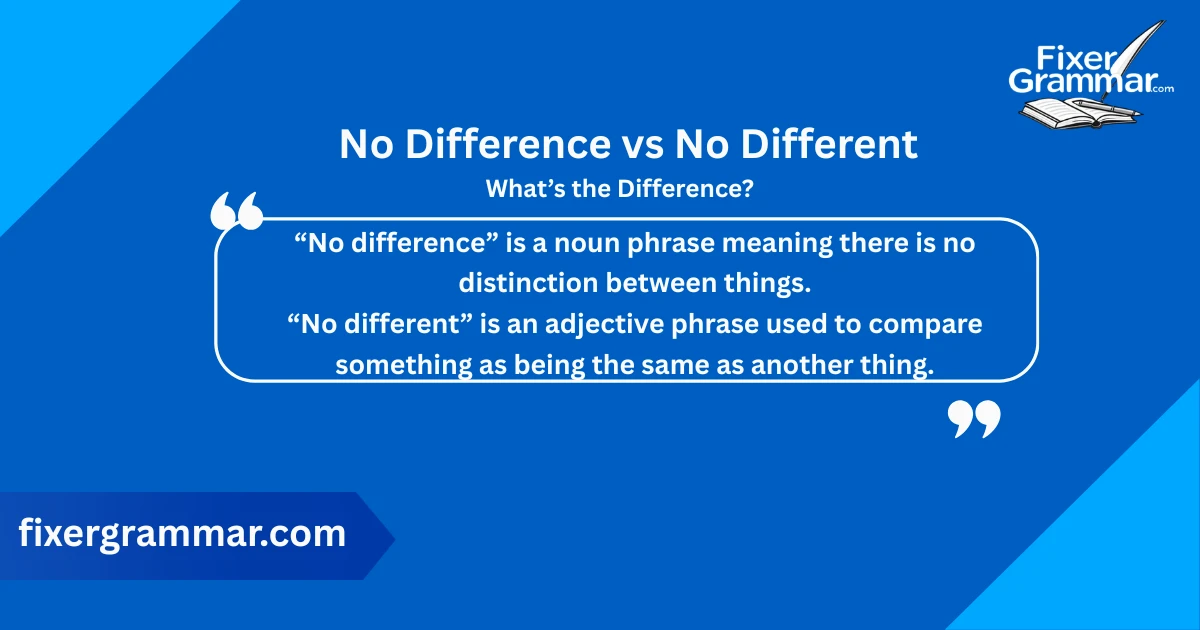
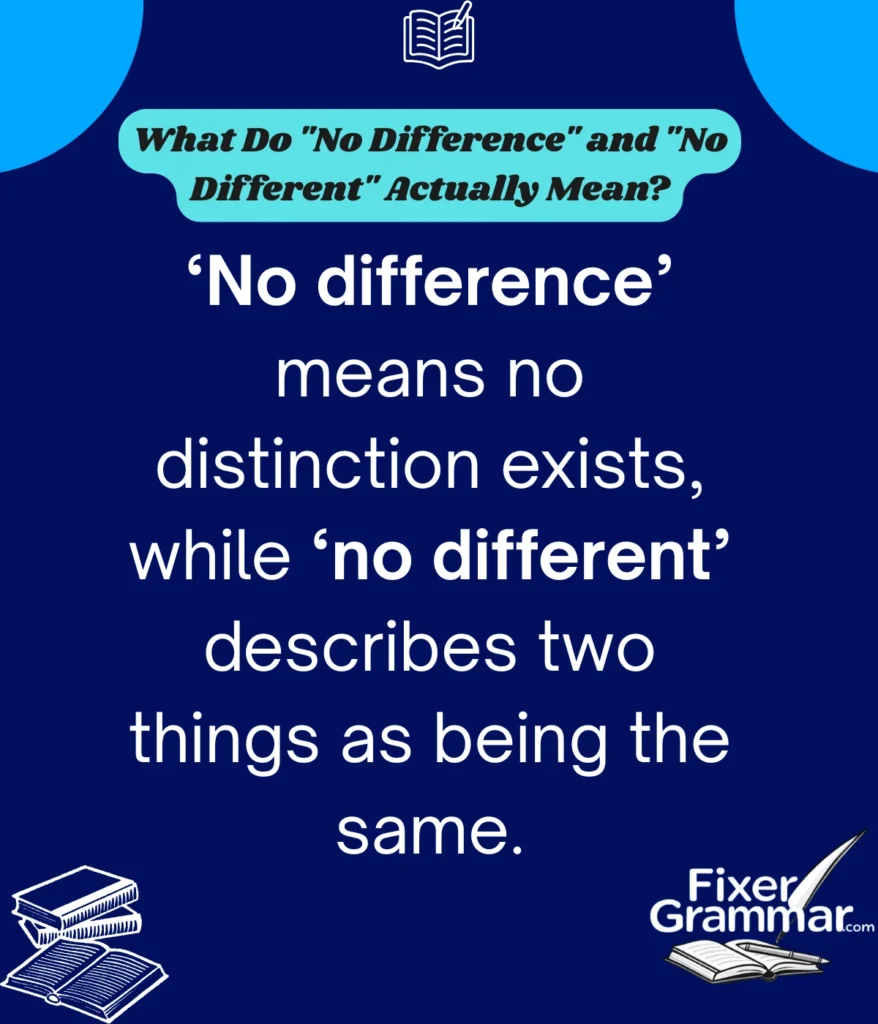
“No difference” means there is no distinction between two or more things. The word difference is a noun. It names an idea — the absence of distinction.
- There is no difference between the two plans.
- It makes no difference which route you take.
What “No Different” Means
“No different” describes something as being the same as something else. The word different is an adjective. It describes a quality, not a thing.
- This phone is no different from last year’s model.
- Her answer was no different from mine.
| Feature | Leaned | Leant |
|---|---|---|
| Verb origin | to lean | to lean |
| Tense | Past simple / past participle | Past simple / past participle |
| Ending pattern | Regular (-ed) | Irregular (-t) |
| Common in | Standard modern English | British English |
| Frequency | ~10× more common | Rare and declining |
| Style | Modern, natural | Old-fashioned |
The Grammar Behind No Difference and No Different
This is where most confusion begins. Both phrases look similar. But their grammatical roles are completely different.
Why “Difference” Is a Noun (and Why It Matters)
“Difference” belongs to a word family: differ (verb), different (adjective), difference (noun), differently (adverb). As a noun, it names a thing — specifically, the absence of distinction. That is why it fits perfectly after “there is no” or “it makes no.”
- ✅ There is no difference.
- ❌ There is no different.
Why “Different” Is an Adjective (and Why It Matters)
“Different” describes a noun. It tells you how something compares to something else. It follows linking verbs like is, are, was, seems, looks. It always needs a comparison word — usually “from” — to complete the thought.
- ✅ The result is no different from before.
- ❌ The result is no difference from before.
Sentence Structure – Where Each One Belongs
| Sentence Pattern | Correct Phrase | Example |
|---|---|---|
| There is no ___ | Difference | There is no difference in price |
| It makes no ___ | Difference | It makes no difference to me |
| Subject + is/are + no ___ | Different | The rule is no different from before |
| I see no ___ | Difference | I see no difference between them |
More Posts:Gray or Grey – What’s the Difference ? 2026
How to Use “No Difference” Correctly
“No difference” is the more common of the two phrases. It appears in everyday conversations, professional emails, academic papers, and research studies. According to Google Ngram Viewer, “no difference” appears significantly more often in published English than “no different.”
Common Sentence Patterns for No Difference
The most natural patterns with “no difference” follow these structures:
- There is no difference between A and B
- It makes no difference whether you do X or Y
- I noticed no difference in the results
- There was no difference in quality
No Difference in Everyday Speech
People use “no difference” when comparing choices, outcomes, or results. It works in both casual and formal speech without sounding stiff or unnatural.
- It makes no difference if we leave now or later.
- There’s no difference between the store brand and the name brand.
No Difference in Formal and Academic Writing
In research and academic writing, “no difference” is the standard phrase. Studies and reports commonly state findings like:
- The trial showed no difference in patient outcomes between the two groups.
- There was no statistically significant difference between the control and test groups.
How to Use “No Different” Correctly
“No different” works as a descriptive phrase. It compares the quality or character of one thing to another. It almost always appears after a linking verb and before the word “from.”
Common Sentence Patterns for No Different
- Subject + is/are + no different from + comparison
- Subject + was/were + no different than + comparison
- Subject + seems/looks + no different from + before
No Different From vs No Different Than – Which Is Right?
This is one of the most searched grammar questions on Google. Here is the direct answer:
“No different from” is the grammatically preferred form in standard usage. “No different than” is widely used in casual spoken English and is broadly accepted. For formal writing — essays, reports, professional emails — stick with “no different from.”
- ✅ This version is no different from the original.
- ✅ This version is no different than the original. (casual, spoken)
No Different in Casual Speech
In everyday conversation, “no different” sounds natural and descriptive. It feels more personal and comparative than “no difference.”
- Honestly, the new season feels no different from the last one.
- Working remotely is no different from being in the office for me.
More Posts:Recurring vs. Reoccurring – What’s the Difference ? 2026
Synonyms and Smarter Alternatives
Sometimes the best writing avoids repetition. Knowing strong alternatives to both phrases keeps your writing fresh and varied.
Synonyms for “No Difference”
“No difference” can be replaced by these equally clear expressions:
- identical
- unchanged
- all the same
- makes no matter
- equal in every way
Example: The two contracts are identical in every way.
Synonyms for “No Different”
“No different” can be swapped with these natural alternatives:
- similar
- comparable
- alike
- not unlike
- equivalent
Example: Her writing style is comparable to her mentor’s.
FAQs – No Difference vs No Different
Are “no difference” and “no different” interchangeable?
No. “No difference” is a noun phrase and “no different” is an adjective phrase. Swapping them changes the grammar and often makes the sentence incorrect.
Why do people confuse these two phrases?
Both words — difference and different — share the same root and express similar ideas. That shared meaning makes it easy to mix them up, especially when writing quickly.
Which one should I use in formal writing?
Use “no difference” when naming an absence of distinction. Use “no different from” when describing a comparison. Both are acceptable in formal writing when used in the correct grammatical structure.
Can learning grammar rules really help with this?
Absolutely. Once you understand that difference = noun and different = adjective, the correct choice becomes automatic. It stops feeling like guesswork.
How can I master this without overthinking?
Ask yourself one simple question before writing: Am I naming a thing or describing something? If naming — use no difference. If describing — use no different. That single check fixes the confusion every time.
Is “no different than” grammatically correct?
It is widely accepted in everyday spoken English. However, formal style guides traditionally prefer “no different from.” In writing, especially professional or academic contexts, “from” is the safer and more standard choice. British English also strongly favors “from” over “than.”

At FixerGrammar.com, Johnson Isaacs shares easy grammar tips, clear examples, and helpful guidance to make writing simple, smooth, and mistake-free.
Related Posts