Understanding this difference helps you write with more clarity and confidence, whether you’re drafting an email or crafting a story.
What Does the Verb Smell Mean?
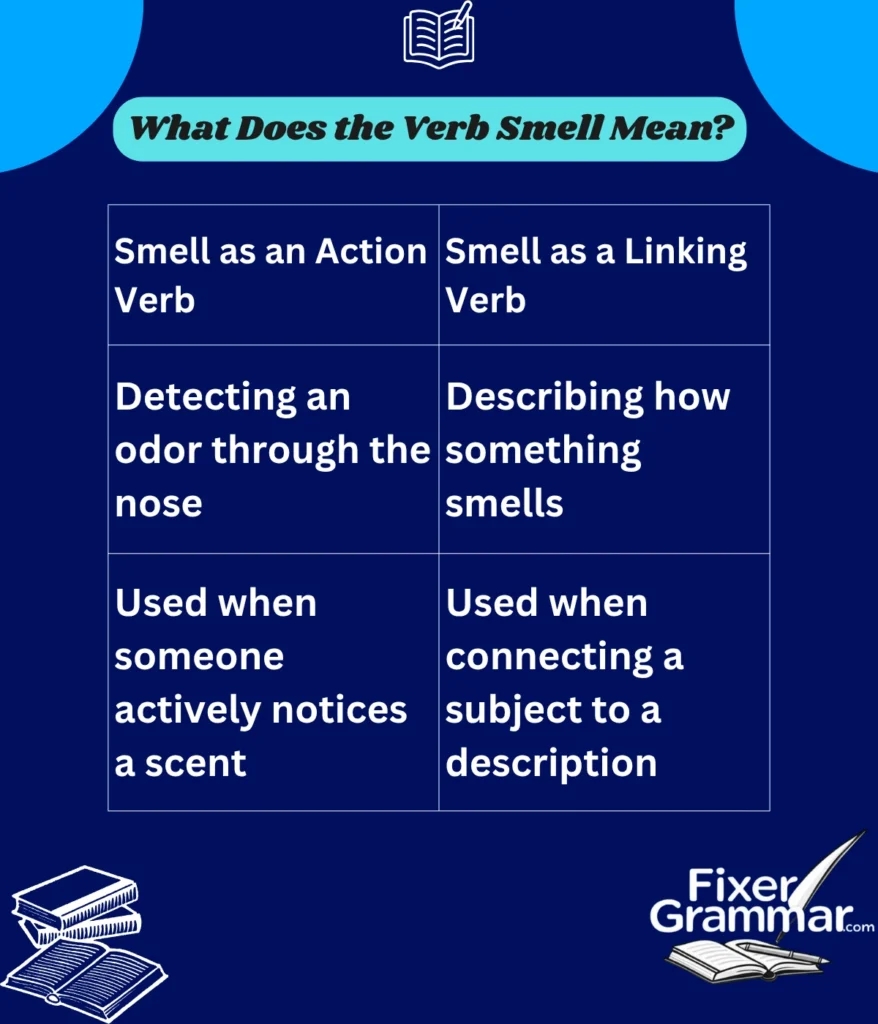
The verb smell describes the act of detecting an odor through the nose. It also works as a linking verb to describe how something is perceived by others.
Knowing which role smell plays in a sentence directly affects which past tense form you should reach for.
Smell as an Action Verb
When someone actively detects a scent, smell is an action verb.
Examples:
- She smelled smoke in the hallway.
- He smelled the fresh bread from across the room.
Smell as a Linking Verb
When smell connects the subject to a description, it acts as a linking verb — similar to is or feels.
Examples:
- The coffee smelled amazing.
- The garbage smelled terrible by morning.
As a linking verb, smelled is always the correct choice. You would never say “the coffee smelt amazing” in standard usage.
More Posts:State vs. Status — Which One Is Correct? 2026
Smelled — Meaning, Definition, and Usage
Smelled is the regular past tense and past participle of the verb smell. It follows the standard English pattern of adding -ed to form the past tense, making it the most universally recognized and accepted form.
It works in every context — formal writing, casual speech, professional documents, and creative fiction.
When to Use Smelled in a Sentence
Use smelled whenever you’re writing in the past tense and referring to the sense of smell. It fits naturally in every tone and setting.
| Situation | Correct Form |
|---|---|
| Formal writing | Smelled |
| Academic papers | Smelled |
| Professional emails | Smelled |
| Everyday conversation | Smelled |
| Linking verb usage | Smelled only |
Example Sentences Using Smelled
- The inspector smelled gas near the main valve.
- She smelled roses the moment she walked into the garden.
- The old library smelled like dust and worn leather.
- He smelled something burning in the kitchen.
Smelt — Meaning, Definition, and Usage
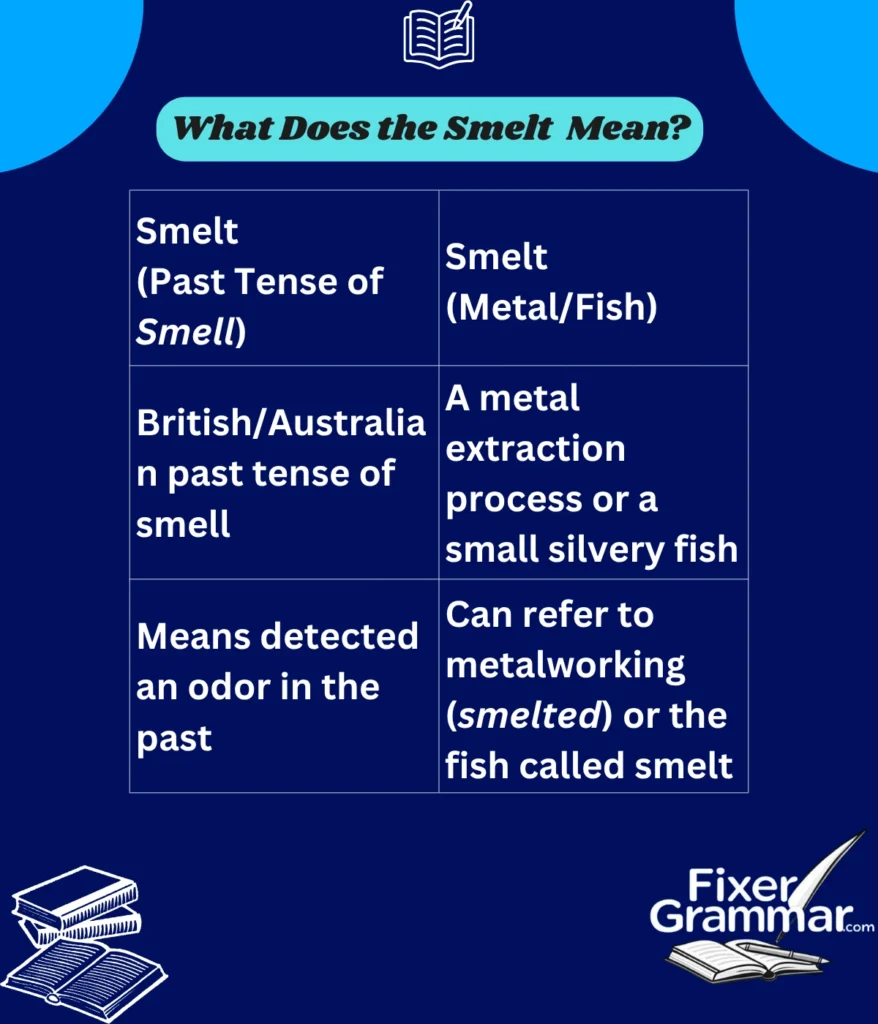
Smelt is what linguists call an irregular past tense form — a leftover from Old English where verbs changed their spelling rather than simply adding -ed. It is grammatically correct, but its usage is narrower and more context-dependent.
Knowing when smelt applies — and when it doesn’t — protects you from two types of confusion.
Smelt as the Past Tense of Smell
As a past tense verb, smelt carries the same meaning as smelled. It appears more commonly in British and Australian English, where both forms are used interchangeably.
- She smelt something strange near the old building.
- He smelt the sea air long before the coast came into view.
Smelt in Metalworking and as a Fish
Here’s where things get genuinely interesting. Smelt carries two completely unrelated meanings beyond grammar.
As a metalworking verb: To smelt means to melt ore at high temperatures to extract metal. Its correct past tense in this context is smelted — not smelt.
- The workers smelted iron ore to produce steel.
As a noun: A smelt is a small, silvery fish from the family Osmeridae, found in cold freshwater streams across the northern hemisphere. It is commonly eaten whole after frying.
- The fishermen caught buckets of smelt from the river.
This is exactly why many editors prefer smelled — it carries zero ambiguity.
Example Sentences Using Smelt
- She smelt the ocean breeze before the shore appeared.
- The old cottage smelt of pine wood and fireplace ash.
- Whoever smelt it dealt it. (familiar expression)
More Posts:Spelled or Spelt — Which One Is Correct? 2026
Smelled vs Smelt — Standard Usage vs British English
Both smelled and smelt are grammatically correct past tense forms. The difference comes down to regional convention and writing context.
Smelled is the dominant, standard form used in most published writing worldwide today. According to usage data tracked in Google Ngram Viewer, smelled surpassed smelt in global frequency during the mid-20th century and has remained the preferred form ever since.
Smelt survives most actively in British and Australian English, where speakers use both forms naturally without preference.
Quick Comparison Table
| Feature | Smelled | Smelt |
|---|---|---|
| Past tense of smell | Yes | Yes |
| Linking verb usage | Yes | No |
| Formal writing | Preferred | Avoid |
| Creative/British dialogue | Acceptable | Acceptable |
| Metalworking meaning | No | Yes (smelt/smelted) |
| Fish meaning | No | Yes |
How to Use Smelled or Smelt Correctly in Writing
The rule is simple. When in doubt, smelled is always safe. It works in every genre, every tone, and every audience without risk of confusion.
In Formal and Professional Writing
In business emails, academic papers, news articles, and technical documents, smelled is the only form you should use. It signals clean, neutral, professional language.
- The technician smelled a chemical leak during the routine inspection.
- The report noted that workers had smelled an unusual odor near the storage unit.
In Creative Writing and Dialogue
This is where smelt earns its place. If your character is British, or your narrative voice carries a distinctly British or period flavor, smelt adds authenticity and texture.
- “I smelt something rotten before I even opened the cellar door,” she whispered.
That single word choice anchors the character’s voice in a way smelled simply wouldn’t.
FAQ — Smelled or Smelt
Is it I Smelled or I Smelt?
“I smelled” is the standard, correct form for most writing. “I smelt” is grammatically valid but mostly used in British English and informal contexts. In formal or professional writing, always go with I smelled.
Is smelt a real word?
Yes, absolutely. Smelt is a real, grammatically correct word with three distinct meanings: the past tense of smell (chiefly British), a type of small silvery fish, and the act of melting ore to extract metal.
Can you use smelt in formal writing?
It is better to avoid it. In formal, academic, or professional writing, smelled is the universally preferred form. Using smelt in a formal document can read as a regional or stylistic quirk that distracts from your message.
Which word do style guides recommend?
Major style guides including AP Style, Chicago, and APA all recommend smelled as the standard past tense form for formal and professional writing.
Does smelled or smelt change the meaning?
When referring to the sense of smell, both words mean exactly the same thing. The difference is purely one of regional convention and formality — not meaning.
What is the past participle of smell?
The past participle of smell is also smelled — used in constructions like “has smelled” or “had smelled.” In British English, smelt can also serve as the past participle, but smelled is the safer and more widely accepted form globally.

At FixerGrammar.com, Johnson Isaacs shares easy grammar tips, clear examples, and helpful guidance to make writing simple, smooth, and mistake-free.
Related Posts