Mixing them up is one of the most common mistakes in English writing. This guide breaks down both words clearly, so you never confuse them again.
What Is a Homophone — And Why Do Hail and Hale Confuse So Many People?
English is full of homophones — words that sound identical but have different spellings and meanings. Think their vs there, or right vs write. Hail vs hale belongs to that same tricky group.
Both words are pronounced /heɪl/. The confusion happens in writing, not in speech. Context is the only thing that separates them — and that’s exactly why understanding each word deeply matters.
What Does Hail Mean? (Definition, Uses & Examples)
Hail as a Noun — Frozen Precipitation
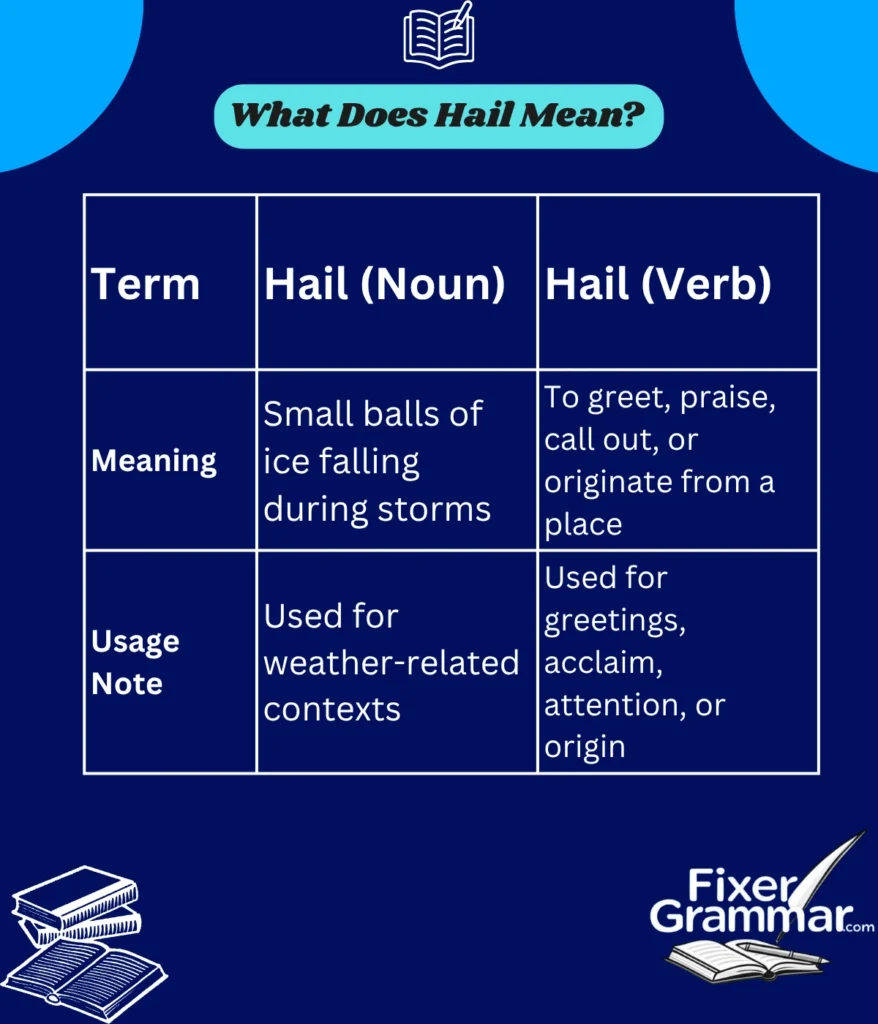
Hail refers to small balls of ice that fall from storm clouds during severe weather. It forms when water droplets are carried upward in thunderstorms, freeze, and fall back down as ice pellets.
Example sentences:
- “The hail dented every car on the block.”
- “Farmers in the Midwest dread hail season.”
Hail as a Verb — To Greet, Acclaim, or Call Out
As a verb, hail means to call out, greet, or give enthusiastic praise to someone or something.
Common verb uses:
- To signal or call attention — “She hailed a cab on Fifth Avenue.”
- To praise or celebrate — “The documentary was hailed as a masterpiece.”
- To originate from a place — “He hails from Austin, Texas.”
Hail in Everyday Phrases
The word hail shows up in several well-known expressions worth knowing.
| Phrase | Meaning |
|---|---|
| Hail Mary | A desperate last-resort attempt (also a prayer) |
| Hail a cab | To flag down a taxi |
| Hails from | Originates from a place |
| All hail | An expression of deep respect or praise |
More Posts:Whole Day or All Day — Which Is Correct ? 2026
What Does Hale Mean? (Definition, Uses & Examples)
Hale as an Adjective — Healthy, Strong, and Vigorous
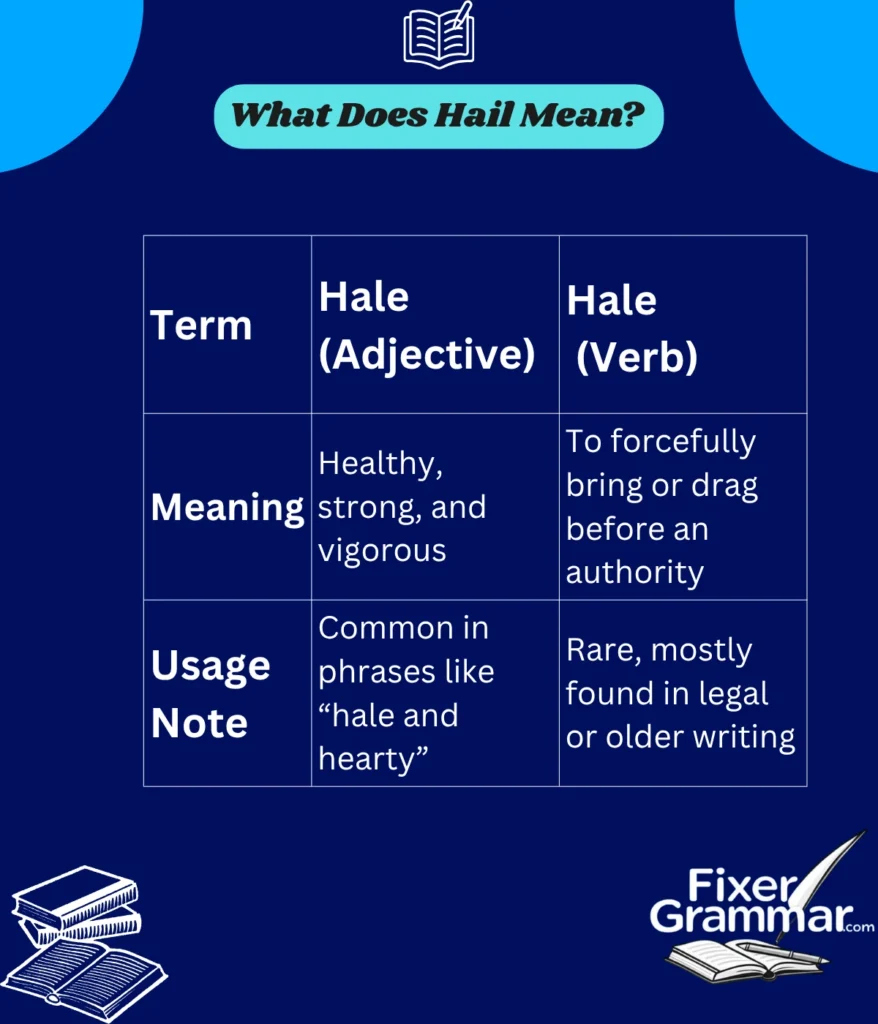
Hale is an adjective. It describes someone who is in excellent physical health — especially an older person who remains strong and active despite their age.
It comes from the Old English word hal, meaning “whole” or “uninjured.” That same root gave us the modern word “whole.” So being hale literally means being whole in body.
Example sentences:
- “At 75, my grandfather is still hale and active.”
- “The doctor confirmed she was completely hale after surgery.”
“Hale and Hearty” — The Most Common Usage
The phrase “hale and hearty” is the most widely recognized use of this word. It describes someone who is vigorous, robust, and full of life — usually despite their age.
Example: “Even at 90, the retired general remained hale and hearty.”
This phrase appears frequently in literature, journalism, and everyday conversation when describing healthy elderly individuals.
Hale as a Verb — Rare but Real
In older or legal writing, hale can also function as a verb meaning to forcibly drag or compel someone — usually before a court or authority.
Example: “The defendant was haled before the judge.”
You won’t encounter this version often in modern writing. It appears mostly in historical texts or formal legal contexts.
Hail vs Hale — Side-by-Side Comparison
| Feature | Hail | Hale |
|---|---|---|
| Pronunciation | /heɪl/ | /heɪl/ |
| Part of Speech | Noun, Verb | Adjective, Verb (rare) |
| Primary Meaning | Frozen rain / to greet or praise | Healthy and strong |
| Common Phrase | Hail Mary, hail a cab | Hale and hearty |
| Used in Context | Weather, greeting, praise | Health, vigor, old age |
| Frequency | Very common | Less common, more literary |
The simplest rule to remember:
- Hail = weather, greeting, or praise
- Hale = health and strength
Memory Tricks to Never Mix Them Up Again
These simple tricks make the difference stick instantly.
Hail contains the letter “I” — think ICE. Hail falls from the sky as frozen ice.
Hale sounds like “whole” — think HEALTH. A hale person is whole and healthy in body.
Quick rhyme: Hail hits hard. Hale stays strong.
Etymology — Where Did Hail and Hale Originally Come From?
The Old English Roots Behind Both Words
Both words are deeply rooted in Old English, but they traveled very different paths through history.
| Word | Old English Root | Original Meaning | Modern Meaning |
|---|---|---|---|
| Hail | hagol | Frozen storm, ice pellets | Ice precipitation / to greet or praise |
| Hale | hal | Whole, sound, uninjured | Healthy and vigorous |
- Hail also carried ceremonial weight in history. Expressions like “Hail Caesar!” and “Hail to the King!” were formal salutations of respect — a usage that still echoes in speeches and songs today.
- Hale, rooted in hal, shares its ancestry with words like whole, health, and even holy — all of which carry the idea of completeness and soundness.
FAQs — Hail vs Hale
What is the main difference between hail and hale?
Hail refers to frozen precipitation or means to greet and praise someone. Hale is an adjective describing someone as healthy and physically strong, especially in older age.
Are hail and hale pronounced the same way?
Yes. Both are pronounced /heɪl/ — making them true homophones. Spelling and context are the only things that tell them apart.
How can I stop confusing hail and hale in writing?
Use these two anchors: hail = ice or acclaim, hale = health. If your sentence is about weather or praise, use hail. If it’s about someone’s physical condition, use hale.
Can hail be used in everyday conversation?
Absolutely. Hail is used daily — from talking about hailstorms to hailing a ride. It’s versatile and appears in both casual speech and formal writing.
Does understanding hail vs hale really matter for writing?
Yes. Using the wrong word changes your meaning entirely. Strong writers choose precise words. Knowing the difference between hail vs hale is a small but powerful step toward cleaner, more credible writing.
Is “hale” a British English word?
Hale is used in both British and American English, though it appears more frequently in formal, literary, or older writing on both sides of the Atlantic. The phrase “hale and hearty” is understood universally.

At FixerGrammar.com, Johnson Isaacs shares easy grammar tips, clear examples, and helpful guidance to make writing simple, smooth, and mistake-free.
Related Posts