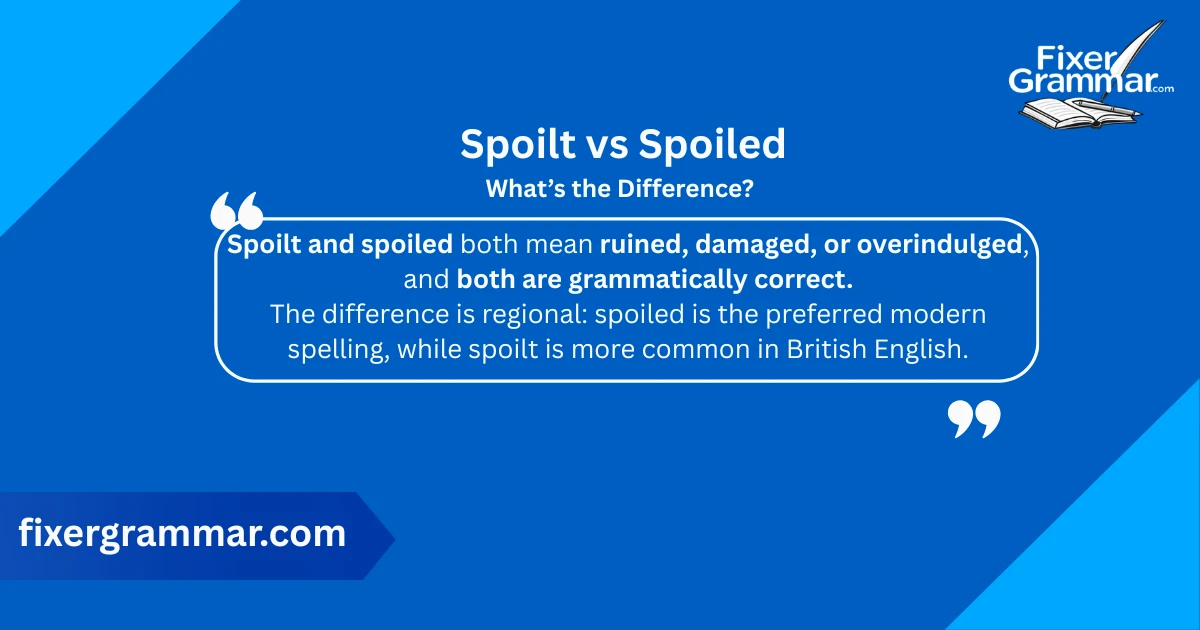
“Spoilt” and “spoiled” are both correct past forms of the verb spoil. The short answer is simple — they mean the same thing. The difference comes down to regional spelling preference, not grammar rules.
What Do Spoilt and Spoiled Actually Mean?
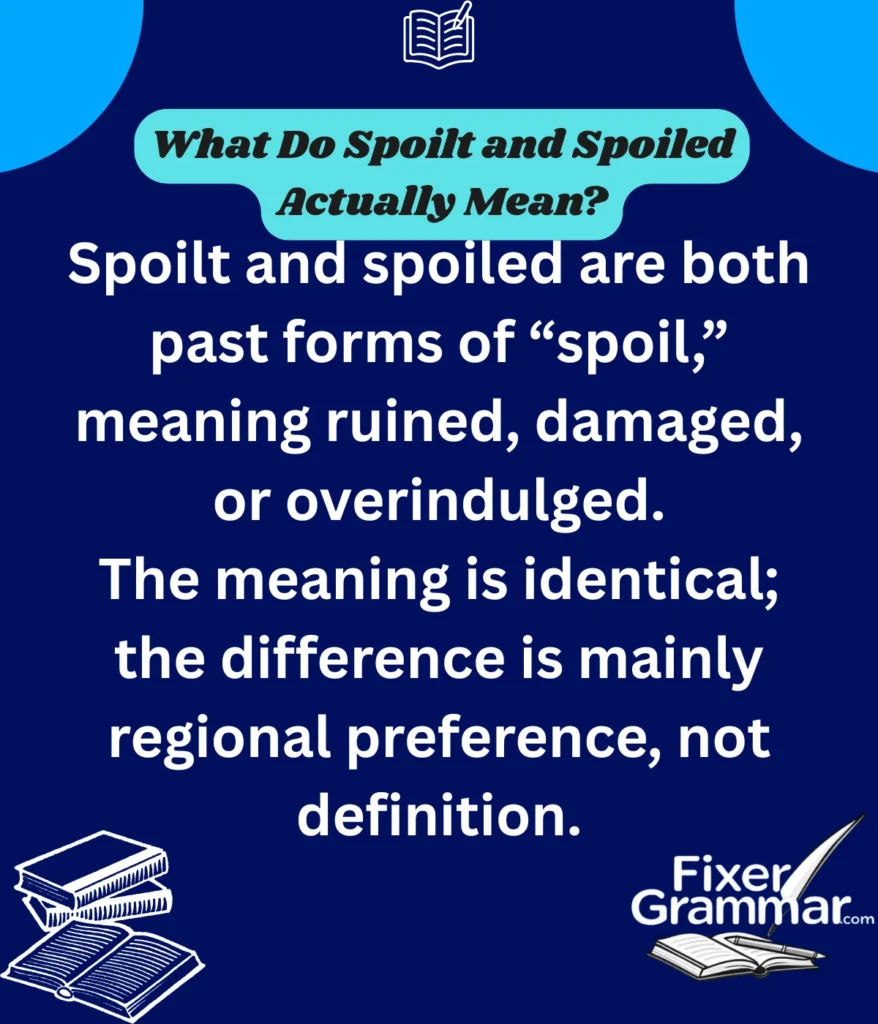
Both words share the same core meanings. They describe something ruined or damaged — like food that has gone bad. They also describe a person, usually a child, who has been overindulged or pampered beyond reason.
Spoil is the base verb. Both spoiled and spoilt are its past forms. Neither one carries a hidden meaning the other lacks.
The two core uses:
- Ruined or decayed — food, plans, events, moments
- Overindulged — children, people given too much without boundaries
Spoilt vs Spoiled — The Regional Difference
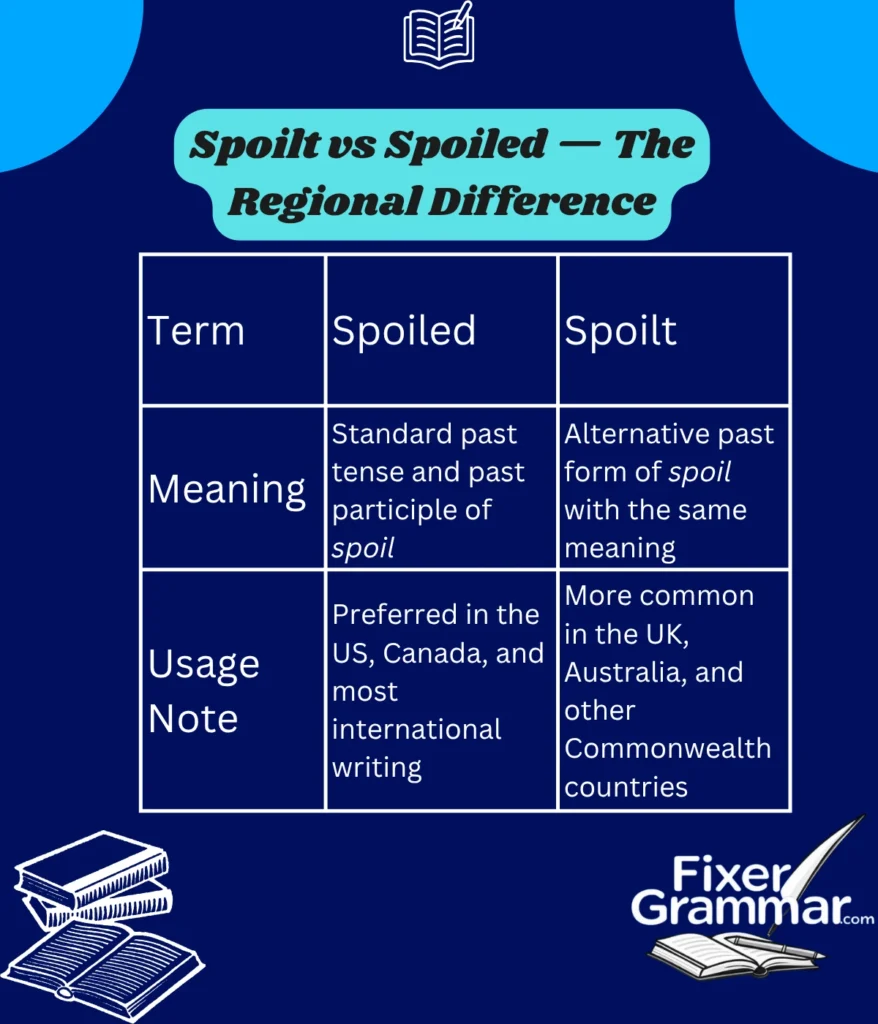
Spoiled is the standard spelling used widely in everyday writing and speech.
Spoilt is more common in British and Commonwealth English — UK, Australia, and parts of South Asia.
| Region | Preferred Form | Also Accepted |
|---|---|---|
| United States | spoiled | spoilt (rare) |
| United Kingdom | spoilt | spoiled |
| Australia | spoilt | spoiled |
| Canada | spoiled | spoilt |
The reason is simple. English in Britain kept shorter past forms like spoilt, burnt, and learnt. Standard usage elsewhere moved toward regular -ed endings.
Spoilt and Spoiled as Past Tense and Past Participle
Neither form belongs exclusively to past tense or past participle. Both work in both roles. Grammar does not force your hand here.
Past tense examples:
- The heat spoiled the milk.
- The heat spoilt the milk.
Past participle examples:
- The milk has spoiled.
- The milk has spoilt.
Same grammar. Same meaning. Only the spelling changes.
Spoilt and Spoiled as Adjectives
Both words also work as adjectives — words that describe a noun directly.
This is where you will see them most often in daily writing and conversation.
- A spoiled child
- Spoiled food
- A spoilt ballot
- Spoilt plans
Spoiled is the dominant adjective form in standard usage today. Style guides including AP Stylebook and Chicago Manual of Style both list spoiled as the preferred form.
Real-World Examples of Spoiled and Spoilt in Sentences
Seeing both words in real sentences removes all doubt. The meaning never shifts — only the spelling does.
Food and safety:
- The leftovers were spoiled after sitting out overnight.
- The cheese had gone spoilt due to poor storage.
Children and behavior:
- He grew up spoiled, rarely hearing the word no.
- She was described as a spoilt child who expected everything.
Events and situations:
- Rain completely spoiled the outdoor ceremony.
- The ending was spoilt by an online leak.
Notice that in every sentence above, swapping one form for the other changes nothing about the meaning.
FAQs — Spoilt vs Spoiled
Is spoilt wrong in English?
No. Spoilt is a valid English word, standard in British and Commonwealth writing. In everyday US usage, spoiled is the more common and expected form.
Do spoilt and spoiled mean different things?
They mean exactly the same thing. Both describe something ruined or a person who has been overindulged. The difference is only in spelling.
Which spelling do most style guides recommend?
Major style guides — AP Stylebook, Chicago Manual of Style, and Merriam-Webster — all list spoiled as the primary and preferred form.
Can you use spoilt and spoiled in the same article?
It is best to avoid it. Mixing both forms looks inconsistent. Choose one spelling and use it throughout your entire piece.
Is spoiled a past tense or past participle?
It is both. Spoiled (and spoilt) function as the simple past tense and the past participle of the verb spoil. Both roles, one word.
Which one should I use in everyday writing?
Use spoiled. It is universally understood, widely accepted, and recommended by every major style authority. When in doubt, spoiled is always the safe and correct choice.
Conclusion
Spoilt vs spoiled is one of the simplest grammar questions once you understand the facts.
They share the same meaning, the same grammar roles, and the same correct usage. The only real difference is regional spelling. For clean, professional, and universally clear writing, spoiled is your default. Use it with confidence.

At FixerGrammar.com, Johnson Isaacs shares easy grammar tips, clear examples, and helpful guidance to make writing simple, smooth, and mistake-free.
Related Posts