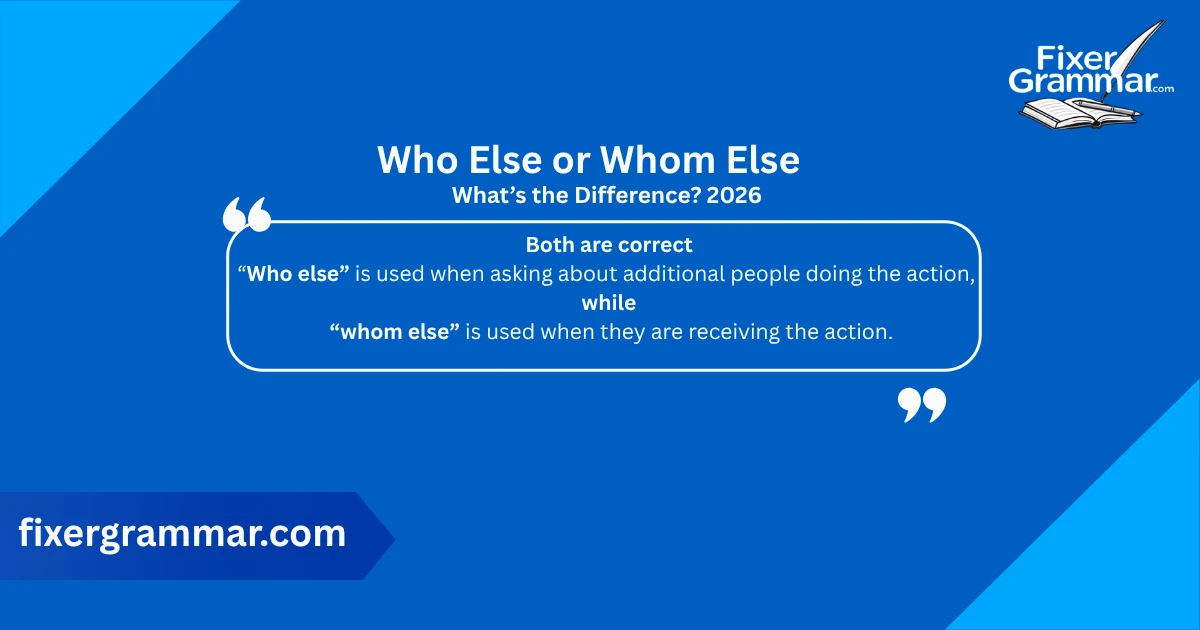
Most people use who else in daily life — in texts, emails, and conversations — and that is perfectly fine. Whom else belongs in formal writing. Once you understand the logic, you will never second-guess yourself again.
What “Who Else” and “Whom Else” Actually Mean
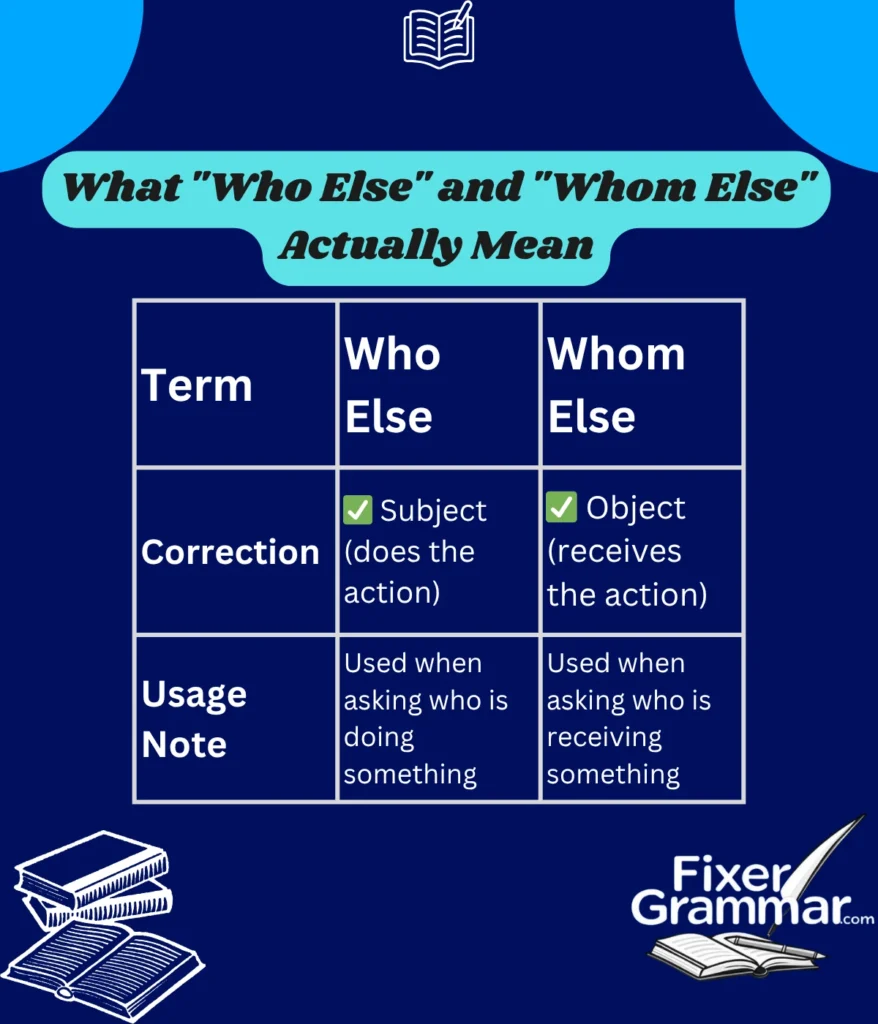
Who else and whom else both ask about additional people. The difference is their role in the sentence.
Who else is a subject pronoun — it refers to the person doing the action. Whom else is an object pronoun — it refers to the person receiving the action. Think of it like he vs. him. You say he called — not him called. Same logic applies here.
Who Else vs Whom Else – Usage Guide
| Pronoun | Role | Equivalent | Example |
| Who else | Subject | He / She / They | Who else is coming? |
| Whom else | Object | Him / Her / Them | Whom else did you call? |
The Simple Rule That Separates Who Else from Whom Else
The fastest trick is the he/him substitution test. Replace who/whom with he or him and see which sounds right.
If he fits → use who else If him fits → use whom else
Who else called you? → He called you. ✅ Whom else did you invite? → You invited him. ✅
This one test works every single time. No grammar degree needed.
More Posts:Attain vs. Obtain– What’s the Difference? 2026
Does “Else” Change the Grammar Rule?
This is the biggest misconception. People assume else makes whom else automatically correct. It does not.
Else simply means another person or additionally. It adds no grammatical weight. The subject or object role of who/whom stays exactly the same whether else is there or not.
Wrong idea: Else = object → must use whom else Reality: Only the sentence role determines who vs. whom
Who Else vs Whom Else — Real-Life Examples
Seeing both in real sentences makes the rule click immediately.
Who else examples — subject doing the action:
- Who else is joining the meeting?
- Who else knows about this?
- Tell me who else was there.
Whom else examples — object receiving the action:
- Whom else did you contact?
- To whom else should I send this report?
- Whom else are we inviting to the board session?
Quick Correct vs. Incorrect Comparison:
Who vs Whom – Common Mistakes (Corrected)
| ❌ Incorrect | ✅ Correct |
| Whom else is coming? | Who else is coming? |
| Who else did you call? | Whom else did you call? |
| To who else should I send this? | To whom else should I send this? |
| Whom else wants coffee? | Who else wants coffee? |
When to Use Who Else vs Whom Else
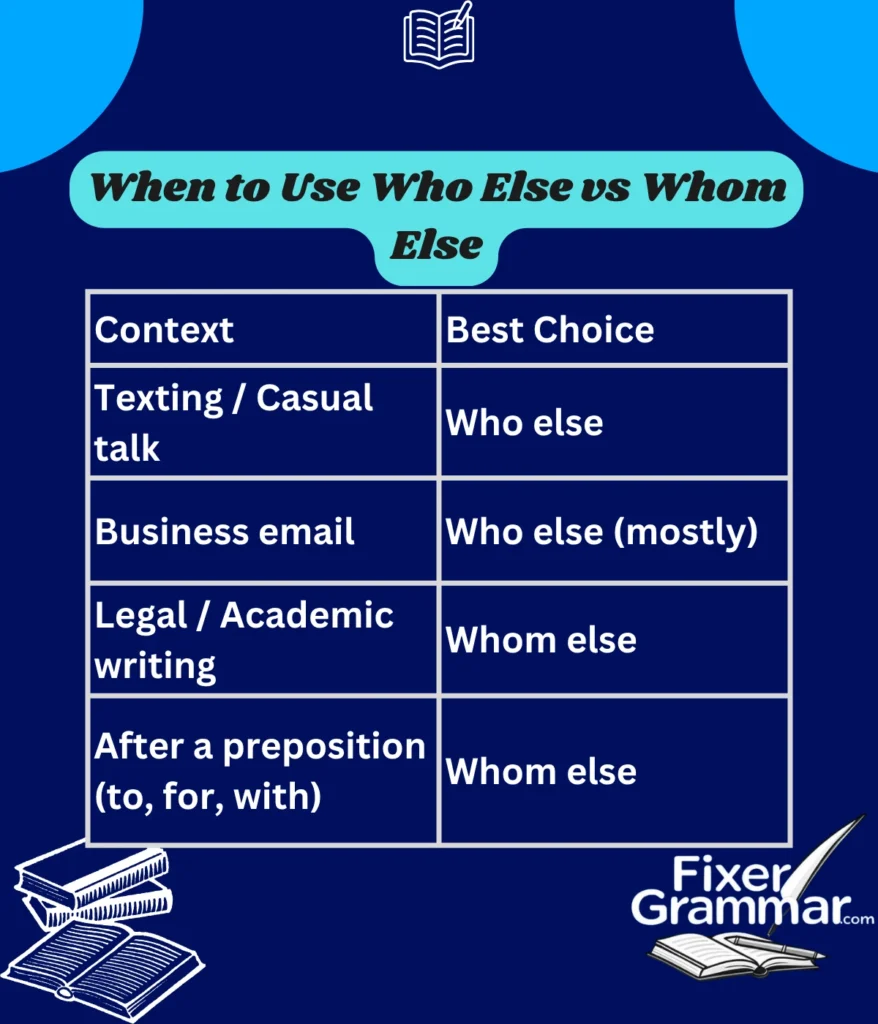
Context matters more than most people realize.
In casual speech and texting, always go with who else. It sounds natural, warm, and easy to understand. Saying whom else in a casual conversation feels stiff — sometimes even awkward.
In formal writing — legal documents, academic papers, professional reports — whom else carries weight and signals precision. The word whom is gradually fading — but it is not gone yet, especially in high-stakes professional writing.
Who vs Whom – Context Guide (Including “Who else / Whom else”)
| Context | Best Choice |
| Texting / Casual talk | Who else |
| Business email | Who else (mostly) |
| Legal / Academic writing | Whom else |
| After a preposition (to, for, with) | Whom else |
One key rule: After a preposition like to, for, or with, always use whom else. This is where most writers slip up.
- To whom else should I address this letter? ✅
- For whom else was this message intended? ✅
More Posts:Tortuous vs. Torturous — What’s the Difference ? 2026
FAQs — Who Else or Whom Else
Is it correct to say “who else” or “whom else”?
Both can be correct depending on the sentence. Use who else for the subject and whom else for the object. In everyday use, who else is almost always the safer, more natural choice.
Can I always use “who else” instead of “whom else”?
In casual speech and most emails, yes. In formal or legal writing — especially after prepositions like to or for — whom else is the grammatically precise choice.
Why does “whom else” sound so awkward?
Because whom is gradually disappearing from everyday English. It survives mostly in formal and written contexts. In conversation, it can feel stiff or even old-fashioned.
What is the easiest way to pick between the two?
Use the he/him test. If he sounds right in your sentence, use who else. If him sounds right, use whom else. It takes two seconds and works every time.
Does the word “else” change the grammar rule for who and whom?
No. Else simply means additionally or another person. It has zero effect on whether who or whom is correct. The sentence role alone decides that.
Is “who else” more common than “whom else” in standard usage?
Yes, by a significant margin. Linguistic data from major English corpora shows who else dominates both spoken and written English today. Whom else appears mainly in academic, legal, and highly formal writing.
Is there a difference between how “whom else” is used in British vs American English?
British English holds onto whom slightly longer, especially in journalism and formal speech. In standard usage here, who else is the far more common and natural choice in everyday communication. The rule itself, however, is the same in both varieties.
The bottom line
Use who else when someone is doing the action. Use whom else when someone is receiving it — or after a preposition. When in doubt, who else almost always sounds right and is widely accepted in modern English.

At FixerGrammar.com, Johnson Isaacs shares easy grammar tips, clear examples, and helpful guidance to make writing simple, smooth, and mistake-free.
Related Posts