What Is an Elegy? Definition, Form, and Purpose
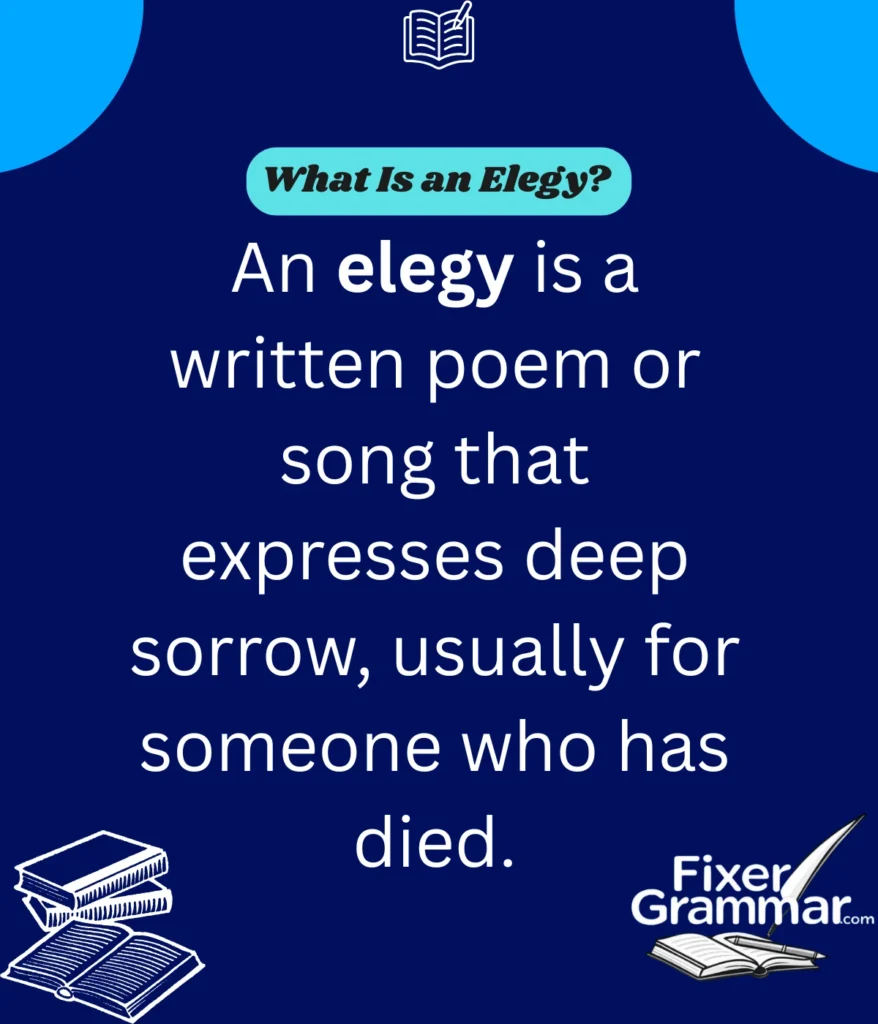
An elegy is a poem or song that expresses deep sorrow — most often for someone who has died. It is a written, literary form. Its purpose is to mourn, reflect, and sit with grief.
The word comes from the ancient Greek elegos, meaning “song of mourning.” Greek poets like Solon used it to lament fallen soldiers. By the Renaissance, it became one of literature’s most powerful forms.
What makes an elegy distinct?
- It is written, not spoken aloud at a ceremony
- Its tone is melancholic and contemplative
- It uses imagery, symbolism, and poetic language
- It explores universal themes — loss, mortality, memory
Famous elegies include W.H. Auden’s Funeral Blues and John Milton’s Lycidas. Walt Whitman’s O Captain! My Captain! mourned Abraham Lincoln through raw, poetic grief. These works don’t just mourn one person — they make loss feel universal.
Today, elegiac expression appears beyond poetry. Songs like Eric Clapton’s Tears in Heaven carry the same mournful, reflective spirit of a classical elegy.
More Posts:Marquee vs. Marquis — What’s the Difference? 2026
What Is a Eulogy? Definition, Form, and Purpose
A eulogy is a speech delivered at a funeral or memorial service. It praises the life, character, and achievements of the person who died. Unlike an elegy, it is meant to be heard, not read silently.The word comes from the Greek eulogia, meaning “praise.” Eulogies have roots in ancient civic and religious traditions, where public figures were honored through formal speech.
What makes a eulogy distinct?
- It is spoken aloud before an audience
- Its tone is warm, celebratory, and respectful
- It focuses on the person’s specific life — stories, values, accomplishments
- It aims to comfort the living while honoring the dead
Famous eulogies include those delivered for Steve Jobs, John F. Kennedy, and Martin Luther King Jr. Each one celebrated a life rather than simply mourning a loss.
Elegy vs. Eulogy — Key Differences Explained
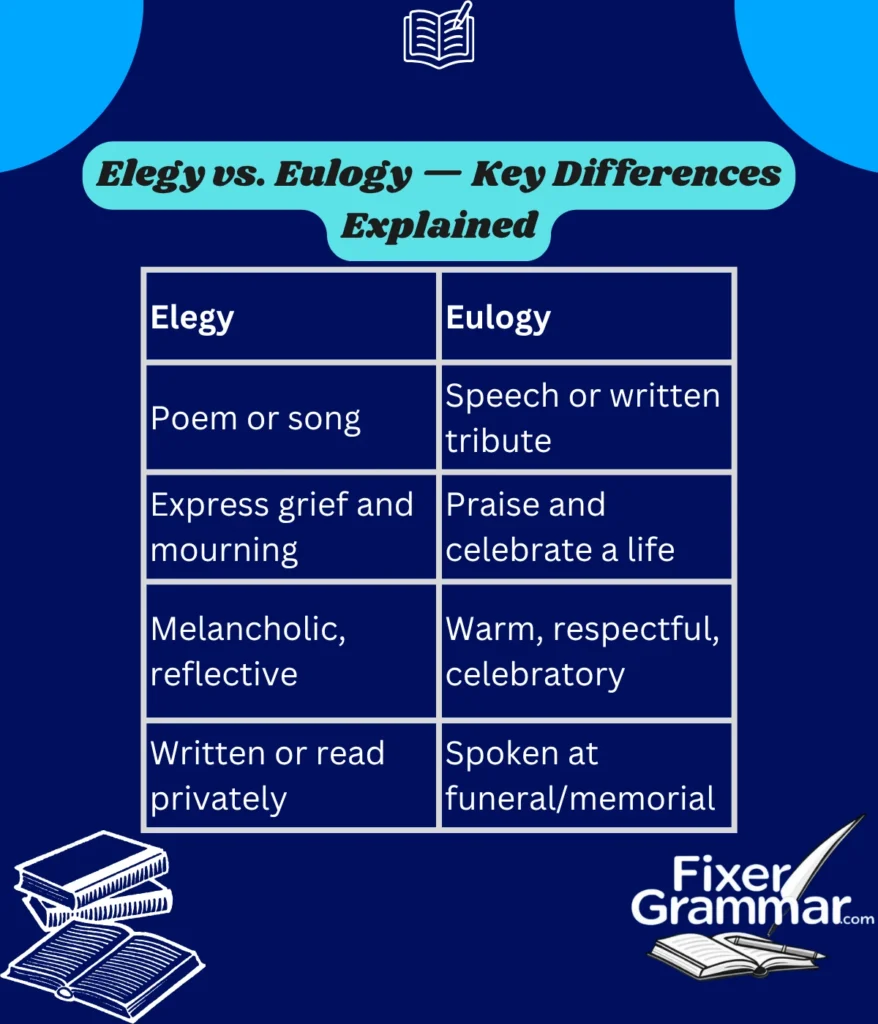
This is where most people get confused. Both words involve death. Both carry emotion. But they serve very different purposes.
| Feature | Elegy | Eulogy |
|---|---|---|
| Form | Poem or song | Speech or written tribute |
| Purpose | Express grief and mourning | Praise and celebrate a life |
| Tone | Melancholic, reflective | Warm, celebratory, respectful |
| Delivery | Written and read privately | Spoken aloud at a service |
| Common setting | Literature, personal writing | Funerals, memorial services |
| Famous example | Funeral Blues – W.H. Auden | Steve Jobs memorial speech |
Pronunciation is also different.
Elegy is pronounced EL-uh-jee. Eulogy is YOO-luh-jee.
They sound similar, but the starting sounds are completely different.
A simple memory trick: Elegy = Lament. Eulogy = Praise. One mourns. One celebrates.
More Posts:Hastle or Hassle — Which Is Correct? 2026
How to Write an Elegy or Eulogy
Writing an elegy is a personal, creative process. There are no strict rules — but these tips help:
- Lead with emotion, not facts
- Use metaphor and natural imagery (seasons, light, silence)
- Keep the tone reflective and quiet
- Let the poem breathe — short lines work well
Example opening line: “Beneath the still sky, I carry your name like a stone in my chest…”
Writing a eulogy is more structured. It serves an audience in grief, so clarity matters:
- Open with a warm, simple acknowledgment
- Share two or three specific stories or memories
- Highlight the person’s values and impact
- Close with something uplifting — a quote, a wish, a thank-you
Example opening line: “Today we honor someone whose kindness left a mark on every person in this room…”
Quick checklist before you write:
- Know your purpose — mourning (elegy) or celebrating (eulogy)?
- Gather specific memories, not general praise
- Keep the tone consistent throughout
- Read it aloud before delivering it
FAQs — Elegy vs. Eulogy
What is the main difference between an elegy and a eulogy?
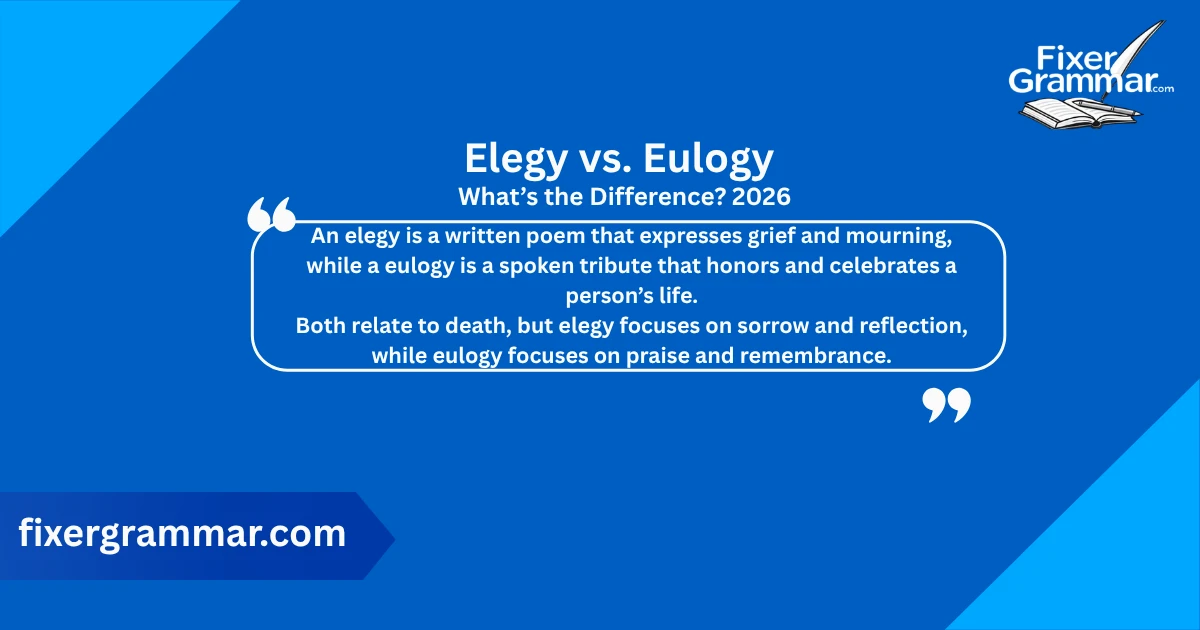
An elegy is a written poem that expresses grief and mourning. A eulogy is a spoken tribute delivered at a funeral to celebrate and honor someone’s life.
Can a eulogy be written as well?
Yes. A eulogy is always written first before being delivered. But its purpose and form are still rooted in spoken, public tribute — not private poetic reflection.
Which should I choose — elegy or eulogy?
Choose a eulogy for a funeral or memorial service. Choose an elegy for personal, poetic expression of grief or a literary tribute.
Can an elegy and a eulogy be combined?
Yes. Some people write a poem (elegy) and incorporate its lines into a spoken tribute (eulogy). The two forms can complement each other beautifully.
Are elegy and eulogy spelled differently in British English?
The spellings are the same in both British and standard usage. The difference between them is form and purpose — not regional spelling.
Why does it matter which word I use?
Using the right word shows emotional intelligence and respect for the occasion. It also ensures your message — whether written or spoken — lands with the right meaning.
Conclusion
Elegy and eulogy both honor loss — but in different ways. An elegy mourns through poetry. A eulogy celebrates through spoken tribute. One is felt on the page.
The other is heard in a room full of people who are grieving together. Knowing the difference helps you choose the right form for the right moment — and that choice always matters.

At FixerGrammar.com, Johnson Isaacs shares easy grammar tips, clear examples, and helpful guidance to make writing simple, smooth, and mistake-free.
Related Posts