Knowing which one to use makes your English sound natural and confident. Let’s break it down simply.
What Does “All Day” Mean?
“All day” describes continuous duration. It tells you something happened from morning to night without stopping. Think of it as a time-stretching phrase — it attaches directly to a verb, no article needed.
These sentences show it clearly:
- I worked all day and forgot to eat lunch.
- It rained all day in Chicago.
- She was on her phone all day.
“All day” flows naturally in everyday speech. It’s the go-to phrase for most people in casual conversation and informal writing.
What Does “Whole Day” Mean?
“Whole day” emphasizes completeness. It treats the day as one full, finished unit of time — not just duration, but the entirety of it.
Here’s the key grammar rule most people miss:
“Whole day” almost always needs a determiner before it — either “the” or “a.”
Saying whole day alone sounds incomplete. Saying the whole day sounds natural and emphatic.
Correct examples:
- I spent the whole day cooking for the family.
- She dedicated a whole day to studying.
- He wasted the whole day doing nothing.
More Posts:Elegy vs. Eulogy – What’s the Real Difference? 2026
Whole Day or All Day — What’s the Real Difference?
Both phrases refer to a full day. But they carry different weight and grammar structure.
| All Day | The Whole Day | |
|---|---|---|
| Grammar role | Adverbial phrase | Noun phrase |
| Needs article? | No | Yes (“the” or “a”) |
| Tone | Neutral, casual | Emphatic, expressive |
| Best used for | Duration, ongoing action | Completeness, full time block |
| Common in | Casual speech, everyday writing | Formal writing, storytelling |
“All day” feels lighter. “The whole day” feels heavier — almost like a complaint or strong emphasis.
Compare these two:
- I waited all day. → Neutral statement of time.
- I waited the whole day. → Sounds frustrated, more dramatic.
Same situation. Different emotional weight.
Quick-Use Guide — When to Use Each Phrase
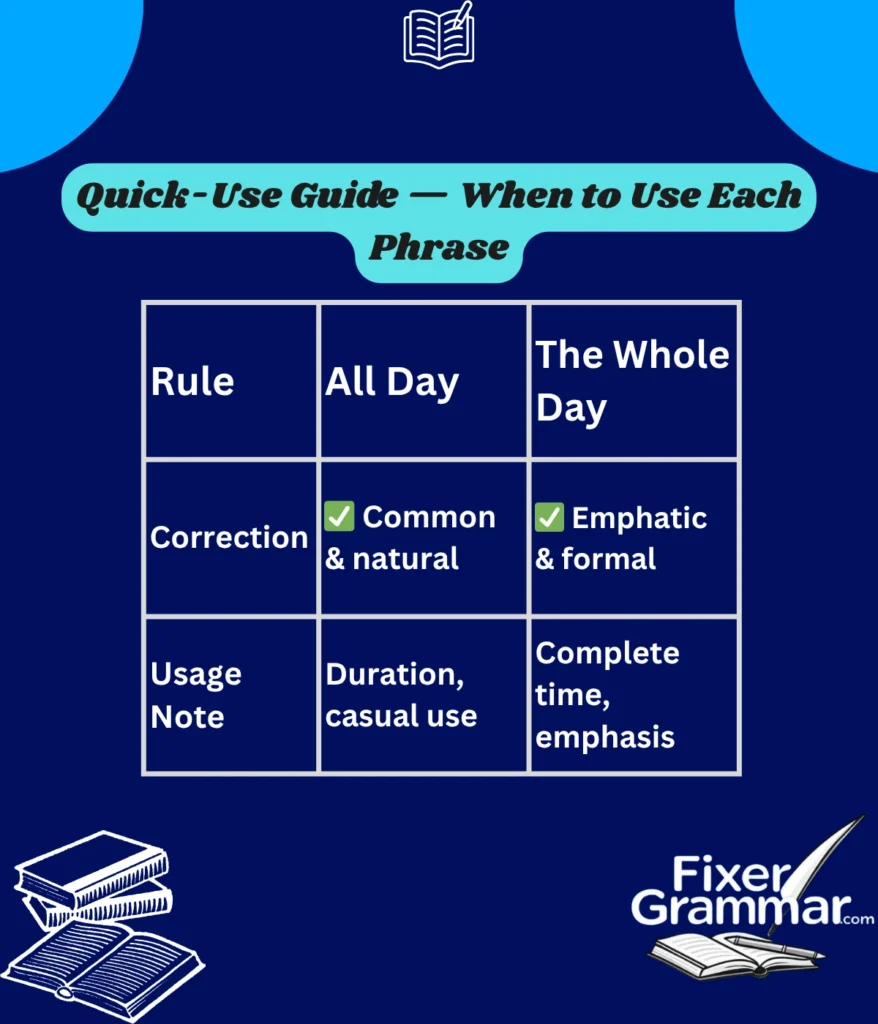
Use “all day” when:
- You’re describing how long something lasted
- You’re in casual conversation or informal writing
- You want the sentence to flow quickly and naturally
Use “the whole day” when:
- You want to emphasize the full, complete block of time
- You’re writing formally or telling a story with emotion
- You want to add dramatic weight or stress
The easiest shortcut to remember:
All = Action and Duration. Whole = Complete Unit of Time.
When in doubt, “all day” is almost always the safer, more natural choice in everyday speech.
More Posts:Checkup or Check Up — What’s the Difference ? 2026
FAQs About Whole Day and All Day
Is “whole day” grammatically correct?
Yes, but only with a determiner. “The whole day” or “a whole day” is correct — “whole day” alone is not standard English.
Can I use “all day” and “whole day” interchangeably?
Not always. “All day” emphasizes duration; “the whole day” emphasizes completeness. The grammar structure and emotional tone are different.
Which sounds more natural in everyday conversation?
“All day” is more common and natural in casual, everyday speech for most people.
Is “all day long” correct?
Yes. “All day long” is perfectly correct and adds extra emphasis to duration. “I waited all day long” is a natural, expressive phrase.
Is there a difference between British and American usage?
Slightly. British English tends to use “the whole day” more often in narrative writing, while standard everyday usage in both favors “all day” in casual speech.
Can I say “I worked the whole day”?
Yes, this is grammatically correct. It sounds slightly more formal or expressive than “I worked all day,” but both are acceptable.
What’s wrong with saying “I worked whole day”?
The missing article makes it grammatically incorrect. You must say “the whole day” or “a whole day” — never just “whole day” alone.
The Bottom Line
Both “all day” and “the whole day” are correct — they just work differently. Use “all day” for smooth, natural, everyday speech.
Use “the whole day” when you want emphasis or completeness. The single most important rule: never drop the article before whole day. Get that right, and your English immediately sounds more natural and confident.

At FixerGrammar.com, Johnson Isaacs shares easy grammar tips, clear examples, and helpful guidance to make writing simple, smooth, and mistake-free.
Related Posts