Extensible items need external additions to grow, while extendable items have built-in expansion capabilities.
Understanding this distinction matters for developers, product designers, and anyone communicating technical specifications.
What Does “Extensible” Mean?

“Extensible” refers to systems, platforms, or software that can be enhanced by adding external components. These additions include plugins, modules, extensions, or APIs.
The word comes from the Latin extendere, meaning “to stretch out.” In modern usage, it primarily appears in technical and software contexts.
Think of extensible items as building blocks.
Examples of “Extensible” in Action
- The WordPress platform is extensible through its plugin ecosystem.
- Our API is extensible, allowing developers to add custom features.
- The framework provides an extensible architecture for third-party integrations.
- This extensible system accepts new modules without core modifications.
- The game offers extensible content through expansion packs.
- Cloud platforms like AWS are extensible via additional services.
More Posts: Is It Correct to Say “Day Well Spent”? Meaning Alternatives & Examples
What Does “Extendible” Really Mean?
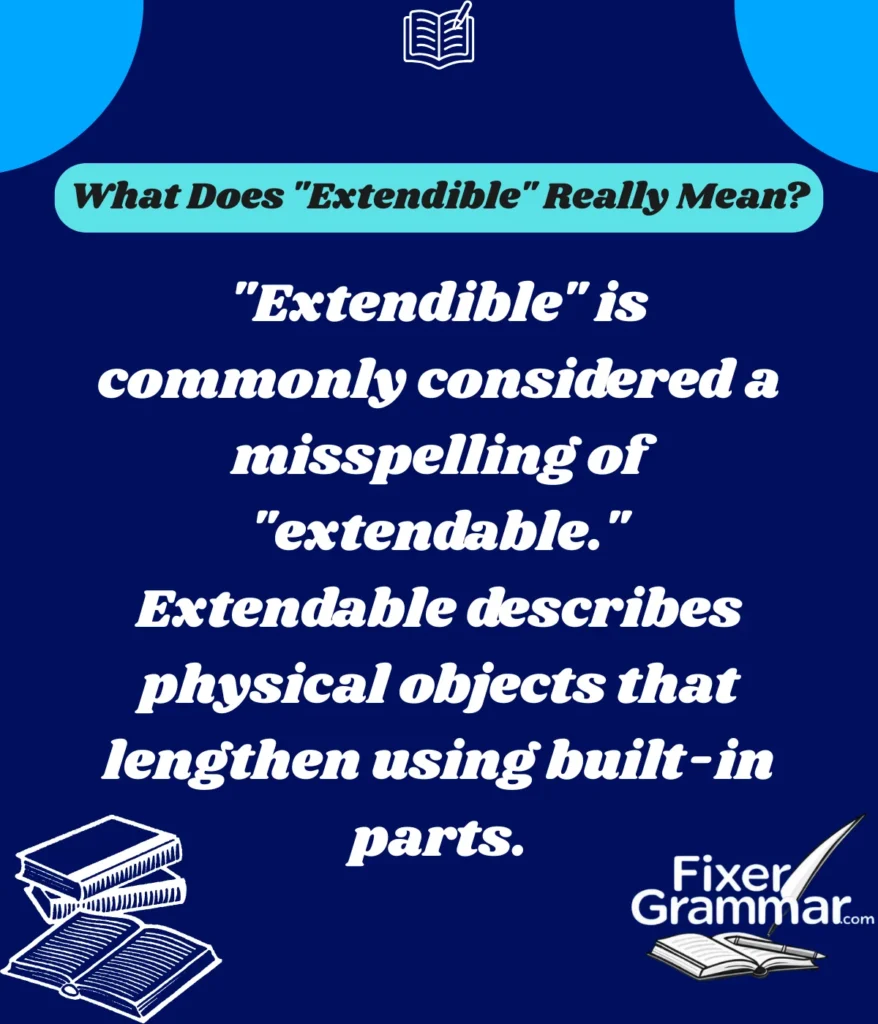
“Extendible” is commonly considered a misspelling of “extendable.” The correct term describes physical objects that can be lengthened, stretched, or expanded through their built-in design.
Unlike extensible items, extendable products don’t require external parts. A telescoping ladder extends on its own. An adjustable table has hidden leaves that fold out. A retractable antenna pulls out without additions.
The Cambridge Dictionary defines “extendable” as “able to be made longer or larger.” This applies to tangible, physical items—not abstract systems or software.
Examples of “Extendable” in Action
- The dining table is extendable for larger gatherings.
- We bought an extendable ladder that reaches 20 feet.
- This extendable hose stretches to twice its original length.
- The tripod features extendable legs for uneven terrain.
- My extendable selfie stick folds down for travel.
- The wrench has an extendable handle for extra leverage.
Extensible vs Extendable
| Aspect | Extensible | Extendable |
|---|---|---|
| Primary Use | Software, systems, platforms | Physical objects, products |
| Expansion Method | External add-ons, plugins, modules | Built-in capability, no extra parts |
| Common Fields | Programming, web development, tech | Manufacturing, product design, tools |
| Examples | WordPress, browsers, APIs | Ladders, tables, antennas |
| Spelling | Always “extensible” | “Extendable” (not “extendible”) |
When to Use Each Term
Use “extensible” when discussing abstract systems that accept additions. Think software architecture, programming frameworks, or modular platforms.
Use “extendable” for physical items with built-in expansion features. Think household products, tools, or furniture.
Memory trick: Extensible needs external parts. Extendable has internal mechanisms.
More Posts: “At the House” vs “In the House” – Which Is Correct?
Examples Extensible vs. Extendible in Action

Extensible Scenarios
Software development relies heavily on extensible architecture. JavaScript frameworks like React and Vue allow developers to add libraries. Content management systems like Drupal support custom modules.
Cloud computing platforms offer extensible services. Amazon Web Services lets you add databases, storage, and computing power. Microsoft Azure provides extensible solutions for enterprise needs.
E-commerce platforms like Shopify use extensible apps. Store owners install payment gateways, shipping calculators, and marketing tools without rebuilding their sites.
Extendable Scenarios
Home improvement products frequently feature extendable designs. Paint rollers have extendable handles for high ceilings. Curtain rods adjust to different window widths.
Professional equipment incorporates extendable components. Camera tripods adjust height. Microphone stands extend for different performers.
Outdoor gear uses extendable functionality. Trekking poles collapse for storage. Fishing rods telescope for portability.
FAQ’s
Is “extendible” a real word?
“Extendible” technically exists but is widely considered outdated or incorrect. Most style guides and dictionaries recommend “extendable” instead for physical objects that can be lengthened.
Can I use “extensible” for physical objects?
You can, but it’s not standard practice. “Extensible” works best for abstract systems and software. For physical items that stretch or lengthen, use “extendable” to match common usage patterns.
What’s the difference between extensible and scalable?
Extensible means adding new features through external components. Scalable means handling increased load or volume. A system can be both—extensible for functionality, scalable for capacity.
Is it “extensible” or “extendable” in software development?
Always use “extensible” in software contexts. Developers, architects, and technical writers consistently choose “extensible” when discussing code, platforms, APIs, and frameworks that accept additions.
Which spelling is correct?
Both “extensible” and “extendable” are correct, but serve different purposes. Use “extensible” for software and systems. Use “extendable” for physical objects. Avoid “extendible” in professional writing.
Do I need to worry about British vs. American differences?
No significant differences exist between dialects for these terms. Both varieties prefer “extensible” for tech contexts and “extendable” for physical objects. “Extendible” is uncommon in both.
Final Thoughts
Remember this simple rule: extensible items need add-ons, extendable items have built-in expansion.
Extensible applies to software, platforms, and abstract systems that grow through plugins, modules, or extensions. WordPress, APIs, and cloud services are extensible.
Extendable describes physical products that lengthen or stretch inherently. Ladders, tables, and antennas are extendable.
Skip “extendible” entirely—it’s outdated and potentially incorrect. Stick with “extendable” for physical objects and “extensible” for technical systems.
Using the correct term strengthens your professional communication. It shows precision in technical writing and clarity in product descriptions. Master this distinction, and you’ll communicate more effectively across industries.

At FixerGrammar.com, Johnson Isaacs shares easy grammar tips, clear examples, and helpful guidance to make writing simple, smooth, and mistake-free.
Related Posts