“Propose” (verb) describes an action you take, while “purpose” (noun) explains why you do it.
This guide breaks down the difference between propose and purpose in simple terms. You’ll learn when to use each word, see real examples, and discover memory tricks that stick.
Understanding Propose: Definition, Usage, and Examples

Propose is a verb that means to suggest something or put forward an idea. When you propose, you’re taking action—offering a plan, making a recommendation, or presenting a concept for others to consider.
The word comes from Latin “proponere,” which means “to put forth.” You’ll pronounce it as pruh-POHZ, with the stress on the second syllable.
Four main ways Americans use propose:
1. Suggesting Plans or Ideas
When you propose a solution at work or propose changes to a project, you’re recommending something new. Business professionals use this meaning constantly in meetings and presentations.
Example: “The team will propose a new marketing strategy next week.”
2. Making Marriage Offers
In romantic contexts, when someone decides to propose marriage, they’re asking their partner to marry them. This is probably the most familiar use of the word in everyday American life.
Example: “He proposed to her on the beach at sunset.”
3. Offering Toasts
At celebrations, people propose a toast to honor someone or mark a special occasion. This formal usage appears at weddings, retirement parties, and other gatherings.
Example: “The best man proposed a toast to the happy couple.”
4. Planning or Intending
When you propose to do something, you’re stating your intention or plan. This usage shows up in both formal and informal contexts across America.
Example: “We propose to finish the renovation by December.”
Understanding Purpose: Definition, Usage, and Examples
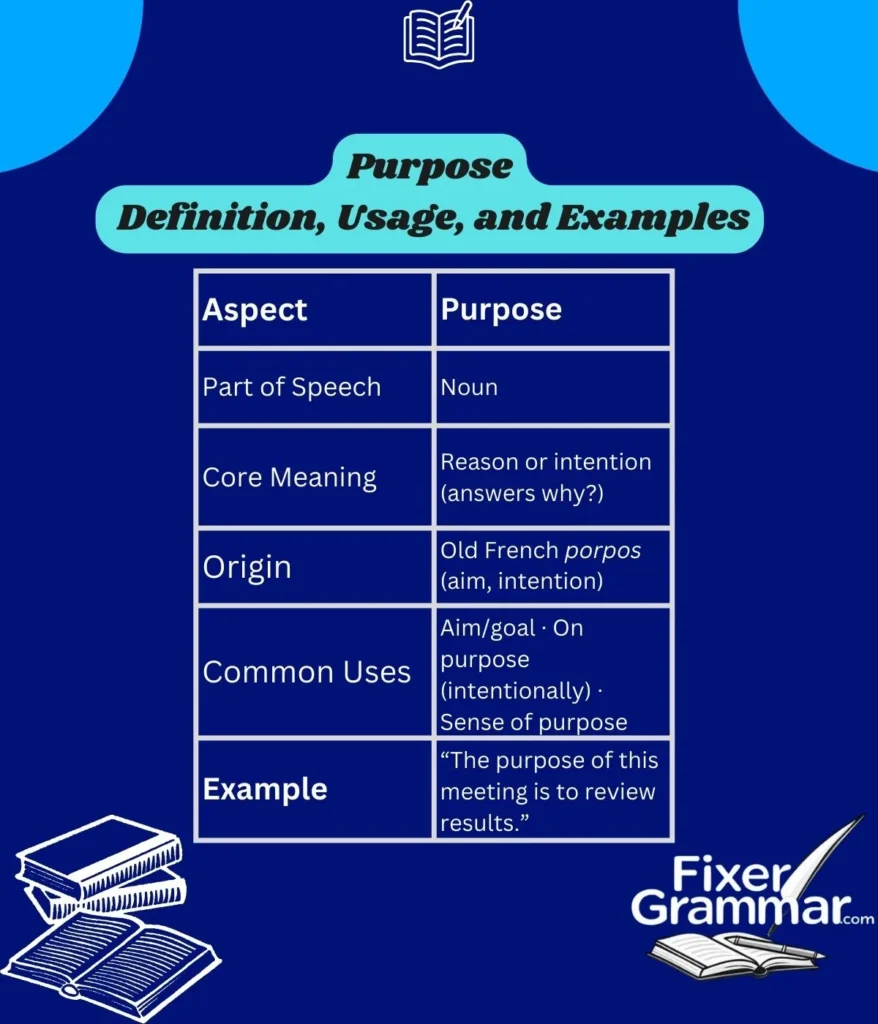
Purpose functions primarily as a noun that refers to the reason or intention behind something. It answers the question “why?” rather than describing an action someone takes.
The word originates from Old French “porpos,” meaning “aim” or “intention.” Americans pronounce it as PUR-puhs, with stress on the first syllable.
Purpose appears in three common ways in American English:
1. Aim or Intention
The purpose of something explains why it exists or what it’s meant to achieve. Every project, product, or action has a purpose—the goal it’s designed to accomplish.
Example: “The purpose of this meeting is to review quarterly results.”
2. Doing Something Deliberately
The phrase “on purpose” means intentionally or deliberately. When someone does something on purpose, they meant to do it—it wasn’t an accident or mistake.
Example: “She left the door open on purpose to let fresh air in.”
3. Determination and Resolve
When someone has a sense of purpose, they feel driven and focused. This meaning relates to personal motivation and the determination to achieve meaningful goals.
Example: “After volunteering, he found a new sense of purpose in life.”
Note: While purpose occasionally works as a verb (meaning “to intend“), this usage is rare in modern American English. You’ll almost always see it as a noun.
Differences B/ W Propose & Purpose

Here’s a simple memory trick: Think of propose as the action arrow (→) pointing forward, suggesting or offering something. Think of purpose as the target (🎯) you’re aiming for—your reason or goal.
- Business Context Example:Propose: “I propose we increase our social media budget.”
- Academic Context Example:Propose: “Researchers propose a new theory about climate patterns.
- Personal Context Example:Propose: “Let’s propose a family vacation to Hawaii.”
The key is remembering that you propose (action) something to achieve a purpose (goal). They work together but serve different grammatical roles in sentences.
How to Use Propose vs Purpose Correctly in Sentences
In professional and academic communication, choosing between propose and purpose is essential for clarity and credibility.
- Propose is used to suggest actions, present ideas, or recommend plans.
It commonly appears in business discussions, academic theories, and everyday suggestions. - Purpose explains reasons, goals, or intentions behind an action or decision.
It is widely used in policies, research writing, and personal explanations.
In academic writing, precision matters:
- Researchers propose theories.
- Studies and experiments define their purpose to explain objectives and results.
In daily conversation, the distinction remains important:
- Propose introduces ideas or offers.
- Purpose clarifies motivation or intent.
To master American English usage, observe how native speakers use propose and purpose in news interviews, business podcasts, and TED Talks for natural, real-world context.
FAQ’s
What is the difference between purpose and propose?
Propose is a verb meaning to suggest or offer something, while purpose is a noun meaning the reason or goal behind something. You propose actions; purpose explains why.
Can “purpose” be used as a verb?
Yes, but it’s rare in modern English. As a verb, purpose means “to intend,” but most Americans use “propose” or “plan” instead for clearer communication.
When should I use “propose” instead of “suggest”?
Use propose for formal suggestions, official plans, or marriage offers. Use “suggest” for casual recommendations. Both work, but propose sounds more formal and intentional.
Is it “for this purpose” or “for this propose”?
Always use “for this purpose” when explaining reasons or goals. “For this propose” is grammatically incorrect and never used in proper English writing.
What does “on purpose” mean?
“On purpose” means deliberately or intentionally—the opposite of accidentally. Example: “She wore red on purpose to match the team colors.”
Quick Takeaways
Understanding the difference between propose and purpose boils down to remembering one simple rule: propose is what you do, purpose is why you do it. This distinction keeps your writing clear and professional.
Remember these key points:
- Propose (verb) = suggesting, offering, recommending an action or plan
- Purpose (noun) = the reason, goal, or intention behind something
- Use “I propose” when making suggestions; use “the purpose is” when explaining reasons
- The phrase is always “on purpose” (never “on propose”)
- Propose becomes “proposal” as a noun; purpose stays as a noun
Final memory trick: Think of the “O” in propose as an open mouth—you’re opening your mouth to suggest something. Think of the “U” in purpose as “you”—it’s about your reason or goal.

At FixerGrammar.com, Johnson Isaacs shares easy grammar tips, clear examples, and helpful guidance to make writing simple, smooth, and mistake-free.
Related Posts