Both are correct, but their usage depends on meaning and context.
“In the street” means you’re physically standing in the middle of the road itself.
The preposition changes the entire meaning, so knowing when to use each one matters for clear communication.
What Does “On the Street” Mean?
“On the street” refers to being positioned along or beside a street. Think of “on” as describing something that sits on top of a surface. When you stand on a sidewalk or live in a house that faces a road, you’re “on the street.”
This phrase works for geographical locations. If someone asks where you live, you’d say “I live on Maple Street.” Shops, restaurants, and buildings are all “on” streets because they’re positioned along them, not floating in the middle of the road.
Common examples include:
- I saw him walking on the street yesterday.
- My favorite coffee shop is on Fifth Avenue.
- She lives somewhere on this street.
- There’s a new store opening on the main street.
- You’ll find the post office on Cedar Road.
What Does “In the Street” Mean?
“In the street” means you’re physically inside the roadway where cars drive. It describes being in the center portion of the street, not on the sidewalk or curb. Parents warn kids not to play “in the street” because that’s where vehicles travel.
This phrase suggests enclosure or being surrounded by the street itself. British English speakers use “in the street” more freely than Americans, but in the USA, it specifically means the road portion.
Common examples include:
- Don’t play in the street—it’s dangerous!
- There’s a ball in the street that rolled away.
- I found a wallet lying in the street.
- The kids were dancing in the street during the parade.
- A tree branch fell in the street last night.
More Posts:Time Slot vs Timeslot: Which is Correct, Usage and Common Mistakes
“In the Street” vs. “On the Street” – Key Differences Explained
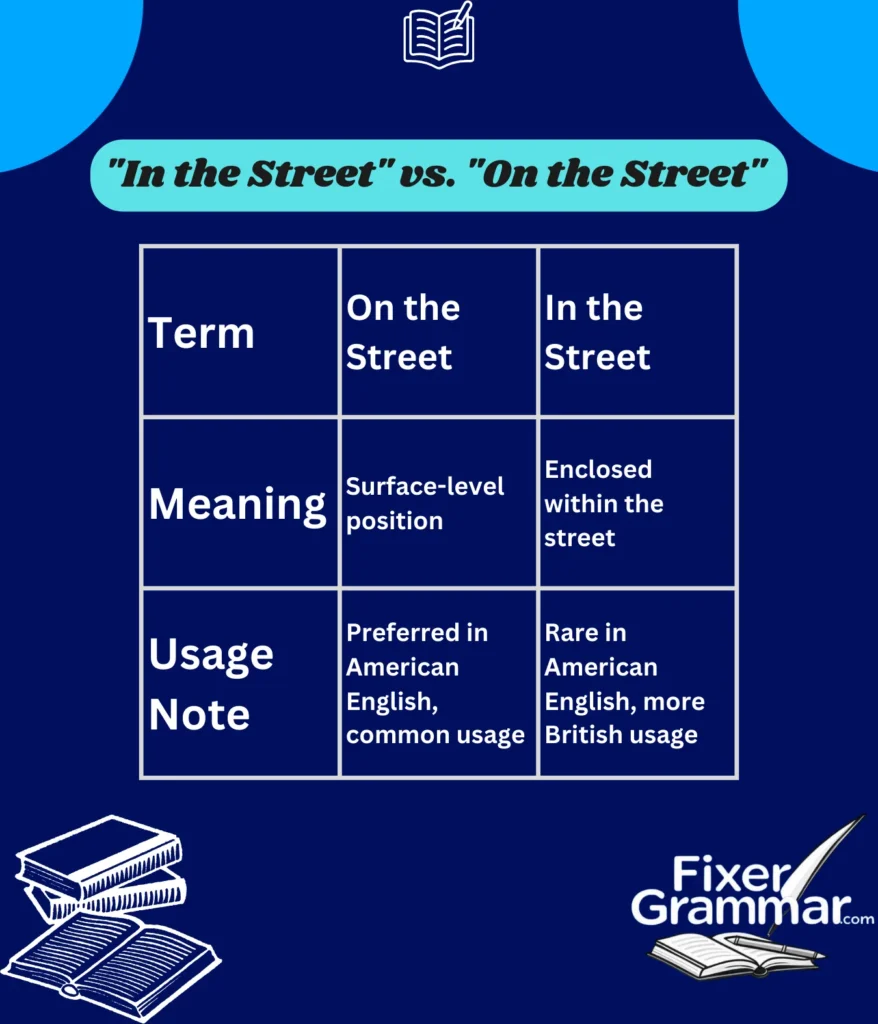
The main difference lies in position and context.
“On” describes surface-level positioning, while “in” describes being enclosed within something.
| Phrase | Meaning | When to Use | Example |
|---|---|---|---|
| On the street | Positioned along/beside the street | Addresses, locations, general position | “I live on Park Avenue” |
| In the street | Inside the roadway itself | Middle of the road, where cars drive | “Don’t stand in the street” |
| At the street | Arrived at a meeting point | Specific arrival locations | “I’m at the street corner now” |
These phrases are NOT interchangeable in most situations. Using the wrong preposition can confuse your listener. If you say “I’m in the street,” people might think you’re standing in traffic.
The geographic context matters too. Americans strongly prefer “on the street” for most situations. British speakers sometimes use “in the street” where Americans would say “on the street.”
More Posts:Passerbyers or Passersby or Passerby? The Right Guide to Getting It Right
Common Phrases: Which Preposition Should You Use?
Playing in the Street vs. Playing on the Street
“Playing in the street” is the standard phrase because kids typically play in the roadway, not just on the sidewalk. This is the more natural and common choice.
“Playing on the street” can work if you mean playing anywhere along the street, including sidewalks. But “in” sounds more natural to native speakers.
Dancing in the Street vs. Dancing on the Street
“Dancing in the street” refers to dancing in the middle of the road. This phrase became famous through the Martha and the Vandellas song. It means freely dancing where cars normally drive.
“Dancing on the street” suggests dancing on the pavement or sidewalk. The context determines which preposition fits better.
Walking in the Street vs. Walking on the Street
“Walking on the street” is correct for normal walking along sidewalks or roadways. It’s the most common phrase Americans use.
“Walking in the street” means walking directly in the roadway where cars travel. You might use this when describing unsafe behavior or when sidewalks aren’t available.
Living in the Street vs. Living on the Street
“Living on the street” describes your residential address. It means your home is positioned along that particular street.
“Living in the street” sounds awkward and isn’t standard English. However, both “living on the streets” (plural) and “living in the streets” can describe homelessness, though “on the streets” is more common.
FAQ‘s
Is it correct to say “on the street”?
Yes, “on the street” is completely correct and the most common phrase Americans use for describing location along a street.
What is the difference between “in the street” and “on the street”?
“On the street” means positioned along a street, while “in the street” means physically inside the roadway where cars drive.
Do you say “in the street” or “on the street” in American English?
Americans prefer “on the street” for most situations involving location, addresses, or general positioning along a street.
Is it “play in the street” or “play on the street”?
“Play in the street” is more common and natural because it refers to playing in the roadway itself.
Can “in the street” and “on the street” be used interchangeably?
No, they have different meanings and aren’t interchangeable except in rare cases involving enclosed street areas.
Conclusion
“On the street” works for most everyday situations involving location and position. Use “in the street” only when describing something physically in the roadway.
Understanding this simple distinction helps you sound more natural and communicate more clearly. Remember that American English strongly favors “on the street” for addresses, directions, and general positioning.

At FixerGrammar.com, Johnson Isaacs shares easy grammar tips, clear examples, and helpful guidance to make writing simple, smooth, and mistake-free.
Related Posts