The confusion between company-wide and companywide trips up even experienced writers.
Know exactly when to use each form.
Hyphenation Rule– Company-Wide vs. Companywide
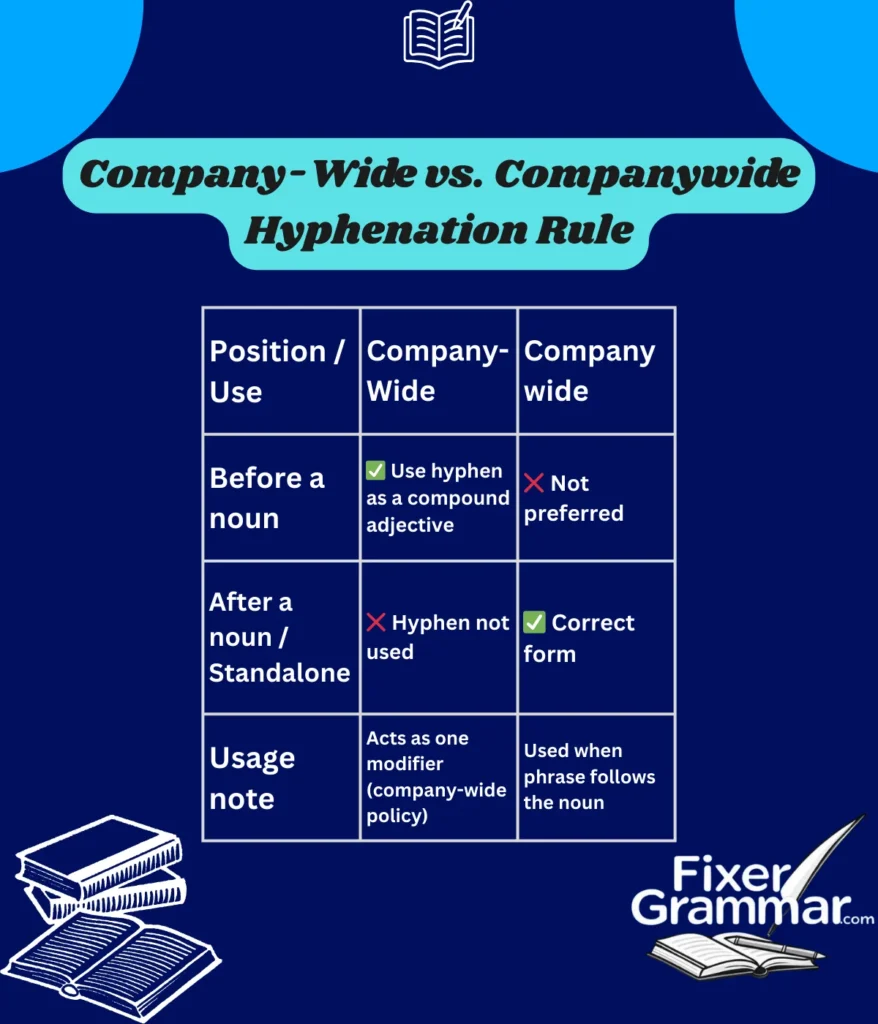
The hyphenation debate around company-wide versus companywide comes down to understanding compound modifiers. A compound modifier is two or more words that work together to describe a noun.
When “company-wide” appears before a noun it modifies, you typically add a hyphen. For example, “The company-wide announcement surprised everyone.” The hyphen connects the two words to show they form a single descriptive unit.
However, when the phrase comes after the noun or stands alone, the hyphen often disappears. You might write, “The policy applies companywide.” This position change affects punctuation rules significantly.
More Posts: Time Slot vs Timeslot: Which is Correct, Usage and Common Mistakes
When to Use the Hyphen in Company-Wide
Use the hyphenated form “company-wide” when it serves as an adjective directly before a noun. This creates clarity and prevents misreading.
Common examples include company-wide meetings, company-wide initiatives, company-wide surveys, and company-wide communications. The hyphen signals that both words function as one modifier.
The hyphen acts like glue. It bonds “company” and “wide” together so readers immediately understand you’re describing something that spans the entire company.
The Case for Writing Companywide as One Word
Modern usage increasingly favors “companywide” as a single word, especially in digital communication and informal business writing. Many organizations have adopted this streamlined approach.
The one-word version appears more frequently in internal memos, email subject lines, and corporate announcements. It looks cleaner and saves space without sacrificing meaning.
What Do Major Style Guides Say About Company-Wide?
Different style guides offer varying recommendations on company-wide versus companywide.
| Style Guide | Recommendation | Usage Context |
|---|---|---|
| AP Stylebook | Companywide (one word) | Journalism, news writing |
| Chicago Manual of Style | Company-wide (hyphenated before nouns) | Academic, book publishing |
| Merriam-Webster | Both accepted | General usage |
| Corporate Style Guides | Varies by organization | Internal communications |
How to Use Company-Wide Correctly in Sentences
Mastering correct usage requires understanding how company-wide functions grammatically in different sentence positions.
The key factor is whether company-wide modifies a noun directly or stands independently. This determines hyphenation and placement in your sentence structure.
Business Writing Examples
Here are practical examples from actual business contexts:
- “The CEO announced a company-wide restructuring during the quarterly meeting.”
- “Our companywide survey revealed important insights about employee satisfaction.”
- “The new policy will be implemented companywide starting January 1.”
- “HR is organizing a company-wide training program for all departments.”
More Posts: “At the House” vs “In the House” – Which Is Correct?
Company-Wide vs Companywide Usage
| Before the Noun (Attributive Position) | After the Noun or Verb (Predicative Position) |
|---|---|
| Form: company-wide (hyphenated) | Form: companywide (one word) |
| Grammar Role: Compound adjective | Grammar Role: Predicative usage |
| Rule: Hyphen is required for clarity when modifying a noun directly | Rule: No hyphen needed when used after a noun or verb |
| Explanation: Both words work together to describe the noun | Explanation: The phrase describes the scope, not a noun directly |
| Examples: company-wide email, company-wide budget, company-wide standards, company-wide goals | Examples: The changes will occur companywide. / This applies companywide. |
Common Mistakes
The most frequent error is inconsistent hyphenation within the same document. Switching between “company-wide” and “companywide” confuses readers and looks unprofessional.
Another mistake involves adding hyphens where they don’t belong. Writing “company wide” as two separate words (without a hyphen before a noun) is incorrect and creates ambiguity.
Incorrect Usage
Wrong: “The company wide initiative launches next week.”
Right: “The company-wide initiative launches next week.”
Wrong: “We’re implementing this policy company wide.”
Right: “We’re implementing this policy companywide.”
Wrong: “All company-wide employees must attend.”
Right: “All employees must attend the company-wide meeting.”
FAQ’s
Is it company-wide or companywide AP style?
AP style uses “companywide” as one word without a hyphen, regardless of its position in the sentence.
How do you write company-wide in a sentence?
Write “company-wide” with a hyphen before a noun (“company-wide policy”) or “companywide” as one word after a verb (“implemented companywide”).
Is companywide one word or two?
Companywide is one word in AP style and increasingly common in modern business writing, though “company-wide” with a hyphen remains correct before nouns.
Should company-wide be hyphenated?
Company-wide should be hyphenated when it appears before a noun in Chicago style, but written as one word “companywide” in AP style or after verbs.
What’s the difference between nationwide and company-wide?
Nationwide is always one word, while company-wide varies based on style guide and position—this inconsistency stems from compound word evolution in English.
Can I use company wide as two separate words?
No, “company wide” as two separate words (without hyphen) is incorrect—always use either “company-wide” (hyphenated) or “companywide” (one word).
Conclusion
The choice between company-wide and companywide depends on your style guide and the word’s position in your sentence.
Use “company-wide” with a hyphen before nouns in formal writing, or “companywide” as one word when following AP style or when the term appears after a verb. The most important rule is maintaining consistency throughout your document. Pick one style and use it everywhere for professional, polished writing.

At FixerGrammar.com, Johnson Isaacs shares easy grammar tips, clear examples, and helpful guidance to make writing simple, smooth, and mistake-free.
Related Posts