Most people have typed one when they meant the other. These two phrases sound identical when spoken.
But they carry completely different meanings. Getting them mixed up changes what you’re actually saying.
What Does Peace of Mind Mean?
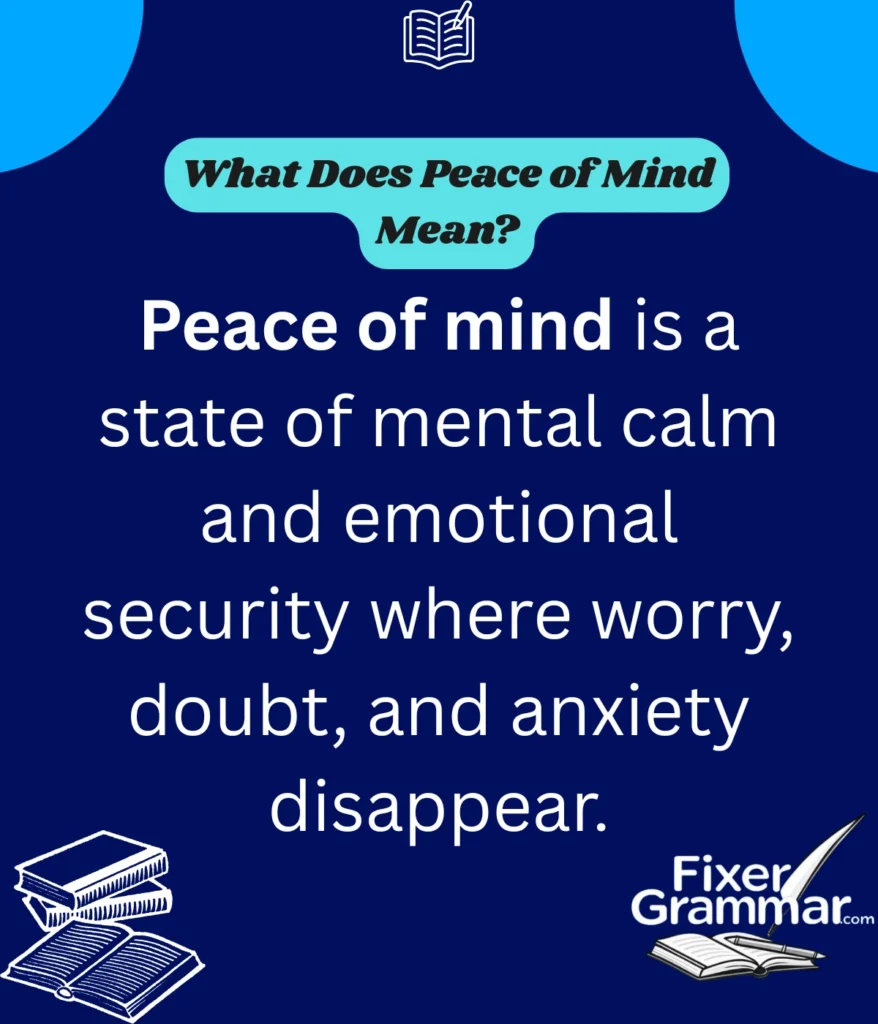
Peace of mind means a state of mental calm and emotional security. You feel it when worry fades and certainty takes over. No anxiety. No doubt. Just quiet confidence.
It is always abstract — you cannot touch it, hold it, or measure it. You simply feel it.
Common situations where peace of mind applies:
- Buying home insurance
- Getting clear medical results
- Knowing your kids are safe
- Having a stable job
- Trusting a reliable security system
Example sentences:
- “This warranty gives customers complete peace of mind.”
- “She finally felt peace of mind after locking the doors.”
- “Good health insurance provides real peace of mind.”
What Does Piece of Mind Mean?
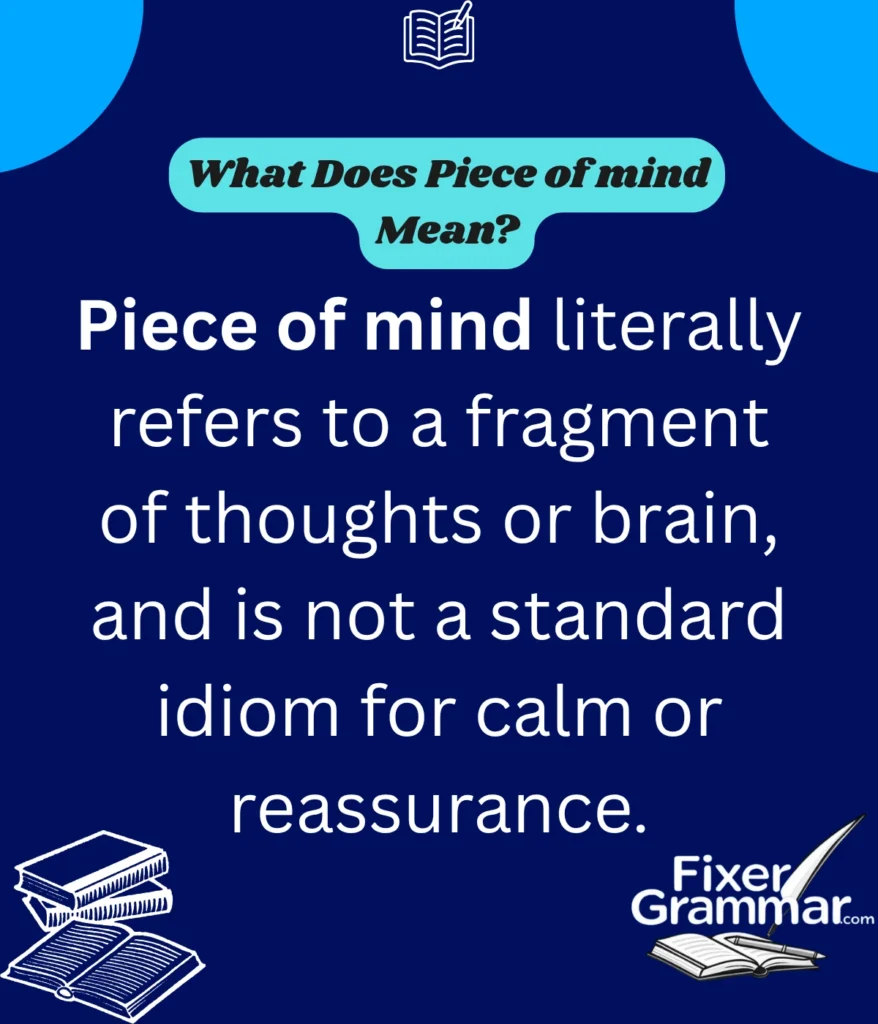
Taken literally, piece of mind means a fragment or portion of someone’s brain or thoughts. That meaning almost never fits what a writer actually intends.
Standard dictionaries do not list “piece of mind” as a valid idiom meaning calm or reassurance. When it appears in writing, editors flag it as an error.
| Context | Example |
|---|---|
| Philosophical writing | “A piece of mind devoted to logic” |
| Experimental creative writing | Used with heavy surrounding context |
| Literal neuroscience discussion | Technical, not idiomatic |
Outside those very specific cases — piece of mind is wrong.
More Posts:Unalienable vs. Inalienable — What’s the Difference ? 2026
Piece of Mind vs Peace of Mind — Side-by-Side Comparison
| Phrase | Meaning | Correct Usage | Tone |
|---|---|---|---|
| Peace of mind | Mental calm, reassurance | ✅ Almost always | Reassuring, emotional |
| Piece of mind | A literal fragment of thought | ❌ Almost never | Literal, technical |
The one-question test: Are you describing a feeling of calm or relief? If yes — write peace, not piece.
Give Someone a Piece of Your Mind (The Phrase That Adds to the Confusion)
“Give someone a piece of your mind” is a real and valid English idiom — and it is the reason many writers accidentally write “piece” instead of “peace.”
What does it mean to give someone a piece of your mind?
It means expressing your honest, often angry, opinion directly and forcefully. You are not holding back. You are not being diplomatic.
Examples:
- “After the delayed flight, she gave the airline a piece of her mind.”
- “He was late three times, so I gave him a piece of my mind.”
The key contrast:
| Phrase | Direction | Emotion |
|---|---|---|
| Peace of mind | Inward — you feel it | Calm, relieved |
| Give a piece of your mind | Outward — you express it | Angry, direct |
One brings you calm. The other means you have lost it. They are opposite in emotional direction.
How to Remember the Difference Every Time
Memory trick 1: Peace contains the word ease. If you are at ease, you have peace of mind.
Memory trick 2: Picture two images side by side. A quiet room with steady breathing — that is peace of mind. A surgeon cutting a brain — that is piece of mind. Only one makes sense in normal conversation.
Memory trick 3: Ask yourself one simple question before writing:
“Am I describing calm and relief — or a physical fragment?”
If calm → peace If fragment → piece (but you probably don’t need that)
Quick Reference
| Situation | Correct Phrase |
|---|---|
| Feeling reassured after a decision | Peace of mind |
| Expressing anger or frustration | Give a piece of your mind |
| Describing a literal brain fragment | Piece of mind |
| Talking about emotional security | Peace of mind |
FAQs About Piece of Mind vs Peace of Mind
What is the difference between piece of mind and peace of mind?
Peace of mind means mental calm and freedom from worry. Piece of mind refers to a literal fragment of thought and is almost always a spelling error in standard writing.
Is “piece of mind” ever correct to use?
Rarely. It only works in highly technical or experimental writing contexts. In everyday and professional writing, it is considered an error.
What does it mean to give someone a piece of your mind?
It means expressing your honest, direct, and often angry feelings to someone without holding back or softening the message.
Which phrase is used in formal writing?
Peace of mind is the accepted phrase in formal, professional, and academic writing. It is the only one recognized as a standard English idiom by major dictionaries. British English uses the same phrase — no difference there.
How can I stop confusing these two phrases?
Remember: peace = ease. If you are describing a feeling of ease, calm, or relief — always write peace. When in doubt, read your sentence aloud and ask if you mean calm or a physical portion.

At FixerGrammar.com, Johnson Isaacs shares easy grammar tips, clear examples, and helpful guidance to make writing simple, smooth, and mistake-free.
Related Posts