When someone calls you disorganized, it stings a little. But if they say you’re unorganized, it feels different — softer, almost fixable. That’s not a coincidence.
These two words carry different meanings, and using the right one changes how your message lands.
Understanding the Prefixes: “Un-” vs. “Dis-“
The real difference starts with the prefix — not the word itself.
- “Un-“ simply means not. It’s neutral. It describes something that never existed in a certain state.
- “Dis-“ means reversal or removal. It implies something changed — usually for the worse.
| Prefix | Core Meaning | Tone | Example |
|---|---|---|---|
| Un- | Absence of something | Neutral | unprepared, unaware |
| Dis- | Reversal or breakdown | Slightly negative | disconnect, disrupt |
What Does Unorganized Mean? (And What Does Disorganized Mean?)
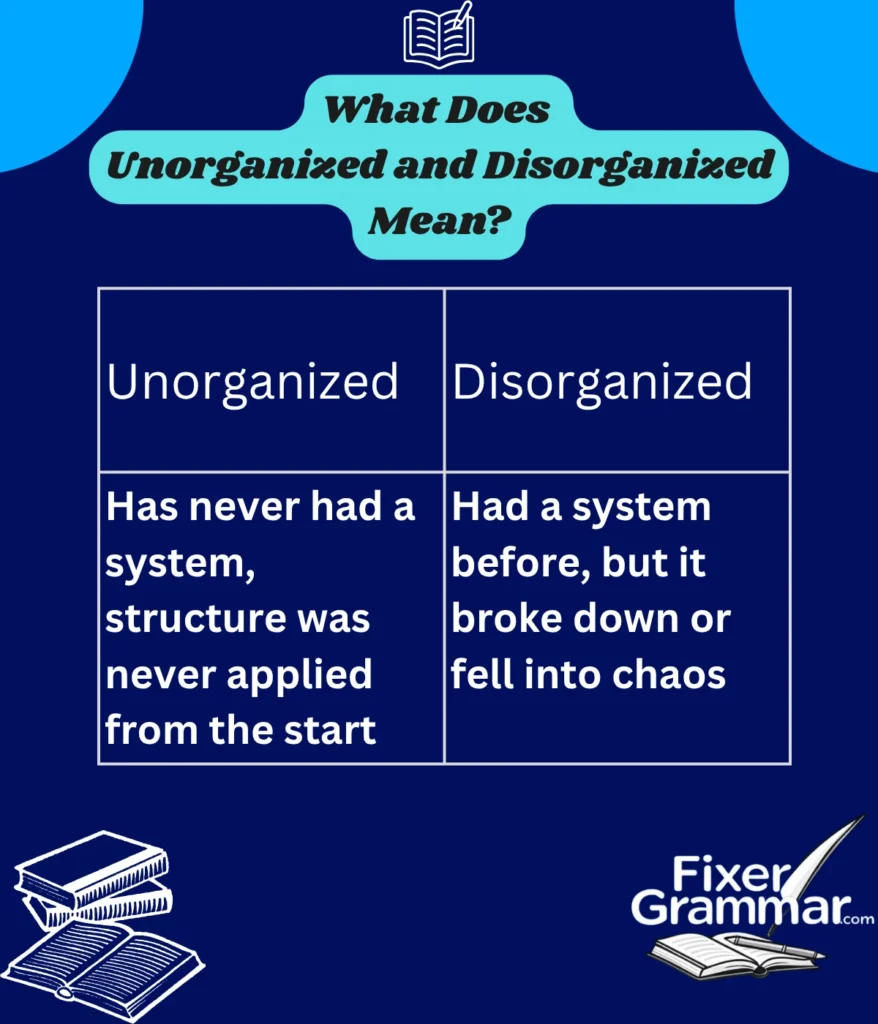
What Does Unorganized Mean?
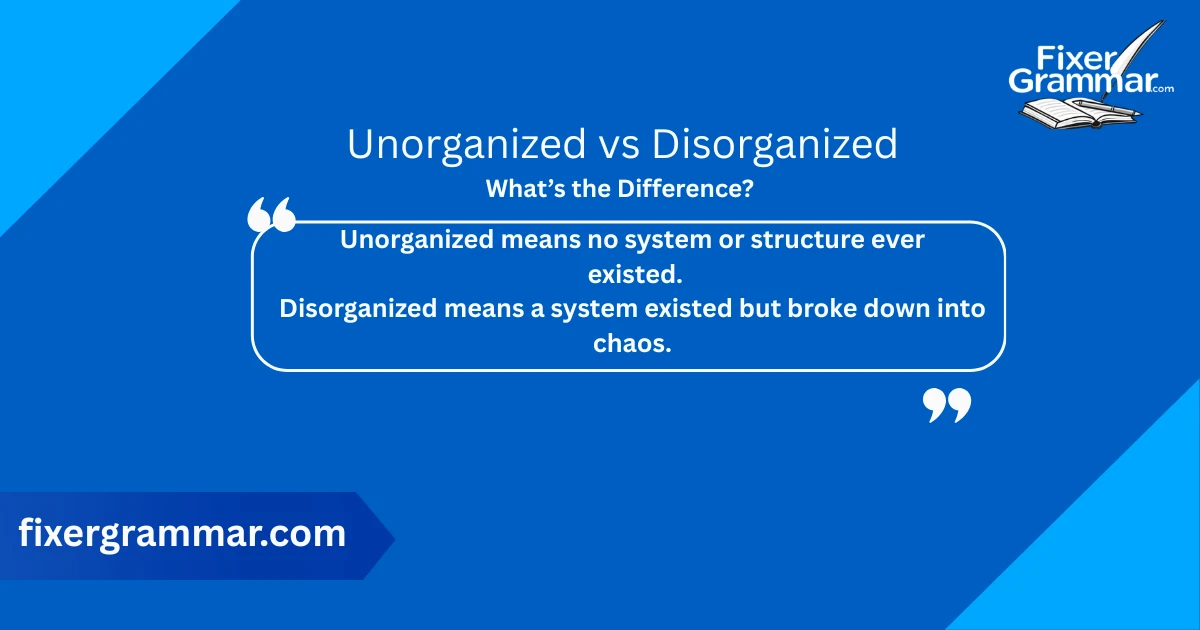
Unorganized describes something that has never been structured. There was no plan, no system, no arrangement — from the start.
It carries zero blame. A brand-new team, a pile of brainstorm notes, or a drawer full of random items — these are unorganized because order was never applied, not because someone failed.
Common synonyms: unstructured, unplanned, raw, untidy
What Does Disorganized Mean?
Disorganized means a structure existed — but broke down. It implies failure, neglect, or chaos that replaced what was once in order.
A filing cabinet that used to be neat but is now a mess? That’s disorganized. A presentation that started with an outline but lost its flow? Also disorganized.
Common synonyms: chaotic, cluttered, haphazard, scattered
| Word | Meaning | Tone | Implies |
|---|---|---|---|
| Unorganized | Never had structure | Neutral | Potential to build |
| Disorganized | Had structure, lost it | Negative | Needs repair |
Unorganized vs Disorganized – Key Differences Explained
The simplest test: Did a system ever exist?
- If yes — and it’s now a mess — use disorganized.
- If no — it was never arranged — use unorganized.
Quick tip: Think of unorganized as a blank page. Think of disorganized as a collapsed house.
The tone difference also matters. Calling someone’s work disorganized sounds critical. Calling it unorganized sounds observational. In professional settings, that distinction can shape how feedback is received.
| Aspect | Unorganized | Disorganized |
|---|---|---|
| Meaning | Never arranged | Was arranged, now chaotic |
| Tone | Neutral, descriptive | Critical, negative |
| Context | New groups, early-stage ideas | Failed systems, poor management |
| Fix | Build a system | Repair or rebuild |
When to Use Each Word – Real-Life Examples
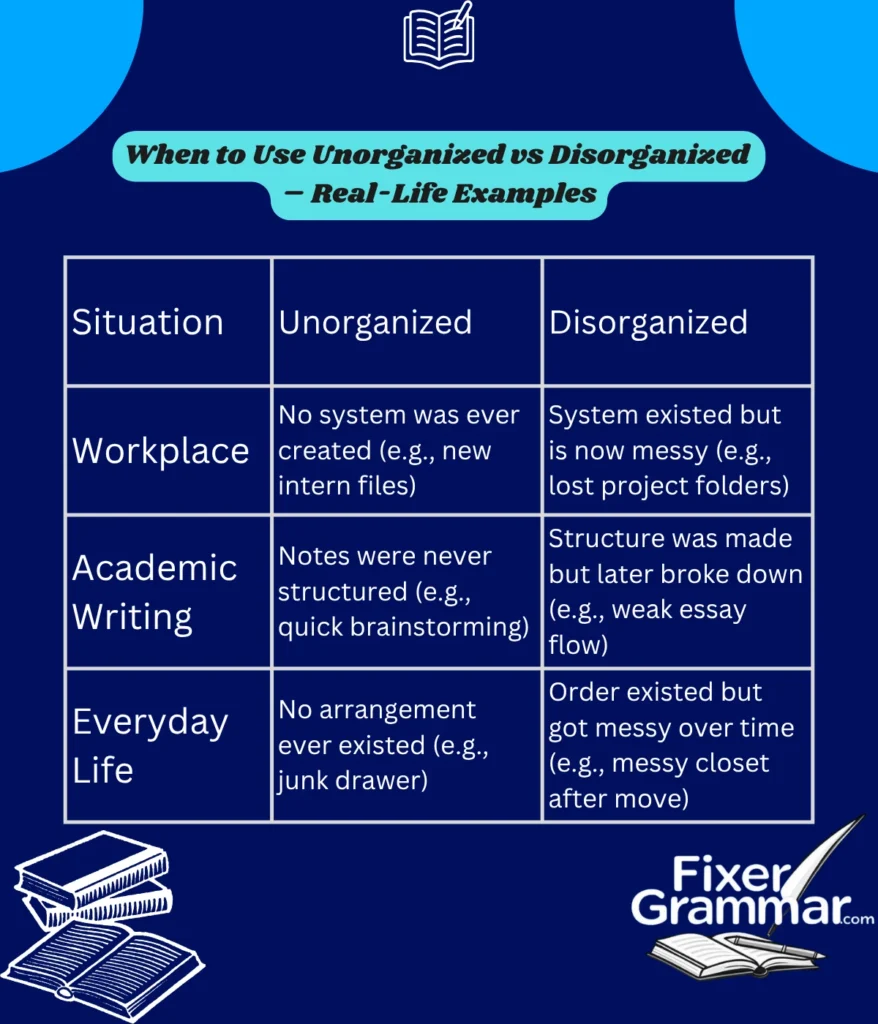
In the Workplace
A new intern’s folder with no naming system? That’s unorganized — no structure was ever set up.
A team’s project drive that had folders but now nobody can find anything? That’s disorganized — the structure collapsed.
In Academic Writing
Brainstorming notes jotted down in a rush are unorganized. They were never meant to be neat.
An essay outline that started clearly but lost its flow halfway through is disorganized — it had structure and lost it.
In Everyday Life
A junk drawer filled over the years with random items is unorganized — no system was ever applied.
A closet that was neatly arranged but fell apart after a move is disorganized — it had order, then lost it.
Memory trick:
- Un- = never organized → blank page
- Dis- = structure disturbed → collapsed house
Quick Decision Guide:
- Was there ever a system? → Yes = disorganized / No = unorganized
- Are you describing a problem or a neutral state? → Problem = disorganized / Neutral = unorganized
Conclusion
The difference between unorganized and disorganized is simple but powerful. One describes the absence of order. The other describes the breakdown of order.
Get this right and your writing becomes more precise, your feedback lands better, and your communication carries more weight.
FAQ’s About Unorganized vs Disorganized
What is the main difference between unorganized and disorganized?
Unorganized means structure never existed. Disorganized means structure existed but broke down. One is absence; the other is failure.
Can a workspace be unorganized but not disorganized?
Yes. A brand-new employee’s desk with no filing system is unorganized — not messy by failure, just never set up.
Why do people use unorganized and disorganized interchangeably?
They sound similar and both suggest disorder. Most people don’t realize the distinction between absence and breakdown that each prefix carries.
Which word fits better in professional writing?
Use disorganized when pointing out a failed system. Use unorganized for neutral, descriptive situations — especially early-stage projects.
Does this difference exist in British English too?
Yes. The distinction applies in both British and American English — though disorganized is spelled disorganised in British English. The meaning remains the same.

At FixerGrammar.com, Johnson Isaacs shares easy grammar tips, clear examples, and helpful guidance to make writing simple, smooth, and mistake-free.
Related Posts