This guide clears everything up in plain, simple language.
What Do Appal and Appall Mean?
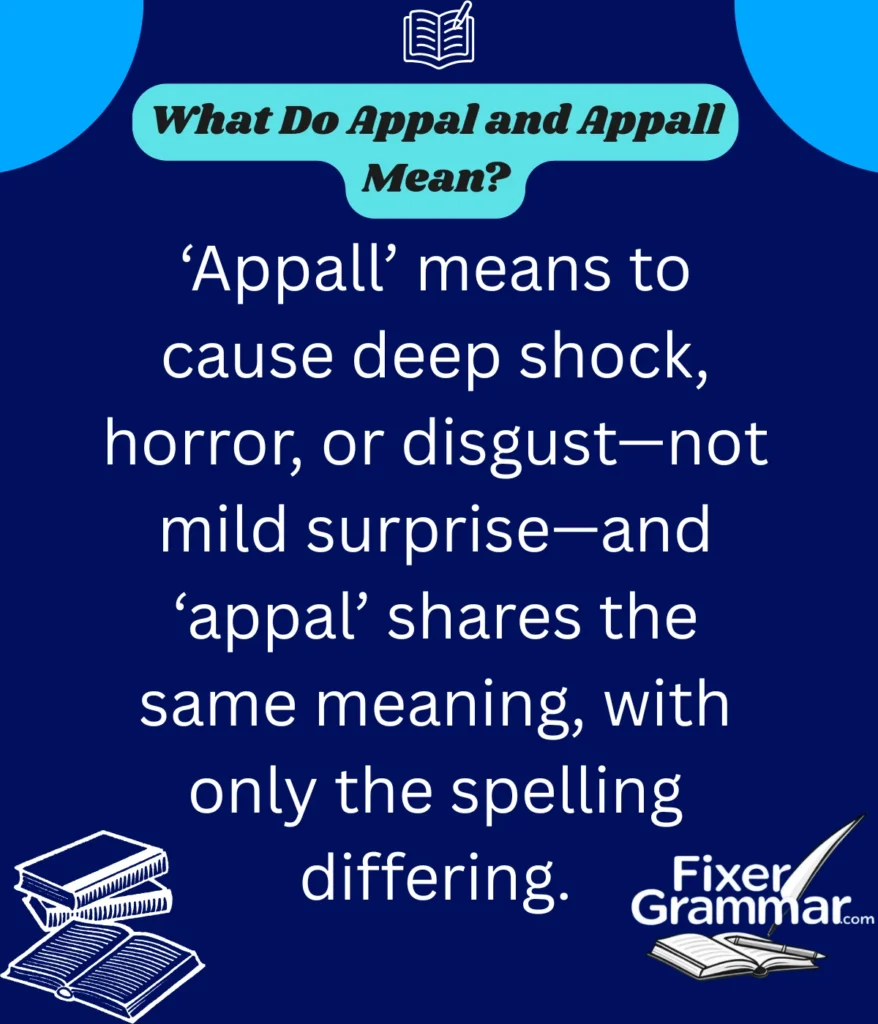
Appall means to cause someone to feel deep shock, horror, or disgust. It’s a strong emotional word — not mild surprise, but genuine moral horror.
According to Merriam-Webster, appall means “to overcome with consternation, shock, or dismay.” It’s the word you reach for when something truly disturbs you.
Common synonyms for appall:
- Horrify
- Shock
- Disgust
- Outrage
- Dismay
Appall vs Appal
| Word | Meaning | Example |
|---|---|---|
| Appall | To deeply shock or horrify | The conditions appalled the inspectors. |
| Appal | Same meaning, alternate spelling | The cruelty appalled the witnesses. |
Both words carry the same emotional weight. The spelling is the only thing that changes.
Appal vs. Appall: The Key Difference Explained
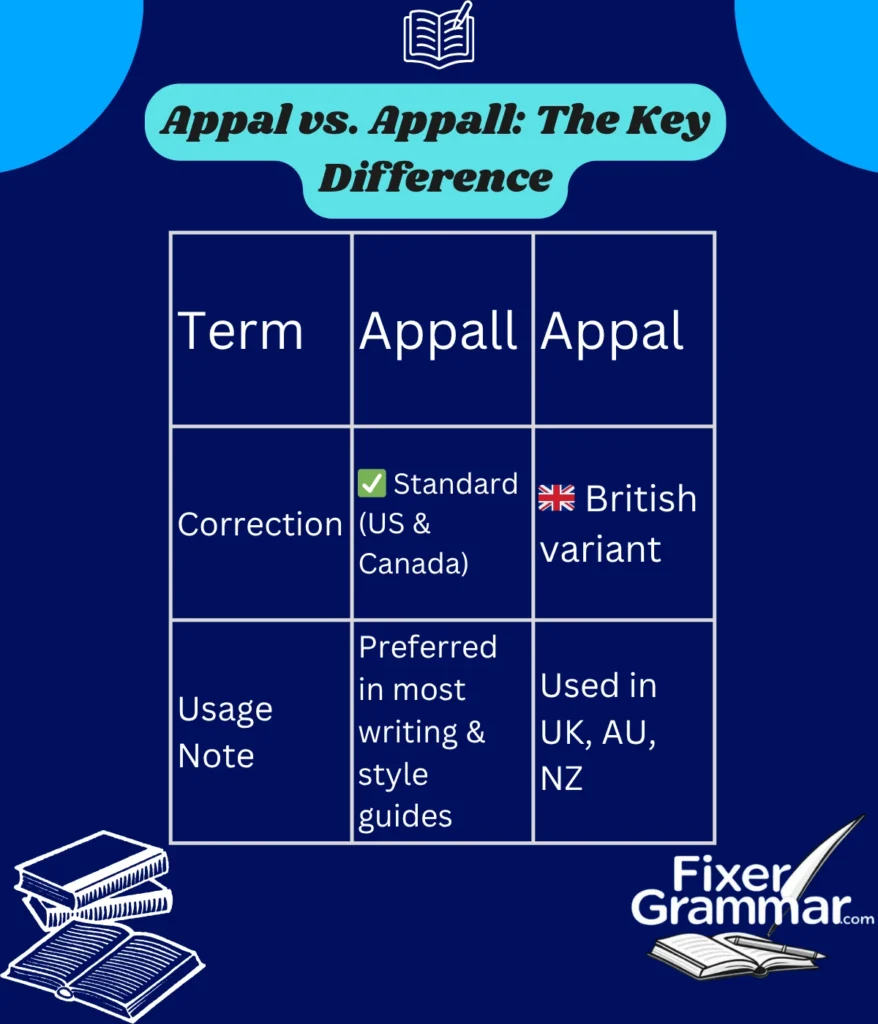
Appall (two L’s) is the standard spelling used in most writing today. Appal (one L) is the British English variant.
Think of it this way: appall has more letters — just like the word “full.” Full shock. Full horror. Double L.
A simple memory trick: If your spell-checker flags “appal” as wrong, that’s normal. It’s not a typo — it’s just the British form. For everyday writing, stick with appall.
Regional Spelling Differences
| Region | Correct Spelling |
|---|---|
| United States | appall |
| Canada | appall |
| United Kingdom | appal |
| Australia / New Zealand | appal |
Style guide standards:
- AP Stylebook → appall
- Chicago Manual of Style → appall
- Oxford Style Guide → appal
The rule is simple: pick one spelling and stay consistent throughout your entire document.
More Posts:He Is Risen or He Has Risen– Which Is Correct? 2026
Origin and History of Appall
Words carry history. Appall has a fascinating one.
It traces back to the Latin word pallēre — meaning “to be pale.” The original idea was physical: something so terrifying it literally drained color from your face.
The word’s journey through time:
- Latin: pallēre → to grow pale from fear
- Old French: apalir → to make pale
- Middle English: appallen → to weaken or cause dismay
- Modern English: appall / appal → to horrify or shock deeply
The two spellings split in the 1820s.
Noah Webster’s landmark American Dictionary of the English Language (1828) standardized appall with two L’s.
British lexicographers took a different path, settling on appal in reference works like the Oxford English Dictionary.
They’re not rivals — they’re siblings. Same root, same meaning, different regional roads.
Grammar Rules: Appalled, Appalling, and All Forms
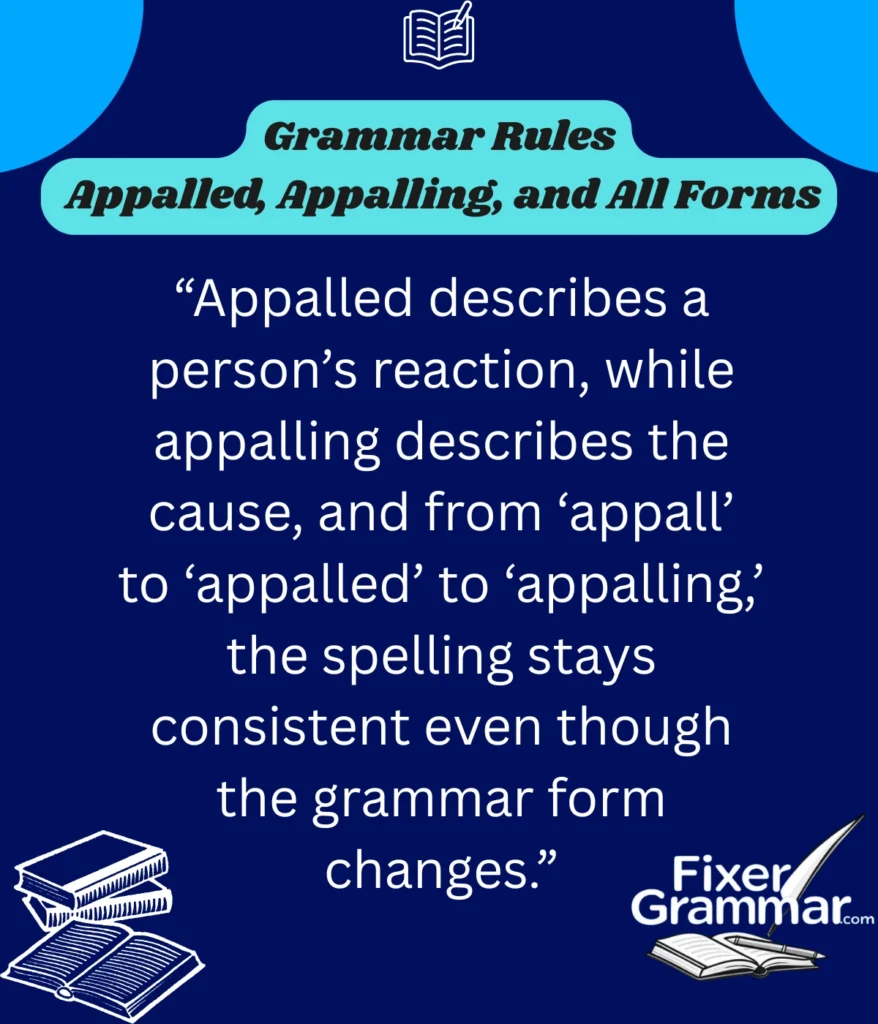
Appalled and appalling always use two L’s — in every region, every style guide, every context.
Forms of Appall
| Form | Spelling | Example |
|---|---|---|
| Base verb | appall | Such cruelty appalls me. |
| Past tense | appalled | She was appalled by the news. |
| Adjective | appalling | The appalling conditions shocked visitors. |
| Present tense | appalls | It appalls me to see this. |
One important distinction:
- Appalled describes how a person feels — the reaction
- Appalling describes what caused that feeling
“The appalling footage appalled everyone who watched it.”
Both words appear in the same sentence — one as cause, one as reaction.
Pronunciation is the same for both spellings: /əˈpɔːl/ — no spoken difference whatsoever.
More Posts:Heard vs Herd vs Hurd– What’s the Difference? 2026
How to Use Appall Correctly
The best way to master a word is to see it working in real sentences.
Appall in action:
- The violence in the report appalled the entire jury.
- It appalls me to think children face this daily.
- The CEO was appalled by the accounting errors.
- His complete lack of empathy appalls his colleagues.
- The appalling service drove customers out the door.
- Viewers were appalled by the footage shown in court.
“What appalls me is not the wickedness of the wicked but the weakness of the good.” — Winston Churchill
One important tip: Don’t overuse this word. Appall is powerful precisely because it’s strong. Save it for genuine moral shock — not minor everyday frustrations. When everything “appalls” you, nothing doe.
FAQ’s Appal vs. Appall
Is “appal” correct to use?
Appal is the British English spelling and is correct in the UK. For most writing, appall (two L’s) is the standard form most readers expect.
What is the difference between appalled and appalling?
Appalled describes a person’s emotional reaction (I was appalled). Appalling describes whatever caused that reaction (the appalling conditions).
How do you spell appall correctly?
The standard spelling is A-P-P-A-L-L — two L’s at the end. This is the form used in Merriam-Webster and major style guides.
Can I use appall and appal interchangeably?
They mean the same thing. However, in formal writing, mixing both spellings in the same document looks inconsistent. Pick one and use it throughout.
Is appalling spelled the same everywhere?
Yes. Appalling and appalled are always spelled with double L — in every region, British or American. Only the base verb (appal vs. appall) differs by region.
Wrapping Up
Appall and appal are the same word wearing different regional clothes.
The meaning never changes: deep shock, moral horror, genuine dismay. For standard writing, appall with two L’s is what most style guides and dictionaries recommend.
Remember the rule: base verb may vary, but appalled and appalling always take double L, everywhere, no exceptions.
Now you’ll never second-guess this word again.

At FixerGrammar.com, Johnson Isaacs shares easy grammar tips, clear examples, and helpful guidance to make writing simple, smooth, and mistake-free.
Related Posts