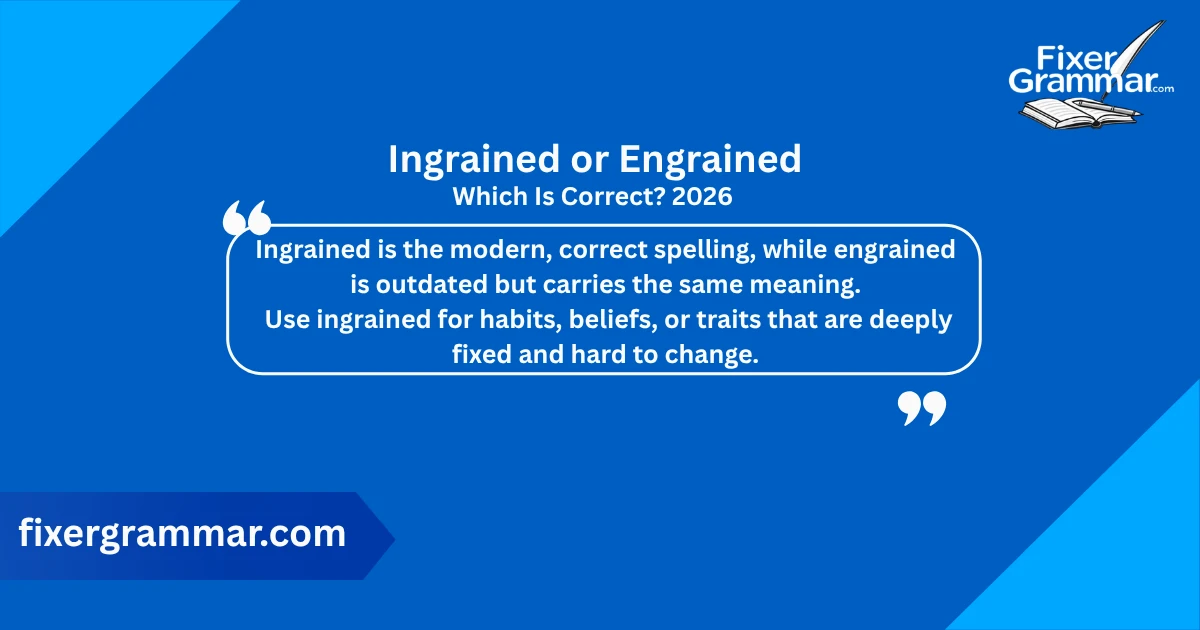
This guide will clear up the confusion and show you exactly when and how to use Ingrained properly.
What Does Ingrained Mean?
Ingrained means something deeply fixed, rooted, or embedded — so deep it’s hard to change.
Think of a dark stain on white fabric. No matter how hard you scrub, it stays. That’s exactly what ingrained feels like in language — permanent, deep, and stubborn.
Common ways ingrained is used:
- Ingrained habits — behaviors built over years
- Ingrained beliefs — values absorbed since childhood
- Ingrained bias — attitudes fixed so deep they feel natural
- Ingrained traditions — customs passed down through generations
Example sentences:
“Honesty was ingrained in her from a young age.” “The fear of failure is deeply ingrained in many students.”
More Posts:Some of Whom or Some of Who — Which One Is Correct? 2026
What Does Engrained Mean?
Engrained carries the exact same meaning as ingrained — deeply rooted or firmly established.
The only real difference is age. Engrained was used centuries ago, before English spelling became standardized. Today, most dictionaries list it as a rare or archaic variant.
You might still spot engrained in old literature, historical texts, or certain British publications. But in modern writing — essays, articles, reports — it’s considered outdated.
Ingrained vs Engrained – Key Differences
| Feature | Ingrained | Engrained |
| Spelling Status | Standard, modern | Dated, archaic |
| Meaning | Deeply rooted | Same meaning |
| Dictionary Listing | Primary entry | Rare / variant |
| Recommended Use | Yes — always | No — avoid |
| Found In | All modern writing | Old texts only |
Roots Of Ingrained or Engrained
Both words come from the verb “to ingrain,” rooted in the Old French word engrain and the Latin granum, meaning grain. Originally, it described dyeing fabric so deeply the color couldn’t wash out. Over time, the meaning expanded to habits, beliefs, and character.
Ingrained won the spelling race as English standardized in the 18th and 19th centuries. By the late 1800s, it had firmly taken over.
More Posts:Alright vs All Right – What’s the Difference? 2026
How to Use Ingrained Correctly in a Sentence
- Ingrained works as an adjective. It usually appears before a noun or after a linking verb.
- Before a noun: “She had an ingrained sense of responsibility.”
- After a verb: “The habit was deeply ingrained after years of practice.”
Quick tip to remember: Think of the word “in” — something ingrained is fixed deep inside you. That “in” at the start is your memory anchor.
Semantically related words you can pair with ingrained:
- Deep-seated — a close synonym
- Entrenched — firmly established
- Rooted — grown into something permanently
- Hardwired — built into the system
- Instilled — placed deeply over time
These words overlap with ingrained and keep your writing varied and natural.
FAQs – Ingrained or Engrained
Is it ingrained or engrained British?
Both British and standard dictionaries prefer ingrained. Engrained occasionally appears in older British texts but is considered an outdated variant today.
Is engrained ever correct?
It’s not wrong, but it’s outdated. Most editors and style guides recommend ingrained for any formal or modern writing.
What does ingrained mean in simple words?
It means something so deeply fixed — a habit, belief, or value — that it feels impossible to remove or change.
Can ingrained describe a person?
Yes. You can say someone has ingrained patience, ingrained kindness, or an ingrained work ethic — qualities built deep into their character.
Is ingrained positive or negative?
It can be both. Ingrained kindness is positive. Ingrained prejudice is negative. The word itself is neutral — the meaning depends on what follows it.
Conclusion
The answer is simple. Use ingrained — always. It’s the modern, accepted, and dictionary-approved spelling.
Engrained belongs to history. Whether you’re writing a school essay, a work report, or a casual article, ingrained is the word that keeps your writing sharp, clean, and credible.

At FixerGrammar.com, Johnson Isaacs shares easy grammar tips, clear examples, and helpful guidance to make writing simple, smooth, and mistake-free.
Related Posts