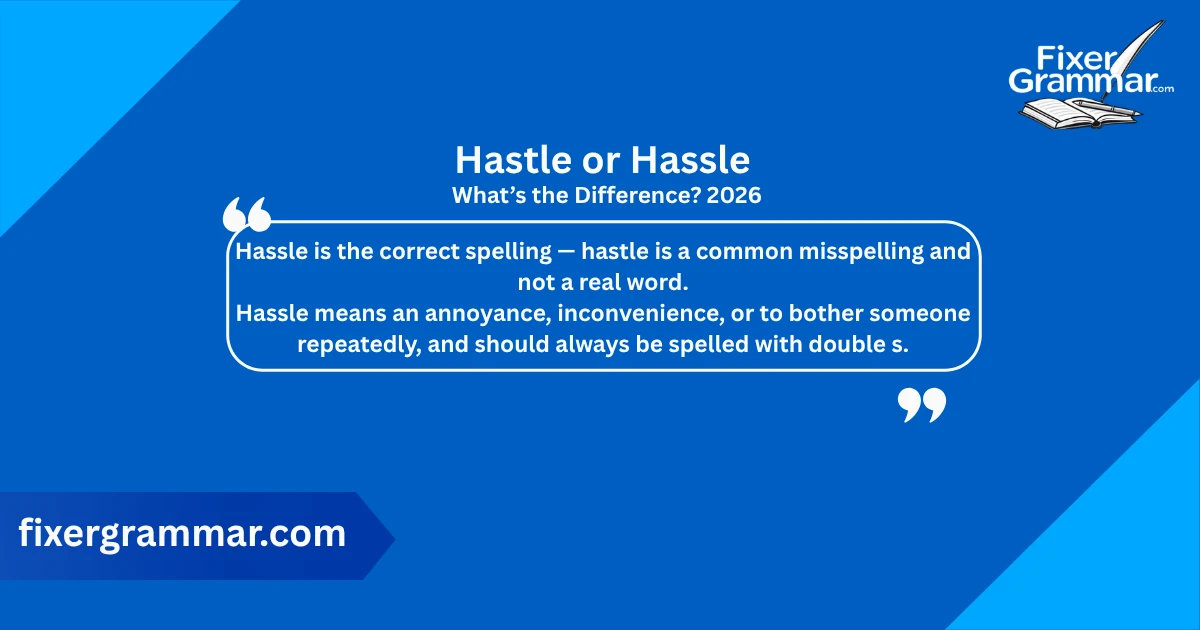
Every year, thousands of people search “hastle or hassle which is correct” — and the answer is always the same. Only hassle is real.
What Does Hassle Mean? (Noun & Verb Explained)
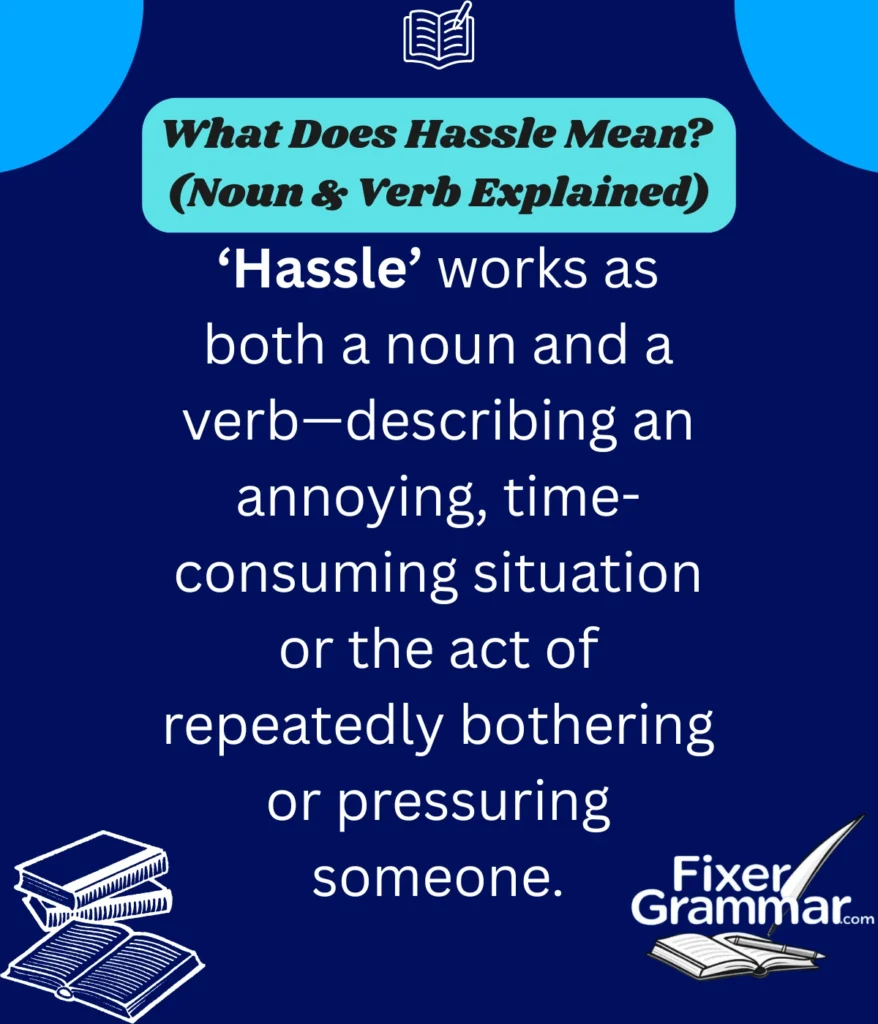
Hassle is a flexible word. It works as both a noun and a verb, depending on how you use it in a sentence.
Hassle as a Noun — Everyday Inconveniences
As a noun, hassle refers to something annoying, inconvenient, or unnecessarily difficult.
Think of situations like waiting in a long line at the DMV, dealing with a delayed flight, or filling out endless paperwork. Those are all hassles — minor frustrations that drain your time and patience.
Usage Examples of Hassle
| Situation | Example Sentence |
|---|---|
| Travel | “Airport security is always such a hassle.” |
| Work | “The approval process was a complete hassle.” |
| Daily Life | “Moving apartments is a massive hassle.” |
Hassle as a Verb — When Someone’s Bothering You
As a verb, hassle means to repeatedly bother, pester, or pressure someone.
- “Stop hassling me about the deadline.”
- “The landlord kept hassling tenants for early rent.”
- “Don’t hassle her — she’s already stressed.”
Key rule: When used as a verb, hassle almost always needs an object — someone being hassled.
More Posts:Emasculate vs Demasculate – What’s the Difference? 2026
Hastle vs Hassle — Why Do People Confuse Them?
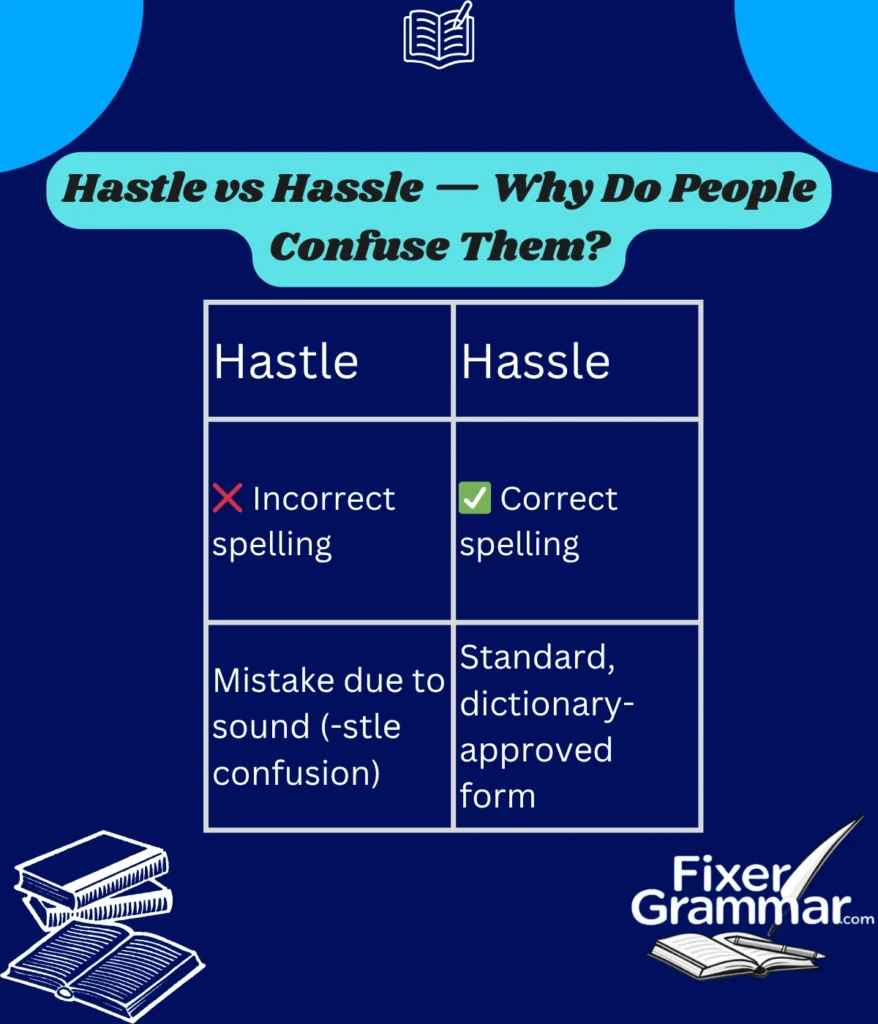
This is one of the most common spelling mistakes in everyday English.
Phonetic confusion is the biggest reason. When you say “hassle” out loud, the double-s blends into a soft sound that some ears interpret as a “t.” Words like castle, whistle, and hustle all end in “-stle,” so the brain unconsciously fills in a “t” where none belongs.
Hastle vs Hassle – Common Mistakes
| Wrong | Right | Why It Happens |
| Hastle | Hassle | Sounds like “-stle” words |
| Hastling | Hassling | Verb form confusion |
| Hastle-free | Hassle-free | Common phrase misspelled |
| Hastle writing | Hassle writing | Confusion from pronunciation |
Autocorrect doesn’t always help either. Many older tools and informal keyboards have let “hastle” slip through uncorrected, spreading the mistake even further online.
How to Use Hassle Correctly — Real-Life Examples
Is hassle formal or informal? It leans informal. You’ll see it in blogs, conversations, emails, and marketing — but rarely in academic writing or official reports.
These examples show hassle used naturally in context:
- “Online shopping removes the hassle of crowded stores.”
- “He was hassled by debt collectors for months.”
- “No-hassle returns are a big selling point for customers.”
- “Moving across the country is a logistical hassle.”
- “Don’t hassle the customer service team — they’re doing their best.”
Quick grammar check: Use a hassle (not an hassle) — because “hassle” starts with a consonant sound, not a vowel.
Memory Tricks to Never Misspell Hassle Again
These mnemonic devices make the correct spelling stick fast.
Double S = Double Stress. A hassle causes stress. Stress has double-s. So does hassle.
No T in Trouble. Hassle means trouble — and trouble has no “t” at the start. Neither does hassle.
Think “mass” not “mast.” Hassle sounds closer to mass than mast — so you keep the double-s, not a t.
Cross out the T trick: H-A-S-T-L-E → Remove the T → H-A-S-S-L-E ✅
One more: Hassle rhymes with tassel and castle — both spelled with double-s, no added t.
More Posts:Impatient vs Inpatient – Which Is Correct? 2026
FAQs — Hastle or Hassle
Is “hastle” a real word in English?
No. “Hastle” does not exist in any standard English dictionary — not Merriam-Webster, not Oxford. It is purely a misspelling of hassle.
Why do people write “hastle” instead of “hassle”?
Because words like castle, hustle, and whistle end in “-stle,” the brain assumes hassle follows the same pattern — but it doesn’t.
Can hassle be used in formal writing?
Hassle is best kept informal. In formal or academic writing, replace it with inconvenience, difficulty, or complication for a more professional tone.
What is the difference between hassle and hustle?
They are completely different words. Hassle means annoyance or bother. Hustle means to work hard or move quickly. British English spells and uses hassle the same way — this is one case where there’s no regional difference.
How do you use hassle in a sentence?
Use it as a noun: “Traffic is such a hassle.” Or as a verb: “Don’t hassle me while I’m working.” Both are correct — just keep the context informal.
The Bottom Line
Hassle is correct. Hastle is not a word — never was, never will be.
Whether you’re writing an email, a blog post, or a quick text, always go with the double-s spelling. It’s a small detail, but getting it right shows you pay attention — and that matters more than most people think.

At FixerGrammar.com, Johnson Isaacs shares easy grammar tips, clear examples, and helpful guidance to make writing simple, smooth, and mistake-free.
Related Posts