The good news? Once you know the rule, you’ll never mix them up again.
Gases or Gasses — Why Does This Confusion Exist?
Both words sound exactly the same when spoken. Your ears can’t tell them apart — only context and spelling reveal the difference.
Words like pass become passes, so writing gasses as the plural of gas feels natural. But that instinct leads writers straight into error.
Auto-correct tools often miss this mistake because gasses is a real word — just not the right one in most sentences. According to Garner’s Modern English Usage, gases is used over gasses as a noun at a ratio of 42 to 1.
More Posts:Ageing vs. Aging — What’s the Difference ? 2026
What Does “Gases” Mean? The Correct Plural Form of Gas
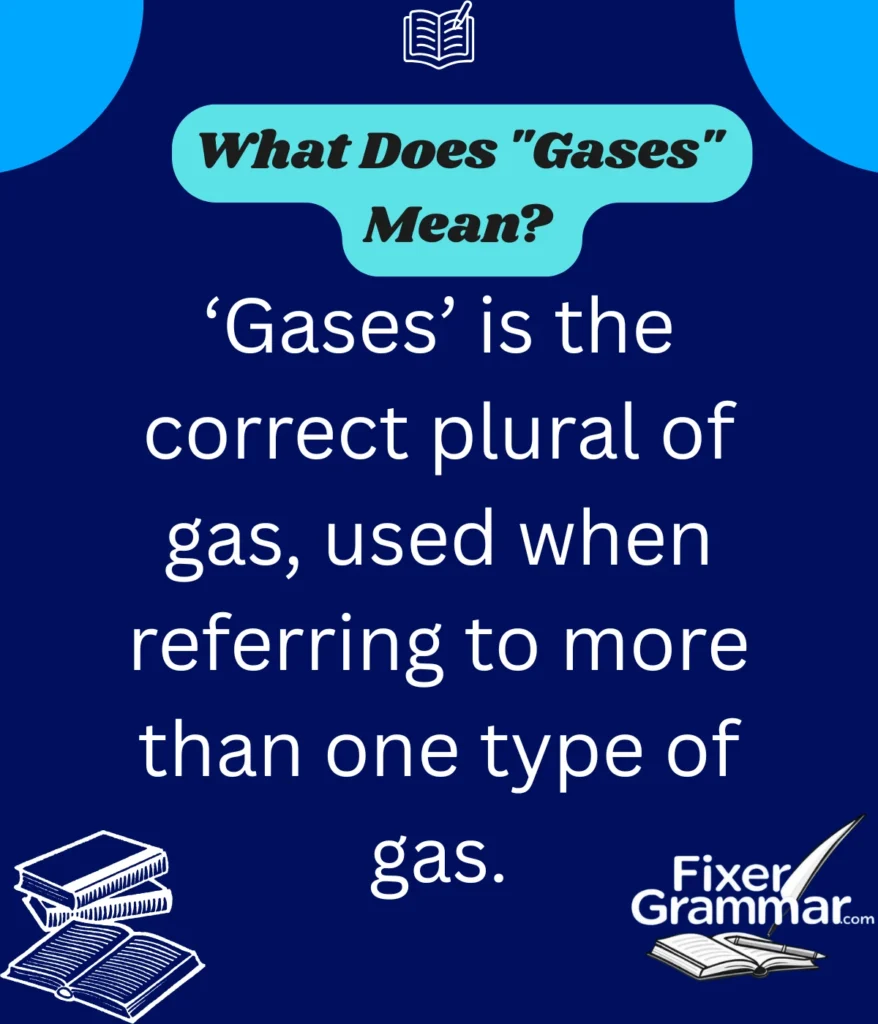
Gases is the plural noun form of gas — one of the four fundamental states of matter alongside solids, liquids, and plasma. When you’re talking about more than one type of gas, gases is always the correct choice.
You’ll see it everywhere in science, medicine, and everyday life.
Common examples include:
- Oxygen (O₂) — essential for breathing and hospital care
- Nitrogen (N₂) — makes up about 78% of Earth’s atmosphere
- Carbon dioxide (CO₂) — a major greenhouse gas driving climate change
- Methane (CH₄) — a natural gas used in home heating
- Helium — used in balloons and MRI machines
Both Merriam-Webster and the Oxford English Dictionary list gases as the only correct plural noun form of gas.
More Posts:Hastle or Hassle — Which Is Correct? 2026
What Does “Gasses” Mean? When the Verb Form Is Correct
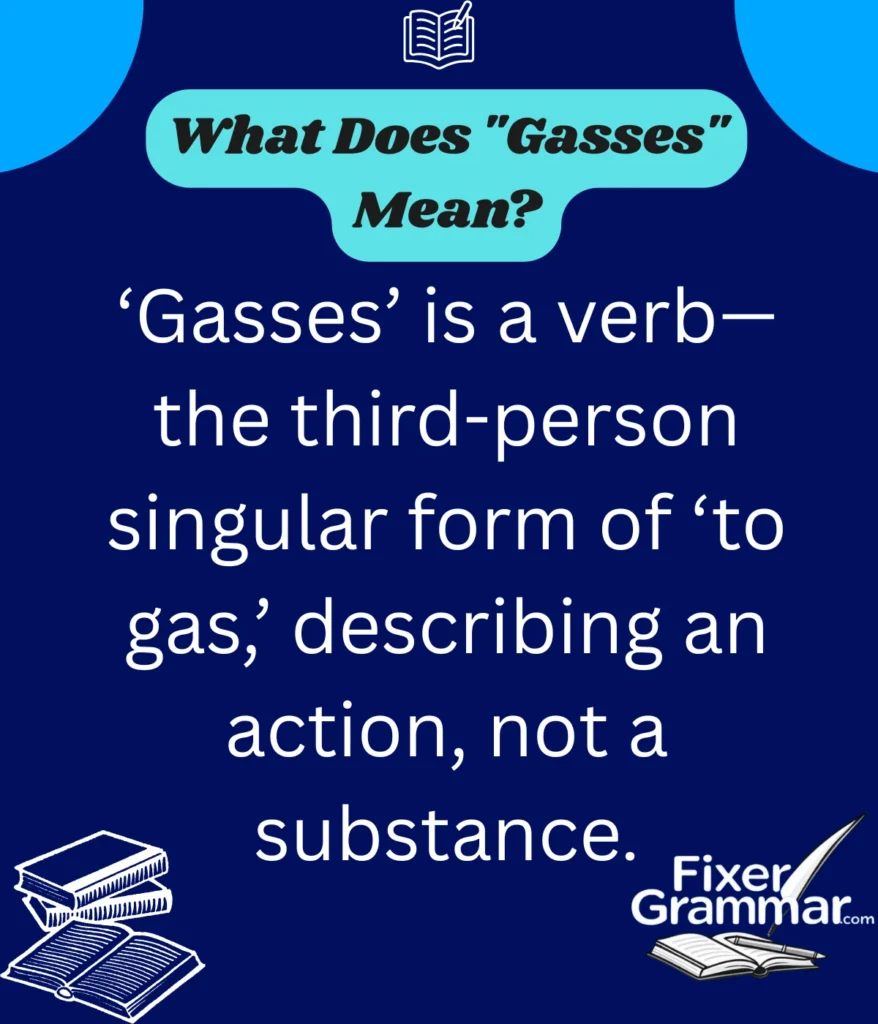
Gasses is a verb. Specifically, it is the third-person singular present tense of the verb to gas. It describes an action — not a substance.
The verb to gas has three main meanings:
- To supply something with gas or fuel
- To expose someone or something to gas
- Informally, to talk excessively or at length
Correct verb examples:
Gasses (Verb) – Examples
| Sentence | Why It’s Correct |
|---|---|
| She gasses up the car every Friday. | Action of fueling — verb form |
| The exterminator gasses the building to clear pests. | Action of exposing to gas — verb form |
| He gasses on about football for hours. | Slang for talking too much — verb form |
These sentences all describe what someone does — that’s the giveaway. Whenever the word describes an action, gasses is correct.
Gases vs. Gasses: Grammar Rules Explained Simply
This is where most people get lost — but the rule is simpler than it looks.
Nouns ending in s form their plural by adding -es. No consonant doubling.
- Gas → Gases
- Bus → Buses
- Box → Boxes
Verbs with a short vowel + single consonant ending do double the consonant before adding -es or -ed.
- Pass → Passes
- Kiss → Kisses
- Gas (verb) → Gasses
The noun gas simply doesn’t follow the verb doubling rule. That’s why gases stays as it is — no extra s needed.
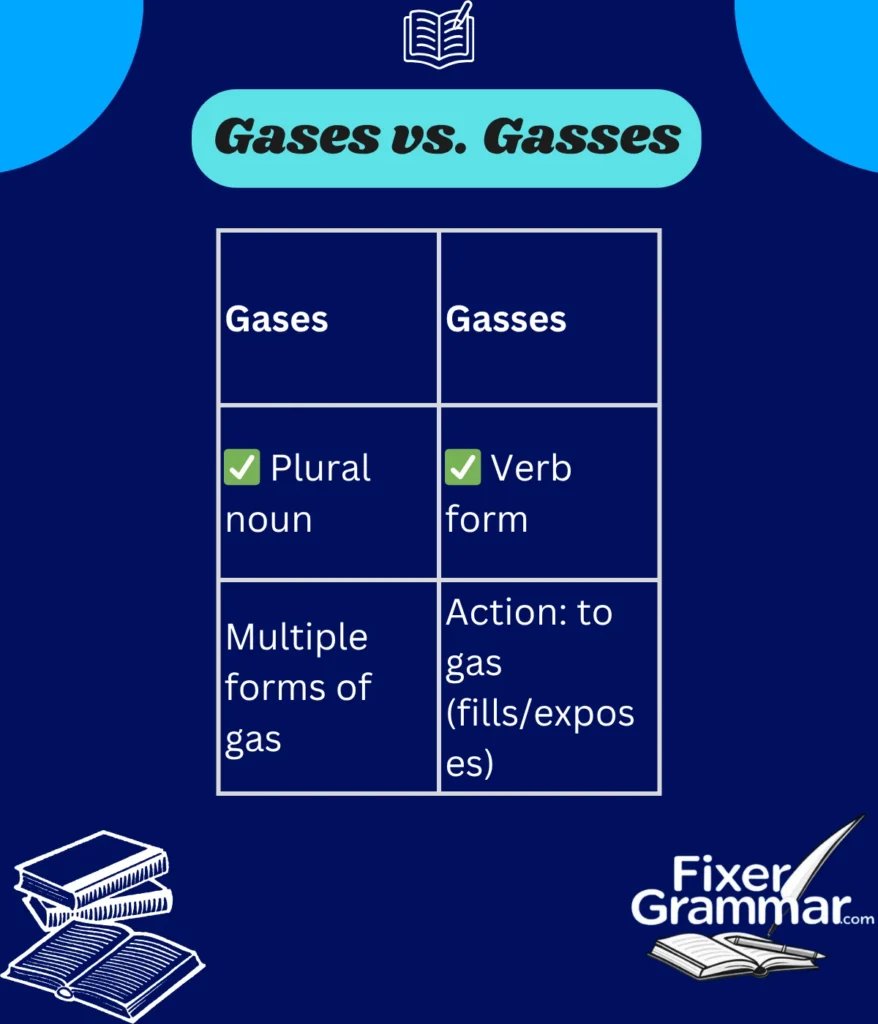
Gases vs Gasses
| Word | Part of Speech | Meaning | Example |
|---|---|---|---|
| Gases | Noun (plural) | Multiple forms of gas | Oxygen and nitrogen are gases. |
| Gasses | Verb | Third-person singular of “to gas” | She gasses up the car each week. |
Why English Spelling Makes This Tricky
The word gas was first coined in the 17th century by Flemish chemist Jan Baptist van Helmont. He borrowed it from the Greek word khaos — meaning void or formless matter — to describe invisible substances distinct from solids and liquids.
As the word entered English and spread through scientific literature, the plural noun form gases became standard. The verb form gasses developed separately, following normal English conjugation rules. By the 19th century, dictionaries had locked in this distinction — and it has held ever since.
More Posts:Marquee vs. Marquis — What’s the Difference? 2026
Easy Memory Tricks to Never Mix Up Gases and Gasses Again
You don’t need to memorize grammar charts. These simple tricks will do the job.
Mnemonic 1: “Noun has an E, verb has extra S.” Gases (noun) keeps it simple. Gasses (verb) doubles up.
Mnemonic 2: “Gases are in science classes.” Both gases and classes share the same -es ending. Science always uses gases.
Mnemonic 3: “Double S means someone’s doing something.” If there are two S’s, it’s an action — a verb. One S means it’s a thing — a noun.
The fastest test sentence:
“He gasses up the car but releases gases into the atmosphere.”
Read that once and both uses click into place instantly.
Quick reference:
- Talking about oxygen, nitrogen, CO₂? → Gases
- Describing fueling, emitting, or exposing to gas? → Gasses
- Writing a science paper, lab report, or climate article? → Always gases
FAQ’s About Gases or Gasses
What is the difference between gas and gases?
Gas refers to a single substance in its gaseous state — like oxygen or propane. Gases is its plural form, used when referring to multiple types or amounts of gas.
Is it gases or gasses in America?
Gases is the correct plural noun in standard usage. Gasses is only correct as a verb. This rule is the same in both American and British English — the plural noun is always gases.
Which is correct about gases?
Gases is always correct when referring to physical substances. Every major style guide, scientific journal, and dictionary — including Merriam-Webster — confirms this.
Is it fox or foxes?
Foxes is correct. Nouns ending in x add -es to form the plural — just like gas becomes gases. The pattern is consistent across English pluralization rules.
What is the plural of princess?
Princesses is correct. Nouns ending in -ss add -es to form the plural. The same logic applies to gas → gases — add -es, no consonant doubling for nouns.
Wrapping It Up
The difference between gases and gasses comes down to one simple rule — noun or verb. Use gases when naming a substance. Use gasses when describing an action. That’s it.
In science, formal writing, and everyday usage, gases is almost always the word you need. Keep the double s strictly for the verb, and your writing stays accurate, credible, and clear every time.

At FixerGrammar.com, Johnson Isaacs shares easy grammar tips, clear examples, and helpful guidance to make writing simple, smooth, and mistake-free.
Related Posts