Many writers confuse these two expressions. The difference lies in verb forms and proper grammatical structure. Understanding this distinction helps you write with precision and credibility.
Why “As Evidenced By” Is the Correct Form
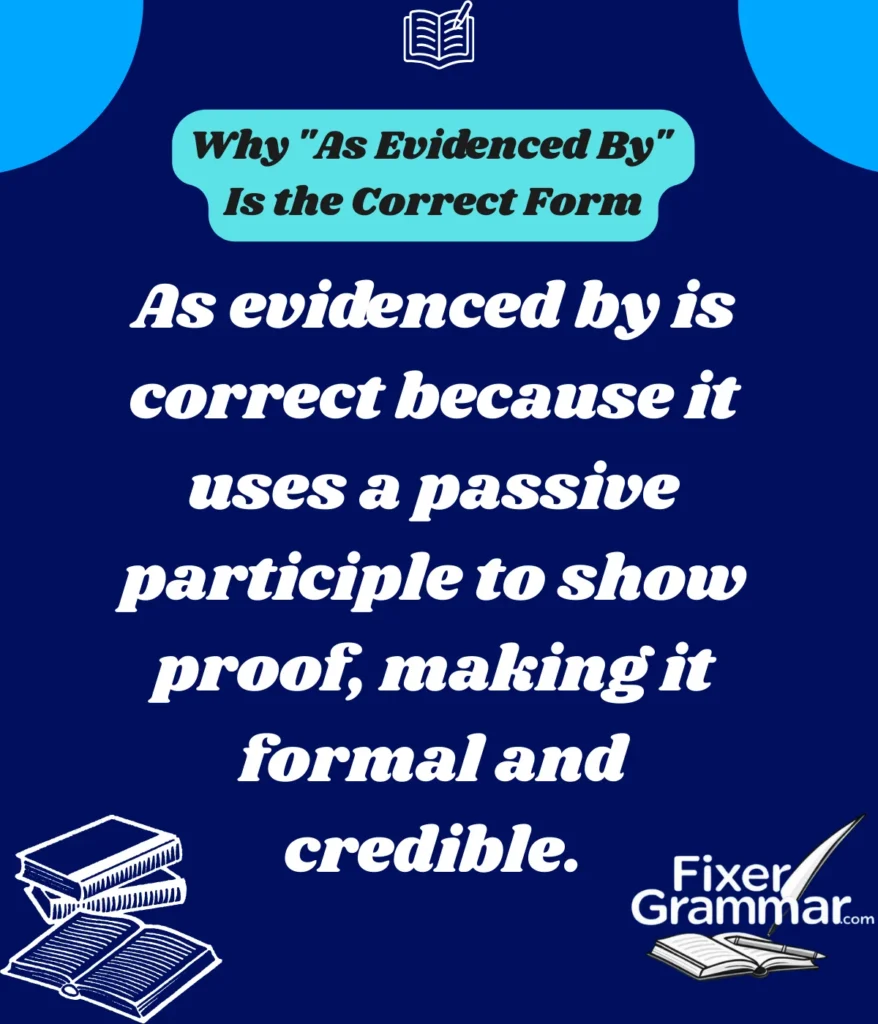
Passive participles create phrases that show how evidence supports a claim. The word “evidenced” comes from the verb “to evidence,” meaning to demonstrate or prove. When we add “as” and “by,” we create a complete grammatical construction.
Professional writing demands this correct form. Legal documents, research papers, and business reports all rely on “as evidenced by” to maintain credibility.
| Correct Form | Incorrect Form | Why |
|---|---|---|
| As evidenced by | As evident by | “Evident” is an adjective, not a verb |
| As evidenced in | As evident in | Same grammatical issue |
| As evidenced through | As evident through | Adjective cannot function as participle |
More Posts:Is It Correct to Say “Day Well Spent”? Meaning Alternatives & Examples
As Evidenced By vs As Evident By
| As Evidenced By | As Evident By |
|---|---|
| Functions as a passive construction. “Evidenced” acts as a past participle verb. | Attempts to use “evident” as a verb, which is grammatically incorrect. |
| Correctly shows that something serves as proof or demonstration. | Breaks grammatical rules because adjectives cannot serve as verbs. |
| Recommended usage in formal writing, academic papers, and professional documents. | Should not be used; replace with the correct “as evidenced by.” |
Correct Examples of “As Evidenced By” in Sentences
Business context:
- The merger created significant value, as evidenced by the 40% stock price increase.
- Customer satisfaction improved dramatically, as evidenced by our Net Promoter Score rising from 32 to 68.
Academic writing:
- Climate patterns have shifted, as evidenced by temperature data from the past three decades.
- The hypothesis proved correct, as evidenced by consistent experimental results across five trials.
News and reporting:
- Public opinion changed rapidly, as evidenced by polling conducted between March and June.
- The technology sector continues growing, as evidenced by venture capital investments reaching $150 billion annually.
More Posts:Brite vs Bright – Correct Spelling and Usage Guide
Alternative Phrases You Can Use Instead
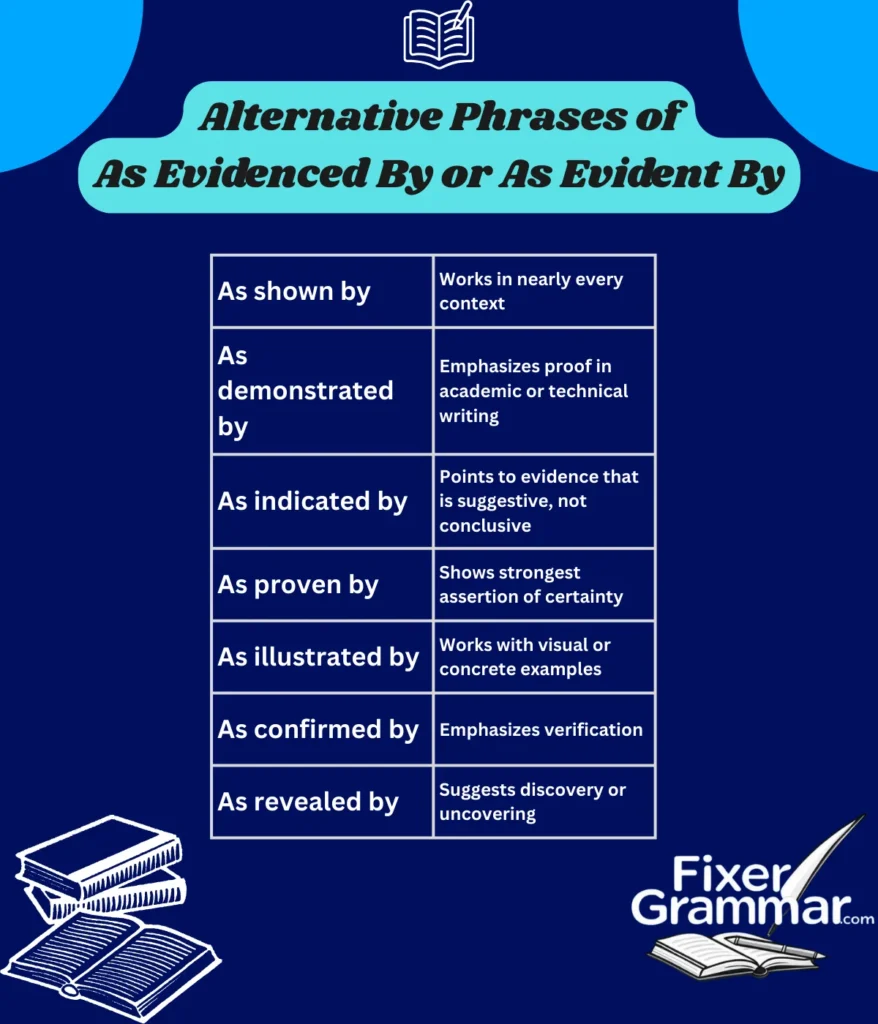
“As shown by” offers the simplest alternative. This phrase works in nearly every context where you’d use “as evidenced by.” The meaning stays identical while using more common vocabulary.
“As demonstrated by” adds slightly more formality. Use this option in academic or technical writing where you want to emphasize proof. “As indicated by” works well when pointing to suggestive rather than conclusive evidence.
- As proven by – strongest assertion of certainty
- As illustrated by – works with visual or concrete examples
- As confirmed by – emphasizes verification
- As revealed by – suggests discovery or uncovering
Each alternative maintains grammatical correctness while offering stylistic variety. Choose based on your tone and the strength of evidence you’re presenting.
FAQ‘s
Is “as evidenced by” formal or informal?
“As evidenced by” is primarily formal. It appears in professional, academic, and legal writing. Casual conversation typically uses simpler alternatives like “shown by” or “proven by.”
Can I use “as evident by” in casual writing?
No. “As evident by” remains grammatically incorrect regardless of context. Even in informal writing, choose “as shown by” or “proven by” instead of using the wrong grammatical form.
What’s the difference between “evidenced” and “evident”?
“Evidenced” is a verb form (past participle) meaning “demonstrated” or “proven.” “Evident” is an adjective meaning “clear” or “obvious.” They have different grammatical functions and cannot substitute for each other.
Is “as evidenced by” used in American English?
Yes. This phrase appears regularly in formal writing throughout English-speaking regions. Professional documents, court filings, and research papers consistently use this construction.
Final Takeaway
Always use “as evidenced by” when you need this formal construction. The phrase demonstrates professionalism and grammatical precision. Think of it this way: if something is “evidenced,” it has been turned into evidence—you need the verb form.
Memory trick: Replace the phrase with “as shown by” in your mind. If “as shown by” works, then “as evidenced by” works too. This mental check prevents the “evident” error.
Practice strengthens correct usage. Start incorporating “as evidenced by” into your professional writing today. Your credibility increases when grammar supports your message.

At FixerGrammar.com, Johnson Isaacs shares easy grammar tips, clear examples, and helpful guidance to make writing simple, smooth, and mistake-free.
Related Posts